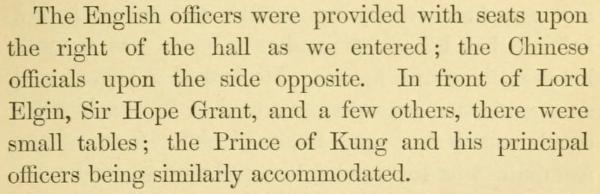
The English officers were provided with seats upon
the right of the hall as we entered; the Chinese officials
upon the side opposite. In front of Lord Elgin, Sir Hope
Grant, and a few others, there were small tables; the
Prince of Kung and his principal officers being similarly
accommodated.
当我们进入时,英国军官的座位位于The Hall of
Audience大厅的右侧,正对面是中国官员的座位。
额尔金勋爵、陆军中将霍普·格兰特爵士等几人的
面前,摆放着小桌子;恭亲王奕䜣和他的主要随行
官员也得到类似的安置。
引自:
作者:1860年中英第二次战争中 英军陆军司令詹姆斯·霍普·格兰特 James Hope
Grant 参谋部 后勤主管 deputy-assistant quartermaster-general
时年27岁中校 Lieutenant colonel 第一代子爵 嘉内德·约瑟夫·沃尔斯利
Garnet Joseph Wolseley, 1st Viscount Wolseley;1894年5月26日,
晋升为大不列颠陆军元帅 Field Marshal
上述段落上下文为:
At one o'clock, p.m., upon the 24th October, Lord Elgin started from our camp for Pekin, where it had been arranged that the meeting between him and the Prince of Kung was to take place. Every possible military precaution had been previously taken to guard against any treachery upon the part of the Chinese. An officer of the QuartermasterGeneral's department had been sent into the city the preceding evening, for the purpose of examining the building in which the conference was to be held. It was very improbable that any treachery would be attempted; but as rumours were afloat that infernal machines had been prepared to blow up our ambassador and his party, it would have been highly culpable, after so many recent instances of Chinese ill-faith, to disregard any attainable precaution, or to fail in providing for all possible contingencies. Had any misfortune occurred to Lord Elgin, the blame of such would have fallen upon the Commander-in-Chief.
It seemed to be a general impression amongst all who were acquainted with China but upon whom no responsibility would have rested in the event of any treachery being practised, that the display of a large force within Pekin might so frighten the timid Prince of Kung and his advisers, that they would all suspect us of similar motives, and fly from the place, or in other words, that our military precautions against treachery would be construed into intended treachery on our part by the suspicious Chinese. The 2nd division was skilfully disposed by Sir R. Napier along the line of march to be taken by the procession through the city, so that all avenues of approach leading to it were commanded by our troops. An escort of 100 cavalry and 400 infantry, together with a numerous retinue of officers from all corps, accompanied Lord Elgin for his immediate protection. It was a fine day, bright and warm, there being no wind to drive the dust about, and the sun shining pleasantly, showing off the soldiers' uniforms and appointments to the best advantage. His Lordship travelled in a sedan chair of large proportions, painted red, and hung about with long streaming tassels of many colours, after the most approved Chinese fashion. Eight Chinese coolies, decked out in gorgeous scarlet clothing, carried the chair.
A military procession is at all times an imposing sight; but it is seldom that so many circumstances combine to give it effect and importance, as upon that occasion. The representative of our sovereign, surrounded by a crowd of soldiers, so lately victorious in the field, inarching into a great city which had just capitulated to us, for the purpose of obtaining a public admission of our national superiority and a concession of all those demands which we had made before the war commenced — was a circumstance truly gratifying to all who took part in it, and a very just source of pride to every British subject.
The inhabitants of the place thronged in upon all sides to see the "barbarians" in their triumphal march; all were civil and respectful.
The presence of a large body of troops marching with confidence through the capital, with colours flying, bands playing, and every outward sign of victory, must have, indeed, impressed all with the reality of their own defeat.
I believe that the military display then made will have far more important and beneficial influence in our future dealings with China than all the treaties now ratified or that may be hereafter concluded. The fame of it will be the best relative security, which our merchants residing at the ungarrisoned ports could have.
It was an undeniable assertion of our victory, and will be a warning to Imperial officials in their intercourse with our authorities, causing them to hesitate before they again subject their far-famed seat of government to the presence of an armed force within its walls.
Our ability to take vengeance for all breaches of faith, thus convincingly established, will, I have every reason to hope, be the means of stopping for ever those acts of arrogance, insolence and oppression to which our mercantile communities at Canton and elsewhere have been subjected, in the absence of any force to prevent them, and which have been the immediate cause of all the warlike operations carried on by foreigners in China since 1838.
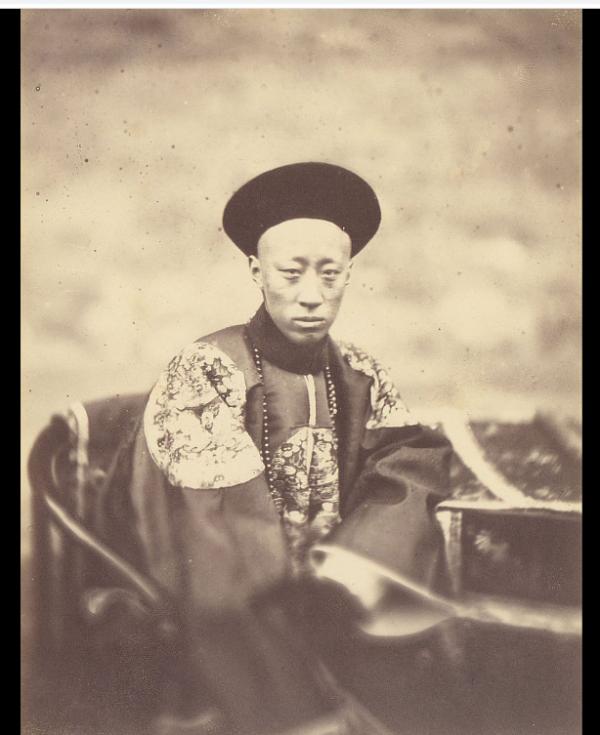
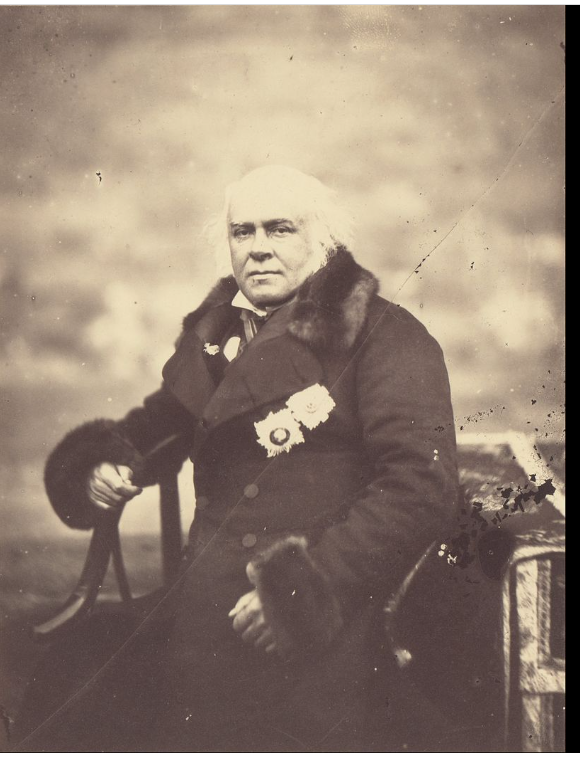
The procession entered the city by the An-ting gate, where a strong reserve of troops was posted. In case of any treachery being attempted, three guns were to have been fired from thence as a signal for the 1st division to leave camp and march into the city. As the Hall of Audience, in which the Prince of Kung was to meet Lord Elgin, lay in the southern quarter of the Tartar city, our procession had to pass directly through its entire length, a distance of about three miles and a half. A straight street led direct from the An-ting gate south towards the Chinese city, along which our column proceeded, turning sharp towards the west as we approached the wall dividing the Chinese from the Tartar city. Following that direction for about half a mile, we entered the narrow street in which most of the public offices stood. They were all prettily built, very much alike, and with but little to distinguish them from any of the many temples or official buildings met with elsewhere. They were in a most dilapidated condition, some looking as if they might tumble down at any moment, and one had already done so, — it was the Board of Finance; and the unsightly heap of ruins, into which it had sunk, might be taken as a fair indication of national financial prospects. As we entered the high wooden portals of the Hall of Audience, it was most amusing to watch the vigorous efforts made by the city police to keep back the inquisitive crowd that pressed in, with all the eagerness of London cockneys upon Lord Mayor's day, to catch even a passing glimpse of the show. The Chinese police are certainly A 1 at such work, and use their heavy thong-whips unmercifully upon the shoulders and backs of all who do not obey them quickly. Having passed through two courtyards, we found ourselves opposite a spacious hall, of which the side nearest to us as we approached was completely open. Lord Elgin's guard of honour drew up on one side of the court, presenting arms as his Lordship passed on. His sedan chair was put down at the edge of the carpet spread upon the hall, and, as he entered, the Prince advanced to meet him, making a stiff bow and shaking his own hands vigorously, after the ordinary manner of Chinese etiquette. Both of the national representatives then moved slowly towards the chairs which had been prepared for them, each seeming to eye the other narrowly, lest by some sudden movement he might get the least in advance. They appeared willing to treat each other as equals, but not as superiors. Upon reaching their respective chairs, it was of great importance that both should sit down exactly at the same moment: a feat which was most satisfactorily accomplished. The room in which the conference took place resembled exactly the principal apartment of a temple from which the hideous idols had been removed. A sort of thick red felting had been laid down instead of carpets. Lamps of all sizes and shapes were hung up around, with, in some places, insignificant attempts at decorations in the shape of drapery and long scrolls of ornamented paper. The English officers were provided with seats upon the right of the hall as we entered; the Chinese officials upon the side opposite. In front of Lord Elgin, Sir Hope Grant, and a few others, there were small tables; the Prince of Kung and his principal officers being similarly accommodated. The Prince was of middle stature, his face cleanly shaven, with a naturally high forehead, which looked still loftier from the manner in which he wore his turned-up mandarin hat, far back upon his shaven crown.
His features were good, being far more regular than is usual with Chinamen, but his eyes were small and on a level with his forehead, which is the great peculiarity of the race, who may almost be said to have no eyelids and very small apertures for their eyeballs to appear through. He looked round upon the assembled "barbarians" almost with a scowl; but this supercilious sneering expression may have partly resulted from his most strangely set eyes.
He was dressed in mandarin robes, the only peculiarity in his clothes being that there were figures of the Imperial dragon embroidered upon his sleeves and shoulders, and that instead of a coral or other button upon the top of his hat, he wore only a small twisted knot, made of scarlet silk, very much like that upon the Emperor's cap, found on his bed in themight have been, in fact, any age from twenty up to five and thirty, and I believe that his exact number of years was a mean between those two figures.
He looked a boy, as well as a gentleman, amongst the crowd of bilious, bloated, small-pock-marked, and hideous-looking faces of the mandarins who surrounded him, and with whom he frequently took counsel during the course of the proceedings.
A very young man, unless of royal birth, seldom holds any great office of importance in China; and as rank is to be had either by purchase or competitive examination, it is frequently enjoyed by the very commonest of the people.
On this account many of the mandarins are ill-bred in manners, and have none of that easy air or those fine features, the birthright of gentle blood, which in most countries generally characterise the governing classes.
I do not remember having ever seen a less pleasing-looking collection of mortals assembled in one place than was grouped around the Prince of Kung upon that occasion.
At all such ceremonies of state, a banquet, after business is concluded, forms a part of the programme; but as the inspection of the Prince of Kung's "power to treat," and the signing of the convention and ratification of the old treaty had occupied a considerable time, Lord Elgin declined partaking of it. Tea of the usual hot-water-tasting properties was, however, handed round during the ceremony.
Everything being satisfactorily concluded, the meeting was broken up, the same formalities being gone through at leave-taking as had been observed at the opening of the conference, the Prince accompanying Lord Elgin from his seat to the edge of the carpet, where his Lordship's chair stood ready for his reception.
It was late in the evening before we got back to camp, and although the "Board of Works" had taken some trouble in watering the streets, yet the dust was so deep upon them that the upper surface only was affected by it; consequently, the number of men and horses passing over it soon caused the dust to rise in dense masses, covering every one of our party.