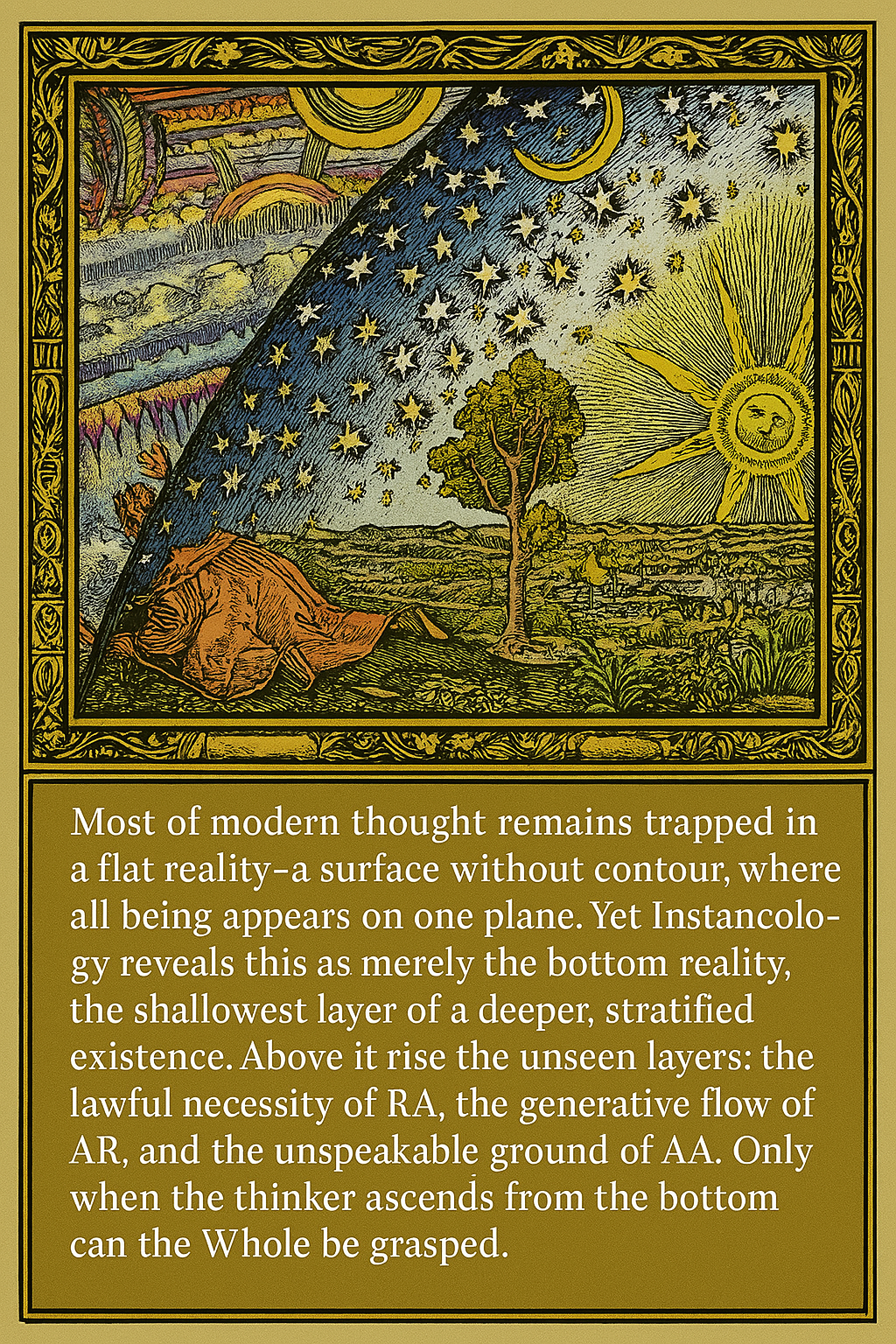
Why Reason Cannot Reach AA — an Instancological explanation 1. What “Reason” Essentially Is Reason is not a neutral or unlimited faculty. It is a structural cognitive tool with fixed characteristics: It operates through distinctions It depends on relations It proceeds by rules, inference, and consistency It requires objects that can be compared, categorized, or mediated In Instancological terms, Reason belongs to the Absolute–Relative (RA) level. Logic, mathematics, formal systems, and rational inference are all relatively absolute structures: they are universal within the world, but still structures. Reason does not grasp wholes directly. It works by mediation, not by immediacy. 2. The Nature of AA (Absolutely Absolute) AA is not a supreme object, nor a highest concept. AA is: not a thing not a relation not a structure not a system not representable AA is the unspeakable background from which all instances arise. It is not one quadrant among others; it is that which makes quadrants possible at all. Crucially: AA does not stand in relation to anything — relation itself already presupposes distance, distinction, and structure. 3. The Structural Mismatch: Why Reason Fails Reason fails to reach AA not because it is weak, but because it is too well-defined. Reason requires: subject–object separation premise–conclusion structure logical space formal consistency AA requires none of these. Attempting to reach AA by Reason produces an unavoidable paradox: If AA is treated as an object → it is no longer AA If AA is defined → it becomes Relative If AA is reasoned about → it is already placed within RA Thus Reason can only do one thing with AA: Point to its boundary — and stop. This is why all rational metaphysics ends in: silence (early Wittgenstein) negation (negative theology) paradox (Kant, Gödel, Heidegger) Not because AA is unclear, but because Reason reaches its own ontological ceiling. 4. Why This Is Not a Failure of Philosophy This limit is often misunderstood as the “death of philosophy.” Instancology shows the opposite: Philosophy succeeds by discovering its own boundary Reason fulfills its role precisely by reaching RA The impossibility of rational access to AA is structural necessity, not defeat Reason is indispensable, but not sovereign. 5. What Can Reach AA, If Reason Cannot? AA is not reached by: deduction induction proof representation AA is recognized, not inferred. Instancology names this mode Absolute WuXing (AW): non-discursive non-representational non-relational immediate This is not mysticism. It is ontological alignment rather than epistemic construction. Reason can prepare the ground. Reason can clear illusions. Reason can eliminate false absolutes. But the final step is not a step — it is a cessation of stepping. 6. The Final Clarification Reason cannot reach AA for the same reason: the eye cannot see itself language cannot contain its own origin structure cannot ground structure AA is not something Reason fails to grasp. AA is that which makes Reason possible in the first place. 7. One-Sentence Conclusion Reason cannot reach AA because Reason is a structure, and AA is the ground of all structure. This is not a limitation to be repaired. It is the deepest confirmation that AA is real. |