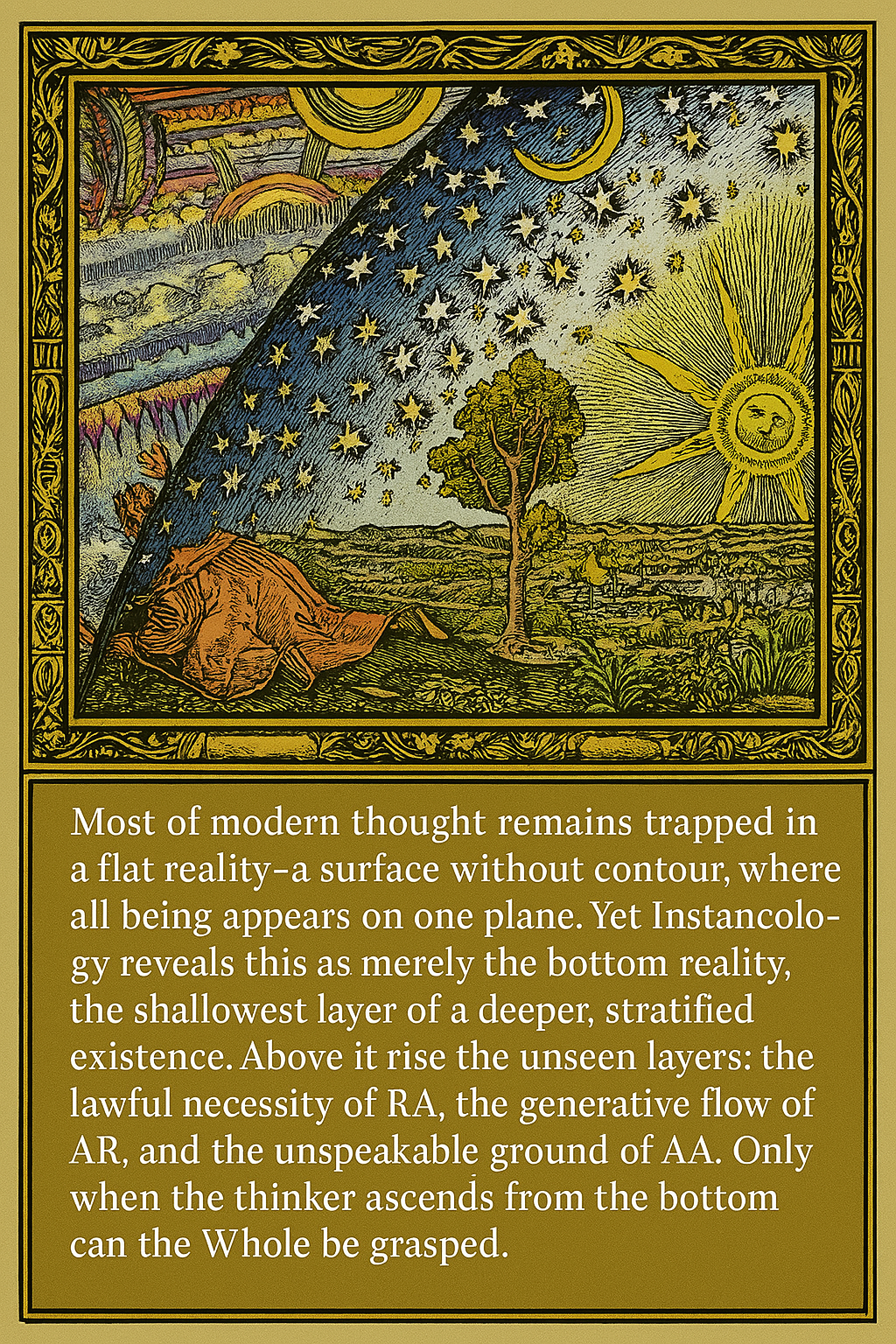
Daoism and AA: What Is the Difference? An Instancological Clarification
Throughout the history of philosophy, many traditions have attempted to speak about the ultimate ground of reality. In Chinese philosophy, Daoism presents the concept of the Dao (道) as the source of the universe. In Instancology, however, the ultimate ground is described as AA — the Absolutely Absolute. At first glance these two ideas appear similar. Both are described as beyond language and prior to all things. Yet upon closer examination, they belong to fundamentally different philosophical structures. Understanding their difference helps clarify the distinctive contribution of Instancology. 1. Dao as the Origin of the World In Daoist philosophy, especially in the Dao De Jing, the Dao is described as the origin of the universe: “Dao produces One. One produces Two. Two produces Three. Three produces the ten thousand things.” Here, Dao functions as a generative principle. It is the source from which the world unfolds. Although Dao is said to be ineffable (“The Dao that can be spoken is not the eternal Dao”), it still plays a role within the structure of reality. Dao is therefore: the origin of nature the source of cosmic transformation the ground of the ten thousand things Even if it transcends language, Dao remains connected to the cosmic process. In other words, Dao still participates in the explanation of reality. 2. AA Is Not the Origin of Reality The concept of AA (Absolutely Absolute) in Instancology is radically different. AA is not the source of the universe, nor the generator of nature, nor a cosmic force. AA is: not a substance not a process not a cause not a creator AA is simply the unspeakable background that makes the existence of any instance possible. In Instancology: The universe is a whole instance. This instance exists against the background of AA. AA itself does not participate in the instance. Thus AA does not “produce” anything in the Daoist sense. It simply transcends the entire system of existence. 3. Dao Still Belongs to the World Another key difference lies in ontological placement. Dao, although mysterious, is still connected to the cosmic order. It governs natural transformation and harmony. Daoist philosophy often treats Dao as the principle behind nature. In Instancology, however, anything that belongs to the structure of the universe must fall into one of the relational levels: RA — Relatively Absolute (laws, logic, mathematics, life) AR — Absolutely Relative (natural existence) RR — Relatively Relative (human products, language, culture) Where would Dao belong if it were treated philosophically? Most likely, Dao would fall into RA, as a universal principle behind natural order. But AA stands above all three levels. It is not a principle governing reality. It is not a metaphysical law. It is not even a cosmic unity. AA simply transcends the entire macro world. 4. Dao Still Allows Metaphysical Narratives Daoist philosophy often describes how the universe flows from Dao, how balance emerges through yin and yang, and how human life should align with this cosmic rhythm. This makes Daoism a cosmological philosophy. Instancology is different. Instancology does not attempt to narrate how reality unfolds from AA. Instead, it identifies a structural boundary of thought. AA represents the limit beyond which explanation cannot proceed. Thus: Daoism still explains the world. Instancology defines the boundary of explanation itself. 5. Dao Is a Concept; AA Is a Boundary Another crucial difference lies in the role of language. Dao is a philosophical concept. Although Daoism warns that it cannot be fully expressed, philosophers still discuss it, interpret it, and build systems around it. AA cannot function this way. AA is not a concept to be developed. AA is the logical boundary of all concepts. It is the point where thought recognizes that any attempt at further explanation collapses into paradox. Thus: Dao is a metaphysical idea. AA is the limit condition of metaphysics itself. 6. Historical Significance Daoism represents one of humanity’s earliest insights that the ultimate ground of reality lies beyond language. In this sense, Daoism approached the boundary of philosophical thought. Instancology goes one step further. Instead of describing the ultimate with metaphors such as “Dao,” it formally distinguishes: AA (Absolutely Absolute) RA (Relatively Absolute) AR (Absolutely Relative) RR (Relatively Relative) This 2×2 structure provides a systematic framework for understanding how reality, knowledge, and language relate to the ultimate background. Thus Daoism intuited the boundary. Instancology maps the structure of that boundary. Conclusion Daoism and Instancology both recognize that the ultimate ground of existence lies beyond ordinary language. However, their philosophical roles are fundamentally different. Dao is treated as the origin and governing principle of the cosmos. AA, in contrast, is not part of the cosmos at all. It is the unspeakable background beyond the entire system of existence. In short: Dao describes the source of reality. AA marks the limit of reality and thought. Where Daoism hints at the ineffable, Instancology formally identifies the absolute boundary of metaphysics. And it is at this boundary that philosophy finally reaches its end. So is the end of thought or conception. So is the end of reality. Only the AA shadows. |