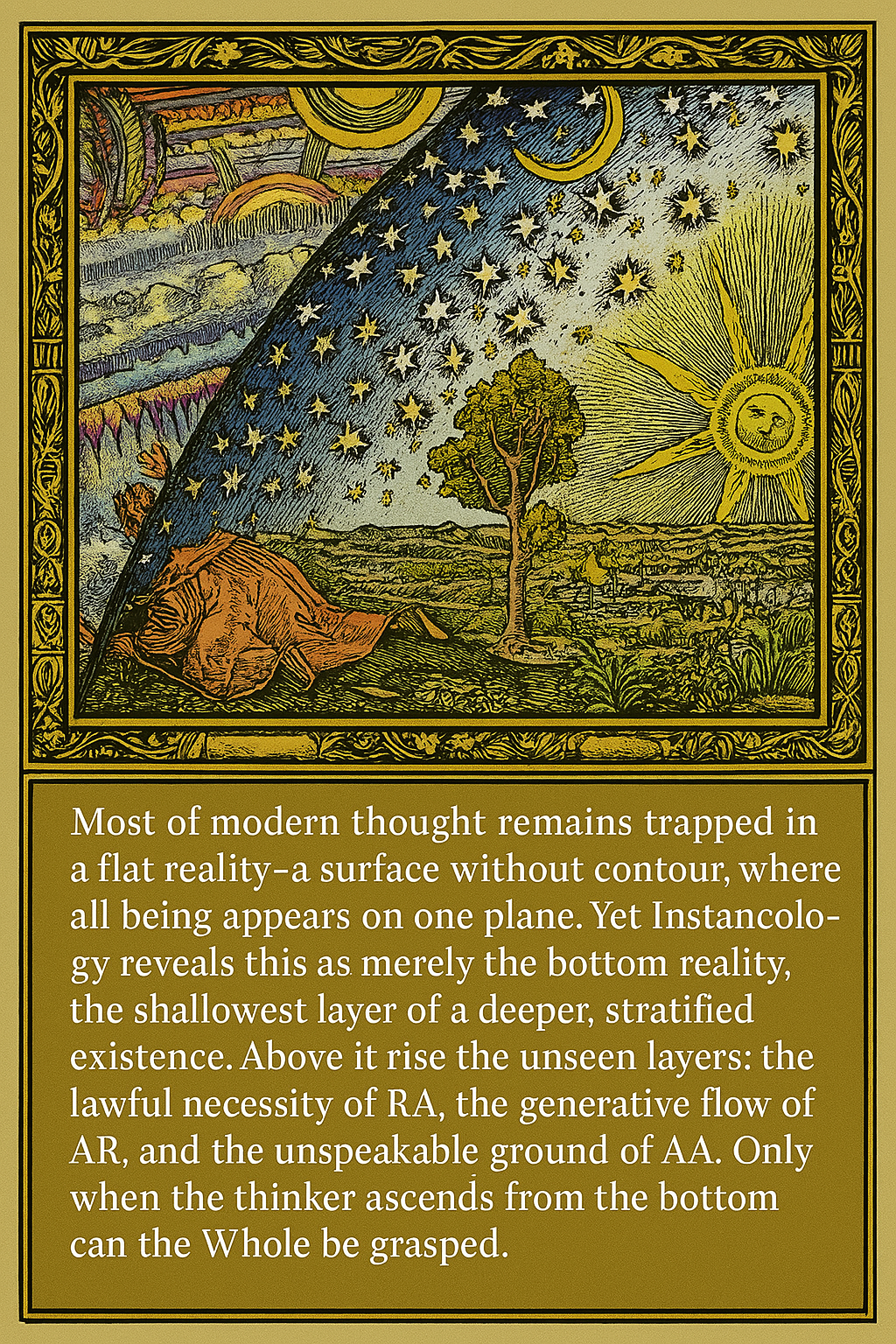
Consciousness to Thinking as AA to World Instance An Ontological Identity, Not an Analogy The proposition—“Consciousness : Thinking = AA : World Instance (WI)”—is not a rhetorical comparison, nor a heuristic analogy. It is an ontological statement about the structure of reality across levels. It asserts that the relation between consciousness and thinking in the human domain is identical in kind to the relation between the Absolute Absolute (AA) and the World Instance (WI) in the total domain. This identity becomes even sharper when we introduce the decisive clarification: Consciousness is the “local AA” of thinking. With this, the human mind is no longer a psychological exception within the universe; it becomes a localized manifestation of the same ontological structure that governs the whole. 1. The Ontological Structure of Ground and Instance At the core of Instancology lies a simple but absolute principle: Every instance presupposes a non-instance ground. This is not derived from logic; rather, logic itself presupposes it. Any structured entity—whether a thought, a law, a physical system, or the universe as a whole—requires a background that is not itself another instance, otherwise an infinite regress ensues. Thus we distinguish: Ground — non-derivative, non-relational, not an instance Instance — structured, manifest, relational Applying this universally yields: AA as the absolute ground WI as the total instance But this structure is not limited to the cosmic scale. It appears again within the human domain. 2. Consciousness as Local Ground Consider thinking. Every thought: has structure has content is identifiable and distinguishable Therefore, each thought is an instance. But what makes thinking possible? Not another thought. Not a chain of reasoning. Not a linguistic structure. Rather: All thinking presupposes consciousness. Consciousness is: not reducible to any single thought not fully objectifiable within thinking always already present as the condition of thought Thus, within the local domain: Thinking = instance Consciousness = ground This matches precisely the structure of AA and WI. Therefore: Consciousness functions as the “local AA” of thinking. 3. Structural Identity Across Levels We can now state the full ontological alignment: Ontological Role Absolute Level Local Level Ground AA Consciousness Instance WI Thinking This is not a metaphor. It is a repetition of the same structure at different scales. Thus: Thinking unfolds within consciousness just as WI unfolds within AA. And crucially: Neither thinking can step outside consciousness, nor WI step outside AA. 4. The Non-Objectifiability of the Ground A decisive feature of both AA and consciousness is this: They cannot be fully objectified within their respective instances. You cannot think “consciousness” as a complete object, because the act of thinking already presupposes it. You cannot represent AA as an entity within WI, because all representation belongs to WI. This leads to a universal constraint: The ground of any domain is inaccessible as an object within that domain. This is where traditional philosophy reaches its limit. Descartes identifies thinking but not its ground Kant identifies conditions but not the absolute ground Heidegger approaches Being but does not formalize its ontological structure They all remain within thinking about the ground, not recognizing the structural necessity of the ground itself. 5. WuXing and the Mode of Access If the ground cannot be objectified, how is it known? Here Instancology introduces a crucial distinction: Thinking operates within instances (RR/RA) WuXing (悟性) is the mode through which the ground is grasped without representation Thus: Consciousness is not known by thinking; it is lived as the condition of thinking AA is not known by reasoning; it is grasped through WuXing This preserves the structure: Thinking : Consciousness :: WI : AA WuXing does not transcend AA—it discloses it from within 6. Against Idealism and Reductionism This framework avoids two classical errors: (1) Idealism It does not claim the world is produced by consciousness. Consciousness is only the local ground of thinking, not the ground of WI AA remains distinct and absolute (2) Reductionism It does not reduce consciousness to brain processes. Brain processes are instances (AR/RR) Consciousness is their ground condition, not a product Thus, the system preserves both: ontological realism (WI exists) absolute grounding (AA is necessary) 7. Collapse of the Subject–Object Divide Once the structure is seen, a profound consequence follows: Thinking (subjective activity) World Instance (objective reality) are both: instances relative to their respective ground Therefore: Subject and object are not fundamentally different—they are structurally parallel. This dissolves one of the oldest dualisms in philosophy. 8. The General Principle From this, a universal law emerges: Wherever there is an instance, there must be a non-instance ground. Thinking → Consciousness WI → AA Any domain → its ground And the ground is always: non-derivative non-relational non-objectifiable 9. Final Formulation We can now state the thesis in its strongest form: Consciousness is the local AA of thinking; AA is the absolute ground of the World Instance. The relation between ground and instance is ontologically identical across levels. Or more compressed: Thinking unfolds within consciousness; the world unfolds within AA. 10. Closing Insight This formulation completes a trajectory left unfinished in the history of philosophy. Philosophy has long attempted to understand: the relation between mind and world the nature of ultimate ground the limits of reason But it has remained confined to thinking about these problems. Instancology introduces a decisive shift: It identifies the structure itself and shows its repetition from the local to the absolute. Thus: Consciousness is no longer mysterious—it is structurally necessary AA is no longer speculative—it is ontologically unavoidable And the bridge between them is not constructed—it is already there: The same structure, seen at two levels. |