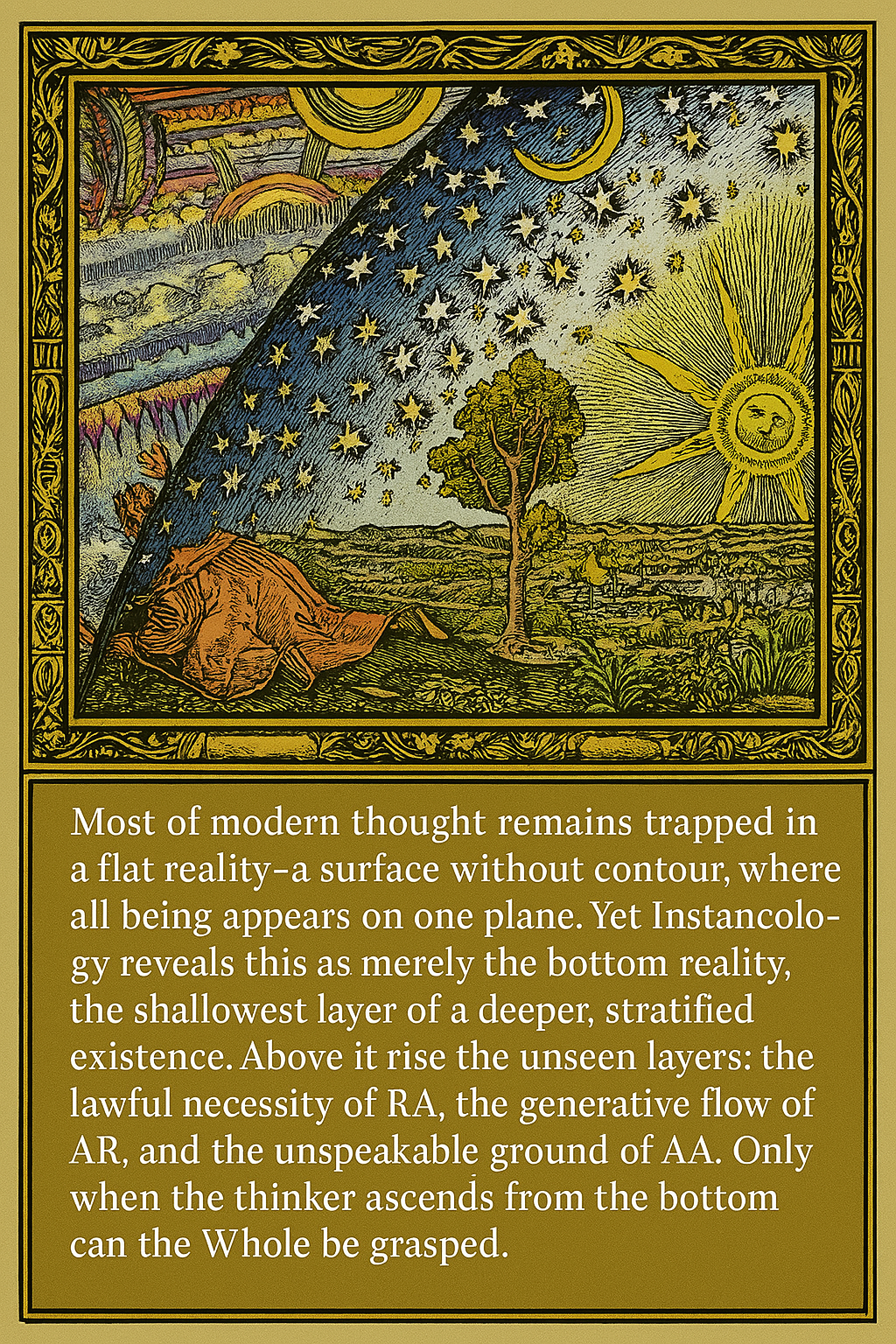
Truth Is a System — From RR to AA Truth is not a sentence, a proposition, or a single correct statement. Truth is a system—a structured progression that unfolds across levels of reality and cognition. From the perspective of Instancology, truth is neither instantly given nor arbitrarily constructed; it is systematically disclosed, moving from RR (Relative–Relative) toward AA (Absolute–Absolute). 1. Why Truth Cannot Be a Single Claim If truth were merely a correct statement, then: different sciences would not conflict, philosophies would converge quickly, and history would not be a graveyard of “once-true” doctrines. Yet the opposite is the case. What we call “truth” changes with: context, framework, cognitive tools, and ontological depth. This already tells us something fundamental: truth behaves like a system, not like a point. 2. RR: Truth as Human Construction At the RR level, truth appears as: opinions, conventions, social consensus, linguistic formulations, ideological systems, scientific models as tools. Here, truth is: negotiable, revisable, historically contingent. RR-truth answers the question: “What works, convinces, or stabilizes human interaction?” This is where most debates occur—and also where most confusion arises, because RR-truth is often mistaken for ultimate truth. RR is not false. But RR is never final. 3. AR: Truth as Natural Constraint Moving beyond human construction, AR (Absolute–Relative) introduces truth as: natural law, physical constraint, biological necessity, causal structure independent of belief. At this level: gravity does not negotiate, death does not vote, entropy does not care about ideology. AR-truth answers the question: “What must be the case, regardless of human agreement?” Yet even here, truth is still inside reality. Natural laws describe how reality behaves, not why reality exists at all. AR is stronger than RR—but still not ultimate. 4. RA: Truth as Formless Structure RA (Relatively Absolute) is where truth undergoes a decisive shift. Here truth is no longer: empirical, experiential, representational. Instead, it appears as: logic, mathematics, structural necessity, non-empirical constraint. RA-truth does not describe the world; it conditions any possible description of the world. Logic does not exist in nature the way trees do. Mathematics does not occupy space-time. Yet without them, no knowledge is possible. RA answers the question: “What must hold for anything to be intelligible at all?” Still, even RA has a limit: it explains structure, but not the existence of structure itself. 5. AA: Truth as Condition, Not Content AA (Absolute–Absolute) is not a higher theory. It is not a deeper law. It is not an ultimate equation. AA is the condition of all truth, not another truth within the system. At AA: explanation ends, grounding stops, questioning collapses—not by force, but by necessity. AA does not say anything. AA does not represent anything. AA is that which makes saying and representing possible at all. This is why AA: cannot be proved, cannot be denied, cannot be replaced. To demand proof of AA is already to presuppose it. 6. Truth as a Vertical System From this perspective, truth unfolds as a vertical structure: RR: truth as agreement and construction AR: truth as natural necessity RA: truth as structural condition AA: truth as unspeakable ground Each level: is valid in its own domain, fails when absolutized, becomes coherent only within the full system. Truth is not relative or absolute in isolation. Truth is systematic. 7. The Core Insight Most philosophical conflicts arise because: RR argues against AR, AR dismisses RA, RA ignores AA, and AA is mistaken for mysticism. Instancology resolves this by recognizing that: truth is not found by choosing a level, but by understanding the system. The journey from RR to AA is not optional. It is the structure of truth itself. Final Statement Truth is not what we say. Not what works. Not even what must happen. Truth is the system through which all saying, working, and happening become possible— a system that begins in RR and terminates, necessarily and silently, in AA. |