" You can manipulate them in the lab pretty easily."
TAIPEI (Taiwan News) — Video taken just days before the start of the coronavirus pandemic shows a current World Health Organization (WHO) inspector discuss the testing of modified coronaviruses on human cells and humanized mice in the Wuhan Institute of Virology (WIV), just weeks before the first cases of COVID-19 were announced in the city of Wuhan itself.
鉴于世卫组织的武汉之行,化名比利·博斯蒂克森( Billy Bostickson)的研究人员及其DRASTIC(分散式激进自主搜索团队调查 COVID-19)的同事发起了一份请愿书,要求国际调查组回答有关该事件的 50 个关键问题。武汉爆发。其中的问题是要求访问该设施的数据库和实验室记录,这些记录应该可以追溯到 20 年前,包括查看其安全程序、安全审计报告和安全事件报告。
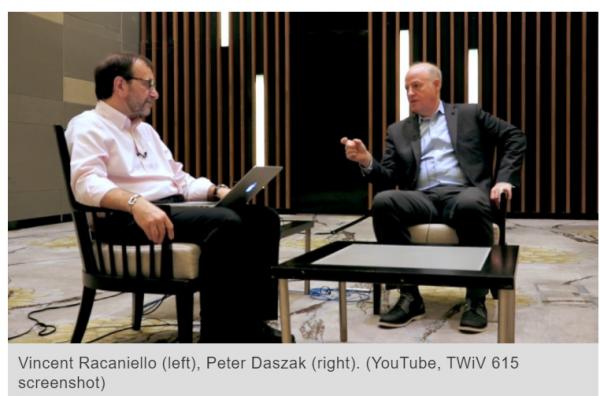
In a video that was originally taken on Dec. 9, 2019, three weeks before the Wuhan Municipal Health Commission announced an outbreak of a new form of pneumonia, virologist Vincent Racaniello interviewed British zoologist and president of EcoHealth Alliance Peter Daszak about his work at the nonprofit to protect the world from the emergence of new diseases and predict pandemics. Since 2014, Daszak's organization has received millions of dollars of funding from the U.S. National Institutes of Health (NIH), which it has funneled to the WIV to carry out research on bat coronaviruses.
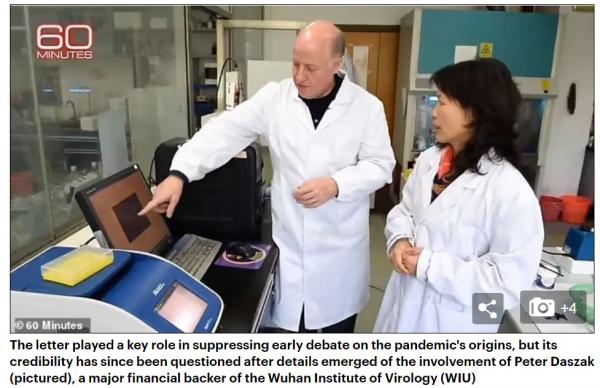
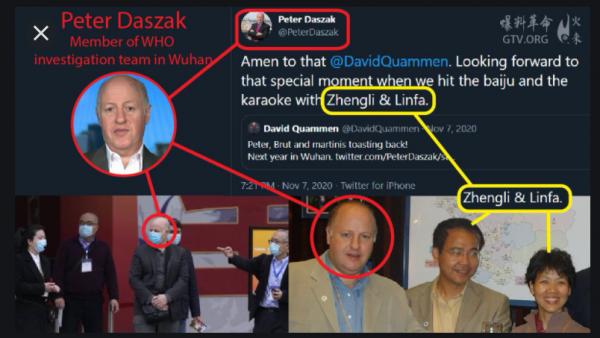
In the first phase of research, which took place from 2014 to 2019, Daszak coordinated with Shi Zhengli, (石正麗), also known as "Bat Woman," at the WIV on investigating and cataloging bat coronaviruses across China. EcoHealth Alliance received US$3.7 million in funding from the NIH for this research and 10 percent was channeled to the WIV, reported NPR.
The second, more dangerous phase, which started in 2019, involved gain-of-function (GoF) research on coronaviruses and chimeras in humanized mice from the lab of Ralph S. Baric of the University of North Carolina. Funding for the program was withdrawn by the NIH under the Trump administration on April 27 amid the pandemic.
At the 28:10 mark of the podcast interview, Daszak states that researchers found that SARS likely originated from bats and then set out to find more SARS-related coronaviruses, eventually finding over 100. He observed that some coronaviruses can "get into human cells in the lab," and others can cause SARS disease in "humanized mouse models."
He ominously warned that such coronaviruses are "untreatable with therapeutic monoclonals [antibodies] and you can’t vaccinate against them with a vaccine." Ironically, he claims that his team's goal was trying to find the next "spillover event" that could cause the next pandemic, mere weeks before cases of COVID-19 were beginning to be reported in Wuhan.
When Racaniello asks what can be done to deal with coronavirus given that there is no vaccine or therapeutic for them, Daszak at the 29:54 mark appears to reveal that the goal of the GoF experiments was to develop a pan-coronavirus vaccine for many different types of coronaviruses.
Based on his response, it is evident that just before the start of the pandemic, the WIV was modifying coronaviruses in the lab. "You can manipulate them in the lab pretty easily." What he then mentioned has become the telltale trait of SARS-CoV-2, its spike protein: "Spike protein drives a lot of what happens with the coronavirus, zoonotic risk."
Daszak mentions the WIV's collaboration with Baric: "and we work with Ralph Baric at UNC [University of North Carolina] to do this." As has been suggested by proponents that SARS-CoV-2 is a chimera made in a lab, he speaks of inserting the spike protein "into a backbone of another virus" and then doing "some work in the lab."
Providing evidence of the creation of chimeras for the sake of a vaccine, he states "Now, the logical progression for vaccines is, if you are going to develop a vaccine for SARS, people are going to use pandemic SARS, but let’s try to insert these other related diseases and get a better vaccine.”
Based on Daszak's statements, it appears that just before the start of the pandemic, the WIV was using GoF experiments with chimeras in an attempt to create a vaccine. These experiments appeared to have included infecting mice genetically modified to express the human ACE2 protein with these chimeras.
In a presentation titled "Assessing Coronavirus Threats," which was delivered four years before the pandemic in 2015, Daszak points out that experiments involving humanized mice have the highest degree of risk. Demonstrating his close ties with the WIV, he also listed the lab as a collaborator at the end of the presentation.
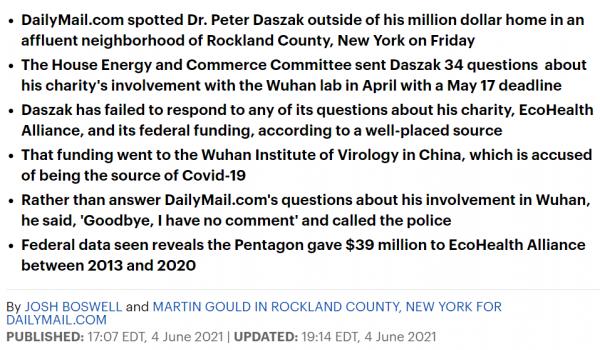
Controversially, Daszak has been included among a team of experts from the WHO that has finally been allowed by Beijing to investigate the origin of the outbreak of COVID-19, over a year after it started. Scientists such as Richard Ebright, a molecular biologist at Rutgers University in New Jersey, are condemning Daszak's participation due to conflicts of interest "that unequivocally disqualify him from being part of an investigation of the origins of the Covid-19 pandemic," reported the Daily Mail.
In light of the WHO's trip to Wuhan, a researcher who goes by the pseudonym Billy Bostickson and his colleagues at DRASTIC (Decentralized Radical Autonomous Search Team Investigating COVID-19) have created a petition demanding that the international investigation team answer 50 key questions about the outbreak in Wuhan. Among the questions is a request to access to the facility's database and laboratory records, which are supposed to go back 20 years and include a look at its safety procedures, safety audit reports, and safety incident reports.
Daszak made the admission at a 2016 forum discussing “emerging infectious diseases and the next pandemic,” which appears to be at odds with Fauci’s repeated denial of funding gain-of-function research at the Wuhan Institute of Virology.
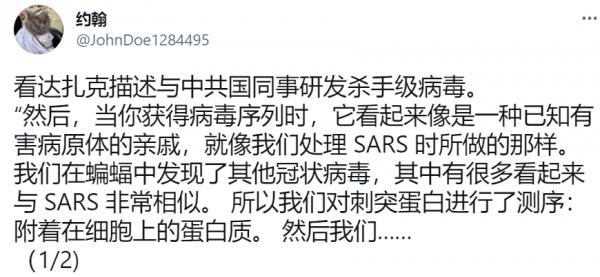
While describing how his organization sequences deadly viruses, Daszak describes the process of “insert[ing] spike proteins” into viruses to see if they can “bind to human cells” as being carried out by his “colleagues in China”:
“Then when you get a sequence of a virus, and it looks like a relative of a known nasty pathogen, just like we did with SARS. We found other coronaviruses in bats, a whole host of them, some of them looked very similar to SARS. So we sequenced the spike protein: the protein that attaches to cells. Then we…
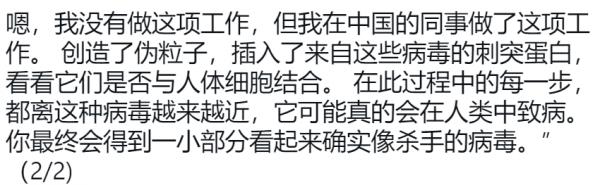
Well I didn’t do this work, but my colleagues in China did the work. You create pseudo particles, you insert the spike proteins from those viruses, see if they bind to human cells. At each step of this you move closer and closer to this virus could really become pathogenic in people.
“You end up with a small number of viruses that really do look like killers,” he adds.
The comments follow growing evidence that Fauci’s NIAID has deep financial and personnel ties to the Wuhan Institute of Virology – and that Daszak’s EcoHealth alliance was one of the primary proxies funneling the money to the Chinese Communist Party lab.
Over a dozen research papers carried out under a $3.7 million National Institute of Allergy and Infectious Disease (NIAID) grant list the Wuhan Lab’s Center for Emerging Infectious Diseases Director Shi Zhengli as a co-author alongside Daszak. Shi has included these Fauci-backed grants on her resume.
The Wuhan lab has also listed the National Institutes of Health (NIH) as one of its “partners,” secretly erasing the mention in March 2021.