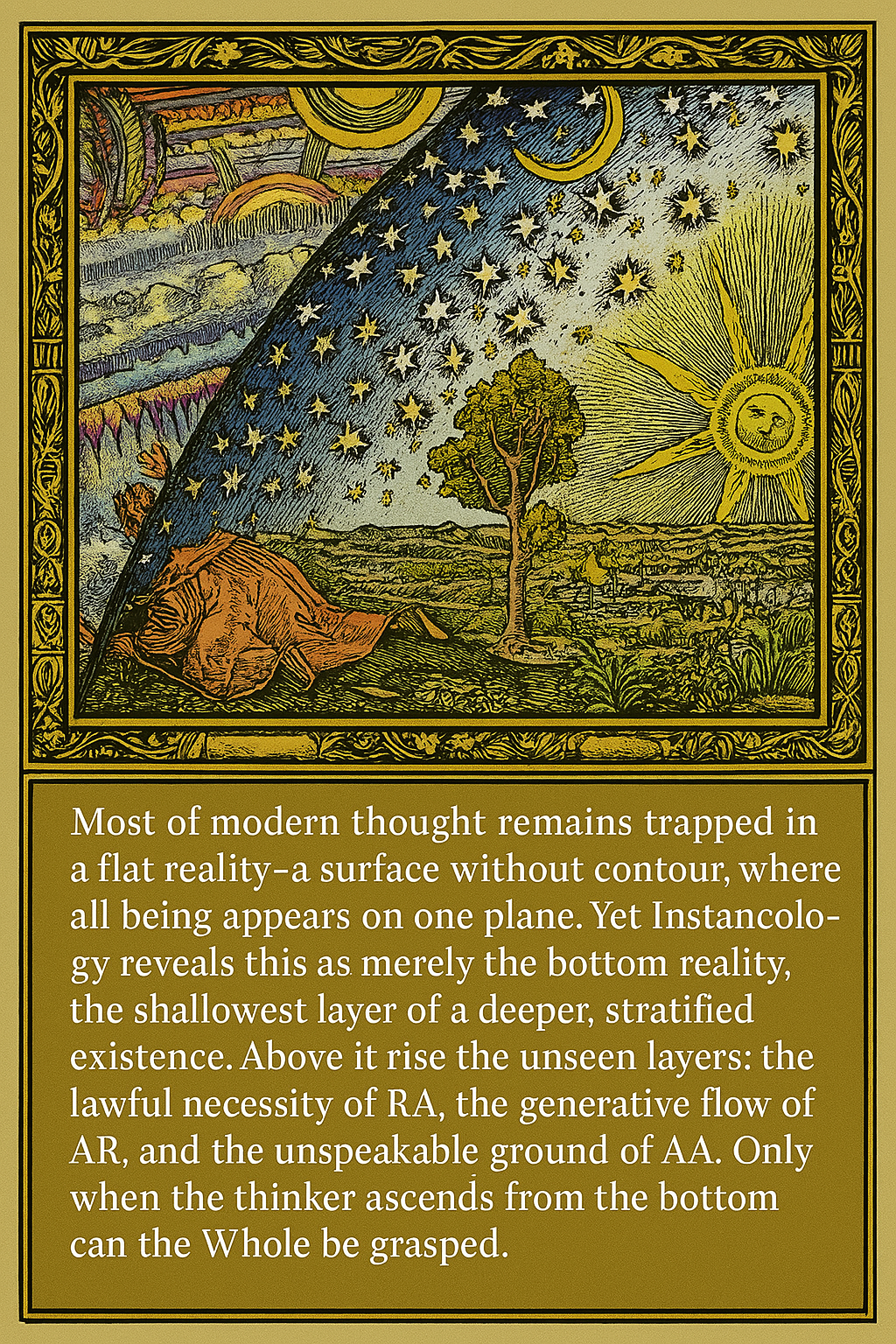
What Legacy Instancology Will Leave in History? Introduction The meaning of philosophy’s legacy cannot be measured in years, nor even in centuries. A true philosophy is not judged by the number of its contemporaries who applaud it, nor by the number of journals that cite it, nor even by the institutions that briefly enshrine it. Its measure is whether its concepts, categories, and frameworks become unavoidable for future generations—whether, in short, it gives thought a grammar without which new knowledge cannot be spoken. Plato, Aristotle, Kant, Hegel, Nietzsche—all were controversial in their lifetimes, all dismissed at times as misguided or irrelevant. Yet each left a legacy not through popularity but through necessity. Their insights became unavoidable, the background grammar of intellectual life, long after their own age had moved on. The same question now arises with Instancology: will it be remembered, and if so, what legacy will it leave in history? Today, Instancology is hardly recognized, even ignored or resisted. Its concepts appear too abstract for politics, too systematic for contemporary academia, too radical for inherited traditions. Yet, if we take history seriously, this resistance is precisely what one expects of a philosophy that carries real originality. For novelty, when genuine, is rarely welcomed by the present. The seeds of philosophy germinate slowly. The farmer dies before the harvest. To ask what legacy Instancology will leave in history is therefore to ask what seeds it has sown, what harvests it prepares for a time beyond its own. Part I. Philosophy and Its Historical Legacies 1. Plato: The Birth of Metaphysics Plato’s legacy is not in the details of his dialogues but in the framework he introduced: the separation of appearance and reality, the world of becoming and the world of being, the shadows and the forms. His “flat world” of dualism—a 1×2 structure of sensible versus intelligible—has shaped two thousand years of philosophy. Even when refuted, Plato set the coordinates of the debate. Instancology’s own dual-world conception—Macro and Micro, temporal and timeless—resonates as a correction and expansion of this original Platonic schema. 2. Aristotle: Classification, Logic, and System Aristotle’s legacy was systematic. He gave philosophy its logic, its categories, its sciences. His works became the curriculum of medieval Europe and the framework through which Muslim, Jewish, and Christian scholars engaged reason. Even after his metaphysics was overthrown, his method of classification remained indispensable. Aristotle proved that philosophy’s legacy is not always in conclusions but in the very tools for reasoning. Instancology, with its 2×2 structure (AA, RA, AR, RR), aspires to a similar legacy: not merely doctrines but frameworks of thought. 3. Kant: The Framework of Modern Rationality Kant’s Critique of Pure Reason was ridiculed as unreadable in his time. Yet his framework—distinguishing phenomena from noumena, imposing categories on experience, grounding knowledge in the conditions of cognition—reoriented philosophy permanently. Modern science and ethics cannot be thought without Kant’s categories in the background. Instancology similarly redefines knowledge through its separation of meaning and symbol, and its insistence that cognition takes place across Relative and Absolute levels. 4. Hegel: Dialectics and World History Hegel was derided by some as obscure, even nonsensical. Yet his dialectical legacy—the unfolding of Spirit through contradictions, negations, and history—became the backbone of Marxism, existentialism, and continental thought. His legacy illustrates how philosophy’s influence may be indirect, refracted through later thinkers who adapt its categories. Instancology’s principles of Rebirth and Reverse—progress through paradox and negation—stand poised for a similar dialectical inheritance. 5. The Lesson The lesson of philosophy’s past is clear: a system’s contemporary reception is no indicator of its long-term legacy. Indeed, neglect and rejection may be signs of depth, for only shallow thoughts are quickly digested. Instancology, like its predecessors, may require decades or centuries before its categories prove indispensable. Part II. The Core Legacy of Instancology 1. The 2×2 Structure At the heart of Instancology lies the 2×2 framework: AA (Absolute-Absolute): the issuing source, timeless and unknowable. RA (Relatively Absolute): forms that carry absoluteness into the relative, such as laws, logic, mathematics, and life. AR (Absolutely Relative): relative elements situated within absolute order. RR (Relatively Relative): everyday relativities, mere appearances. This structure unites what philosophy has long torn apart. Relativists emphasize contingency; absolutists insist on necessity. Instancology shows both as complementary, mapped onto distinct quadrants of reality. Its legacy will be remembered as the first comprehensive reconciliation of relativism and absolutism. 2. Micro and Macro Worlds Instancology introduces the distinction between Micro and Macro Worlds. The Micro is timeless, structural, foundational—the blueprint of existence. The Macro is temporal, causal, finite—the unfolding drama of history, biology, and personal life. Unlike Plato’s eternal forms, the Micro World is not a separate realm but an underlying dimension of this very instance. Unlike Aristotle’s temporal causality, the Macro World is not self-sufficient but dependent on Micro foundations. This dual-world model may prove as enduring as Plato’s original 1×2 schema, yet more precise for modern science. 3. Principles of Rebirth, Reverse, and Uniqueness Rebirth: Every instance, idea, or life must be reborn—renewed across contexts and generations. This principle guarantees both continuity and transformation. Reverse: Progress often comes by inversion, paradox, and negation. Biology, psychology, and history move through reversals. Uniqueness: Each instance is singular, irreplaceable, possessing dignity that cannot be reduced to universal categories. These principles are not mere ethical slogans but ontological laws. They apply to cosmology, cognition, and culture. Their legacy will be in shaping not only philosophy but practical frameworks for ethics, politics, and science. 4. Corrective to Relativism and Absolutism By placing relativities and absolutes in one matrix, Instancology ends the pendulum swing that has defined philosophy since Heraclitus and Parmenides. Its legacy will be as the system that stabilized thought at the highest level, giving future thinkers a map beyond either/or. Part III. Philosophy and Science: A New Bridge 1. The Divorce After Enlightenment After the Enlightenment, philosophy and science parted ways. Physics, chemistry, biology advanced through experiment; philosophy retreated into commentary or speculation. The once fertile union of metaphysics and natural philosophy was broken. 2. Quantum Physics and Relativity Quantum mechanics and relativity posed interpretive crises. Do particles exist as waves or points? Is causality preserved? How do time and space bend? Scientists offered equations, but philosophers had no adequate framework to interpret them. Instancology, with its Micro (timeless) and Macro (temporal) distinction, offers a conceptual bridge. Quantum indeterminacy belongs to Macro relativity, while Micro order sustains the structure beneath. 3. Consciousness and Neuroscience Neuroscience maps the brain, but the gap between matter and consciousness remains unexplained. Instancology’s separation of meaning (A-level) from symbols (R-level) provides a model: consciousness is not reducible to neurons, just as meaning is not reducible to syntax. The legacy here may be a framework that allows neuroscience and phenomenology to converge. 4. Philosophy’s Re-entry into the Laboratory If Instancology succeeds, its greatest legacy will be philosophy’s re-entry into scientific discourse—not as handmaiden or commentator, but as architect. It would provide the categories that unify physics, cosmology, biology, and psychology into a coherent worldview. Part IV. Language, Thought, and Meaning 1. Wittgenstein and the Limits of Language Wittgenstein declared: “The limits of my language mean the limits of my world.” His legacy was to expose the way language games trap thought. But he left the problem unresolved: how to distinguish meaning from symbol? 2. Chomsky and Linguistic Universals Chomsky introduced the idea of a universal grammar, an innate structure behind all languages. His revolution was linguistic, but it did not touch meaning itself. Symbols remained bound to structural syntax. 3. Instancology’s Contribution Instancology separates meaning (A-level) from symbols (R-level). Meaning belongs to the Absolute-related realm, independent of the symbols chosen to represent it. This allows translation, cross-cultural communication, and AI to move beyond syntax into true semantic depth. Its legacy may be remembered as the universal grammar of thought itself, surpassing Chomsky’s grammar of language. 4. Applications Translation: Understanding that meaning precedes symbol allows more accurate cross-linguistic transfer. Artificial Intelligence: AI systems trained only on symbols lack genuine meaning. Instancology offers a blueprint for AI that manipulates meanings directly. Philosophy of Language: Instancology advances the debate beyond the endless circle of signifier and signified. Part V. East and West: Instancology’s Global Correction 1. The Chinese Limitation Chinese philosophy excelled in holism but degenerated into moralism and fatalism. It emphasized harmony and cyclical renewal but lacked rigorous logic. The result was a culture rich in wisdom but poor in system. 2. The Western Limitation Western philosophy excelled in rationality and science but fragmented into abstraction, skepticism, and technicism. It pursued universality but lost sight of the whole. 3. Instancology as Synthesis Instancology combines Eastern holism with Western rationality. It offers holistic rationality and rational holism: the capacity to see the whole without mysticism, and to use reason without fragmentation. Its legacy will be as a global philosophy, not confined to one civilization. 4. Beyond Cultural Limitations Future generations may regard Instancology as the first philosophy born for a planetary civilization, not merely East or West, but humanity as a whole. Part VI. Seeds for the Future 1. Resistance of the Present Age New philosophies are always resisted. Socrates was executed, Spinoza excommunicated, Nietzsche ignored, Wittgenstein dismissed. Instancology faces the same fate: ignored by academia, too abstract for politics, too disruptive for tradition. 2. Deferred Legacy But history shows that deferred legacy is the rule. Gödel’s incompleteness theorem seemed irrelevant in 1931; decades later it became foundational for computer science. Likewise, Instancology’s categories may seem idle today but prove indispensable tomorrow. 3. Possible Future Applications Unifying the sciences: Physics, biology, and psychology may find in Instancology the categories needed for coherence. Guiding ethics: The principles of Rebirth, Reverse, and Uniqueness may provide a framework for human dignity in a technological age. Grounding AI: Artificial intelligence may require Instancological categories to move from symbol manipulation to true semantic processing. 4. Last System, New Beginning Instancology may be remembered as philosophy’s “last system” in the sense that it provides the final comprehensive framework. Yet it is also a “new beginning,” for it opens paths to science, ethics, and culture not yet imagined. Conclusion The legacy of Instancology will not be measured by applause, popularity, or citation. Its categories are too abstract for headlines, its framework too unsettling for traditions, its originality too deep for immediate digestion. But history does not reward novelty with instant recognition. Seeds take centuries to grow. Instancology leaves behind a grammar of thought, a framework of reality, a bridge between philosophy and science, a reconciliation of East and West, a map of relativities and absolutes. Its principles of Rebirth, Reverse, and Uniqueness will remain as ontological laws guiding generations. If history honors its own logic, Instancology will be remembered as the philosophy that closed the age of speculation and opened the age of absolute knowledge. It will not be remembered because it was liked, but because it became necessary. Its legacy will not be immediate power but eventual inevitability. And that is the truest legacy philosophy can leave. |