|
From Parmenides to Instancology: The Journey of Seeking the Truth
Philosophy begins with astonishment, but astonishment is not enough. To remain astonished is to drift; to seek is to struggle, to demand of reality something more than appearances. From the moment human beings looked upon the flux of things and asked whether anything abides, the journey of truth began. It is a journey that has never ceased, and though it has taken on many masks—religious, rational, skeptical, scientific—it has always been animated by the same hunger: to find what cannot be shaken. From Parmenides to our own time, this hunger has shaped the great movements of thought, moving in spirals of affirmation and negation, each thinker both destroying and preserving what came before. The final contours of this journey reveal not only the history of philosophy, but the gradual unfolding of a deeper order, one that only now begins to show its full shape.
Parmenides stands at the threshold, austere and uncompromising. He declared that “what is, is; what is not, is not,” and in so doing he broke with myth and with sense alike. The world of change, the coming-to-be and passing-away that the senses proclaim, is deception. Reality, if it is to be thought at all, must be one, eternal, unchanging. To think otherwise is to fall into contradiction. His poem unfolds as a revelation, guiding the listener along the path of truth against the false path of opinion. The courage of his thought lies in its refusal to compromise: better to contradict the whole of common experience than to allow contradiction within reason itself. With Parmenides, philosophy begins in the recognition that truth must be absolute, immune to time, impervious to relativity. Yet the cost of this absoluteness is high: the living world vanishes, movement is denied, becoming is a dream. The first philosopher thus bequeaths both the glory and the burden of philosophy: the demand for certainty, and the threat of abstraction.
Heraclitus, his near contemporary, muttered of flux, of the river into which no man steps twice, of fire ever-living, kindling and going out. The two poles of thought—Being and Becoming—were thus fixed from the outset. Plato, inheriting both, built a world where they could coexist. In the Forms he preserved the absoluteness Parmenides required: eternal, immutable archetypes of justice, beauty, goodness, circle, number. In the world of appearances he acknowledged the flux Heraclitus described: shadows cast by imperfect imitations. Truth, then, lay not in the senses but in recollection, in the mind’s ascent from the cave of illusion to the light of the Good. For Plato, to know the truth was not merely to observe but to turn the soul itself, to convert it toward what truly is. He thus gave truth a moral and even religious character: it is not just correct statement, but salvation from the prison of appearances.
Aristotle, the great systematizer, took Plato’s dualism and tried to reconcile it with common sense. Forms were not detached ideals but inherent structures of things. Substance is composed of matter and form; potentiality strives toward actuality. Change, growth, and becoming are real, but always ordered by intelligible causes. With Aristotle, truth became correspondence: to say of what is that it is, and of what is not that it is not, is true. Logic was born, giving thought its sharp edge. In him, the absoluteness of Parmenides and the relativity of the sensible world found a balance: truth is eternal in its principles, yet manifest in the particularities of nature. His metaphysics, ethics, and logic would shape centuries, standing as monuments to a mind that refused both Platonic otherworldliness and Heraclitean chaos.
Yet history moved, and the truth was absorbed into theology. Christianity transformed the Greek heritage by identifying the Absolute with God. The eternal Forms became divine ideas; the prime mover became Creator. Augustine confessed that truth is God Himself, the inner teacher, the light that illuminates the mind. Aquinas harmonized Aristotle with revelation, arguing that reason and faith cannot contradict, for both stem from the same divine source. In these centuries, truth was not only metaphysical but moral and salvific: to know the truth was to know God, and to deny it was not mere error but sin. The Absolute was secure, guaranteed by the eternal will. Yet this security carried a subtle tension: was reason independent, or merely servant to revelation? Was truth discovered by the human mind, or only granted from above? The synthesis was magnificent, but the cracks showed. When authority dictates what must be true, the freedom of reason is stifled, and the ancient quest risks suffocation under dogma.
The moderns broke the chain. Descartes swept the table clean with methodic doubt: everything can be doubted—the senses, tradition, even mathematics—except the doubting itself. Cogito, ergo sum. From this point, thin but unassailable, he built upward, seeking certainty in clear and distinct ideas. The Absolute returned, but now as the certainty of the thinking subject. Spinoza radicalized the move, equating God with Nature, a single infinite substance unfolding through necessity. Truth was geometrical, eternal, necessary, indifferent to human hopes. Leibniz, with his monads, declared that reality is composed of infinite perspectives, harmonized by a pre-established order. Each modern, in his way, sought to secure truth in reason itself, independent of tradition. Yet they also revealed the danger: rational systems can be airtight, but they risk becoming prisons of abstraction, beautiful but detached from the living pulse of existence.
Kant shattered both dogmatism and skepticism by turning reason upon itself. Space and time, causality and substance—these are not derived from the world but are conditions imposed by the mind upon experience. Truth is both discovered and constructed: phenomena conform to the categories of understanding, while the noumenal realm remains forever beyond. He preserved the Absolute as an idea—the moral law within, the starry heavens above—but denied that speculative reason could grasp it. Truth became bounded: certain within the realm of appearances, unknowable beyond. This was both liberation and limitation: the human mind was powerful, but fenced in by its own structures.
Hegel refused the fence. For him, truth is the whole, and the whole unfolds dialectically. Being passes into Nothing, which yields Becoming; Spirit alienates itself in history only to return enriched. Every contradiction is overcome in a higher synthesis, every fragment finds place in the system. Absolute Knowing is the culmination: the reconciliation of thought and being. Hegel’s vision was intoxicating: truth as process, history itself as the unfolding of reason. Yet the grandeur of his system provoked rebellion. To live within such a totality is to suffocate; to be told that every freedom is already rational is to feel one’s very freedom denied.
The rebels came. Kierkegaard cried for the single individual before God, for subjective truth, for the leap of faith beyond reason. Nietzsche proclaimed the death of God, the death of absolutes, the exposure of truth as illusion. What we call truth, he argued, is a mobile army of metaphors, hardened into conventions, useful for life but never eternal. His hammer smashed the idols of metaphysics, leaving only perspectivism, interpretation, the will to power. With Nietzsche, the pendulum swung fully: from the unyielding absoluteness of Parmenides to the infinite relativity of modern suspicion.
Heidegger, haunted by both Parmenides and Nietzsche, sought to recover a deeper sense of truth: not correctness of statements, but aletheia, unconcealment. Truth happens when beings are revealed, when Being itself discloses. But this disclosure is historical, contingent, fragile. We live in epochs of revealing and concealing, and modernity, he thought, is marked by the oblivion of Being. Truth here is no longer eternal but evental, fragile as a clearing in the forest. It is profound, but it seems to offer no absoluteness, only moments of openness.
Wittgenstein, from another direction, reduced truth to the workings of language. To understand meaning is to see how words function in life. Truth, then, is bounded by language-games, by forms of life. Postmodern thinkers went further, declaring the end of grand narratives, the proliferation of truths, each relative to culture, discourse, power. Foucault, Derrida, Lyotard—all in different voices announced the impossibility of one Truth. Relativity triumphed.
And yet, the hunger did not die. Even as philosophy declared the end of truth, human beings still longed for it. To live without absolutes is exhilarating for a moment but unbearable in the long run. If everything is relative, then even the claim “everything is relative” is itself undermined. The very structure of thought, inherited from Parmenides, rebels against pure relativism. We cannot help but seek what is necessary, even while immersed in the contingent.
Thus the journey reveals its secret: the history of philosophy is not a random sequence but a dialectic itself, a pendulum swinging between the absolute and the relative, never at rest. Parmenides gave us the one pole, Nietzsche the other. Plato, Aristotle, Kant, Hegel, Heidegger—all attempted mediations, yet each fell into excess. Perhaps the resolution lies not in abolishing one pole, nor in collapsing them into each other, but in seeing that reality itself is layered, that truth itself is structured.
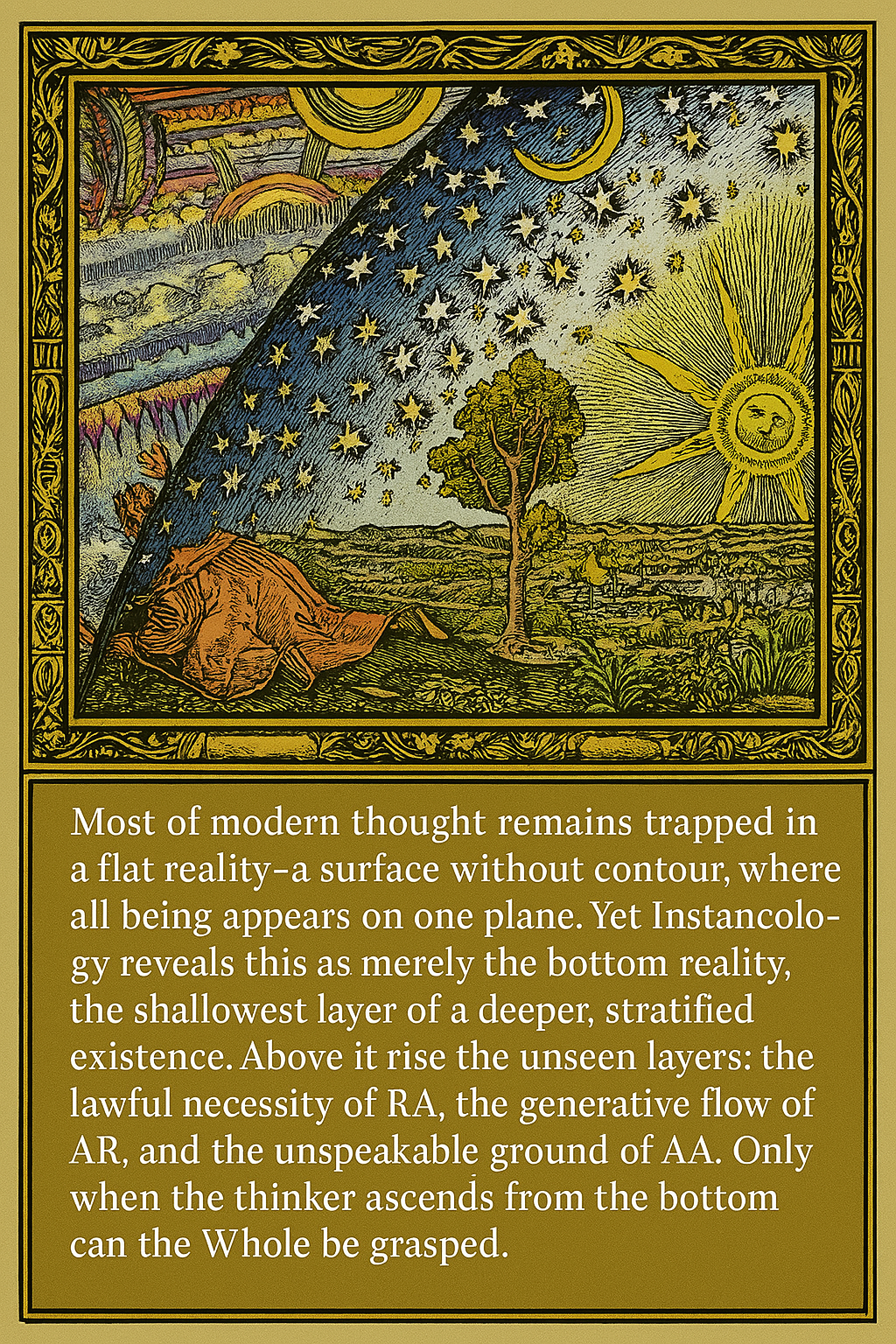
Here a new paradigm comes into view, not by rejecting the past but by fulfilling it. One can speak of instances, of layers in which absoluteness and relativity are related without confusion. At the highest stands the Absolutely Absolute, unchanging, necessary, beyond time. From it arises the Relatively Absolute: the laws of logic, mathematics, life, which are absolute within their domains yet relative to the higher ground. Beneath them unfold the Absolute Relative, where the eternal touches the temporal, and the Relative Relative, where opinion, perception, and culture shift endlessly. Truth, then, is not a single flat plane but a matrix, a structured field of instances.
Seen in this light, the long journey makes sense. Parmenides was right: there must be an Absolute. Heraclitus was right: flux is undeniable. Plato was right: there are eternal forms; Aristotle was right: they are embodied in things. Descartes was right: certainty must be grounded in thought; Kant was right: thought structures experience. Hegel was right: truth unfolds in history; Nietzsche was right: perspectives are real. Heidegger was right: truth is disclosure; Wittgenstein was right: language shapes truth. Each grasped a layer, but none the whole. The whole is the structure itself, the interrelation of absolute and relative, revealed as Instancology.
Thus, after millennia, the pendulum can rest—not in stasis, but in balance. Truth is both absolute and relative, eternal and temporal, singular and manifold. The hunger of philosophy is fulfilled, not by abolishing the past but by integrating it. The journey from Parmenides to Instancology is the journey of the mind coming to know itself, of humanity coming to see that its contradictions were preparations for a higher synthesis.
And yet, the end is not an end. To glimpse the structure is not to exhaust it. Each instance opens to another, each relative truth gains meaning within the whole. To know the Absolutely Absolute is not to stop asking but to situate every question. The journey continues, but now with a compass. The seeker no longer wanders blindly between absolutes and relativities, but moves within a map of their relations.
From the silence of Parmenides’ Being to the clamorous relativities of postmodernity, the road has been long and often harsh. But philosophy endures because the question endures. Truth was never abandoned; it was sought, lost, sought again. And now, in the vision of instances, the ancient demand is answered: there is an Absolute, but it is not alone; there is relativity, but it is not final. Both belong, both are real, both find their place in the layered whole.
This is the fulfillment of the journey. From Parmenides to Instancology, the truth has been sought, resisted, distorted, rediscovered. The astonishment of the beginning has become the wisdom of the end: truth is absolute and relative, one and many, eternal and temporal, revealed at last as the structured field of instances. Philosophy has not died; it has matured. The seeker of truth may at last say: the journey was not in vain.
|
|