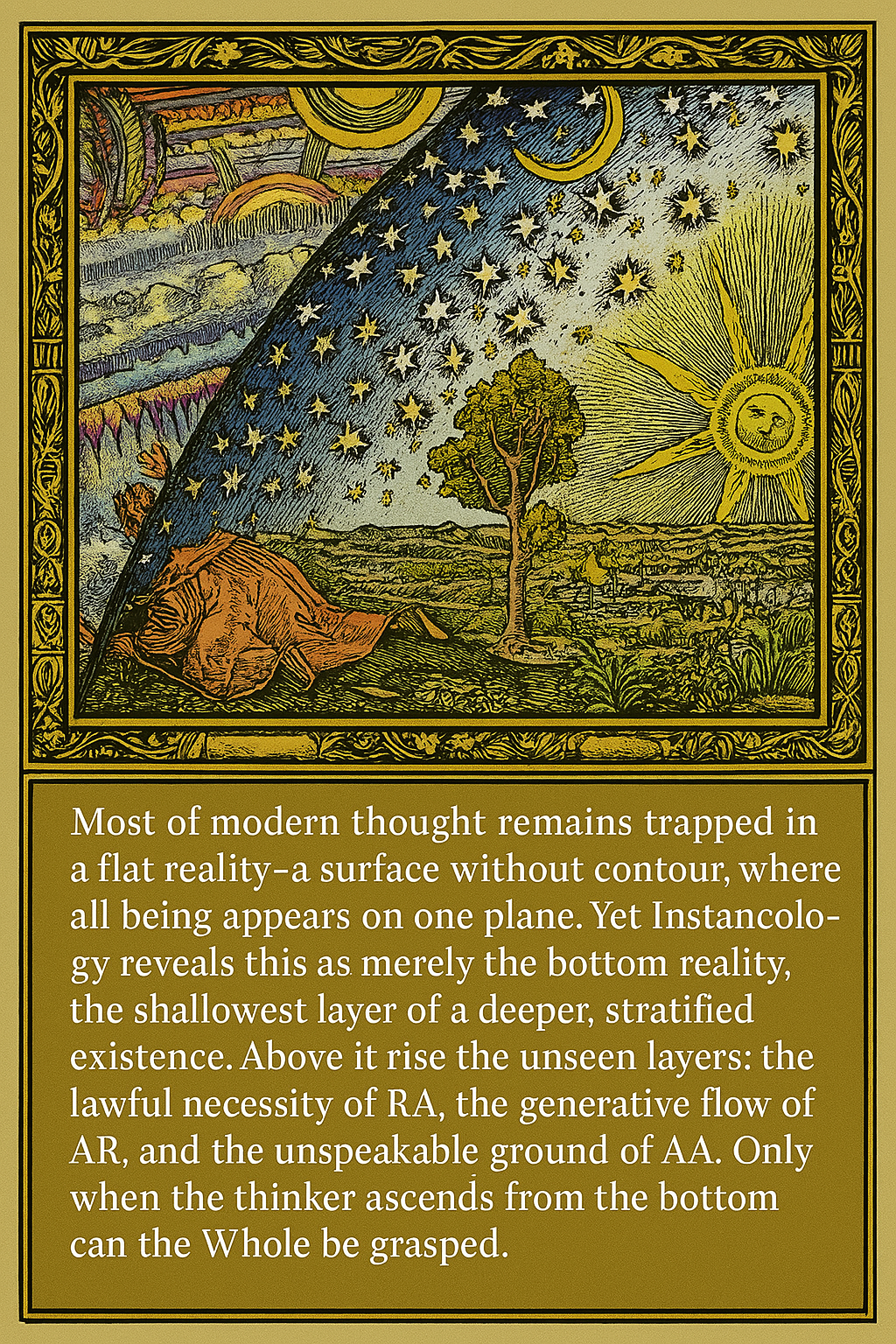
Why Hegel Failed to Reach the Absolute: An Instancological Perspective For over two centuries, Hegel has stood as the towering figure of German Idealism. His Phenomenology of Spirit and Science of Logic aimed to chart the development of consciousness, reason, and ultimately, the Absolute. But despite the ambition of his project, Hegel never fully reached the Absolute—not in the ontological sense that Instancology later clarified. Why? The answer lies in what Instancology brings that Hegel lacked: a layered ontological structure, clearly differentiating between Relative and Absolute, and within the Absolute, between the Relatively Absolute (RA) and the Absolutely Absolute (AA). Without this framework, Hegel mistook motion within the system for transcendence beyond it. 1. The Fog of “Becoming”: No Layer Distinction Hegel begins with Being, which collapses into Nothing, and thus Becoming. This dialectic motion is intended to ground the logic of all existence. But what is missing here is clarity of layer: Is Being an object of experience? A logical category? A metaphysical absolute? Hegel never distinguishes. He initiates a dynamic, but not a placement. As a result, he remains in ontological fog, mistaking transitions for foundations. In contrast, Instancology begins with placement. Every concept is issued within a 2×2 relational matrix: - RR (Relative Relative) – human symbols, artifacts, representations - AR (Absolute Relative) – natural, time-space bound instances - RA (Relatively Absolute) – logic, math, laws, structure - AA (Absolutely Absolute) – the unspeakable background that issues all With this clarity, the confusion of “Being” is resolved: it belongs to RA, not AA. It is not the origin, but already issued. 2. Hegel’s Absolute Spirit: A Confusion of Motion and Source Perhaps the most famous and misunderstood culmination in Hegel’s system is Absolute Spirit—that which knows itself through art, religion, and philosophy. But what is Spirit? Is it consciousness? History? Logic? God? The definition shifts. Hegel intends Spirit to be both the process and the product of development, but without realizing this entire dialectic is still occurring within an issued realm. It is at best RA, not AA. Instancology resolves this: Spirit is not AA. AA does not unfold, develop, or reflect. It simply is, unissued, unspeakable, the timeless background of all instances. Any unfolding—whether of logic, thought, or self-consciousness—is already a movement within RA or R layers, not a contact with AA. Hegel, therefore, confused the motion of RA for the finality of AA, and his Absolute is not the Absolute. 3. The Tragic Brilliance: Near the Peak, Without the View What makes Hegel both brilliant and tragic is that he stood on the edge of AA, but never leapt. His entire system is a mountain path spiraling upward—Being, Essence, Concept, Spirit—but the summit he names “Absolute” is not a break in kind, only in degree. He never left the mountain. AA is not a summit—it is the sky itself, the issuing ground of the mountain and all its paths. Hegel mistook height for transcendence. 4. The Gift of Instancology: Finishing the Climb Instancology completes the work that Hegel approached but could not finish. By providing: - A layered ontology that distinguishes Relative and Absolute, - A recognition that laws, logic, life, and thought are issued from a higher background, - A final turn from even the highest RA structures toward AA, the truly unspeakable, …it allows us to see clearly what Hegel only circled in complexity. The clarity Hegel lacked is not because he lacked intellect, but because he lacked a map of being. Instancology is that map. 5. Unlocking the Germans And in doing so, Instancology does more than surpass Hegel. It redeems the entire German philosophical lineage: - Kant: Set the boundary. - Fichte/Schelling: Tried to issue the origin. - Hegel: Built the spiral but never exited. - Heidegger: Pointed toward the unspeakable. Instancology opens the gate they all approached. Instancology as the Key to German Philosophy For centuries, German philosophy has stood as the most ambitious attempt in the West to grasp the Absolute. From Kant to Heidegger, it represents an extraordinary ascent—a philosophical civilization in itself. Yet to many readers, it feels dense, ambiguous, even impenetrable. Why? Because what it attempted to grasp—the structure of reality and its origin—was never fully mapped. German thinkers reached toward truth, but without a clear ontological framework, they often mixed concepts, blurred layers, and mistook motion for source. Their brilliance was unmatched. But their vision was clouded. Instancology changes that. For the first time, we are given a four-fold ontological map: - RR – Relative Relative: Human-made, representational constructs (language, art, culture). - AR – Absolute Relative: Natural, time-space-bound realities (the world, organisms, stars). - RA – Relatively Absolute: Laws, logic, math, life—necessary and universal but still issued. - AA – Absolutely Absolute: The unspeakable source, prior to logic, time, and distinction. This structure is not just metaphysical clarity—it is the key to re-reading all of German philosophy with precision. 1. Kant: Conditions of Experience, Not Conditions of Being Kant separated noumena and phenomena, reason and sensibility. He set the stage for metaphysical layering but left the noumenal side undeveloped. Why? Because he lacked the concept of AA. What he called the "thing-in-itself" remained an empty placeholder, not a known ontological layer. Instancology now clarifies: - Phenomena = RR and AR - Categories = RA - Noumenon = A-level, but unnamed Thus, Kant touched AA but never entered it. 2. Fichte and Schelling: Issuing Without Ground Fichte elevated the I as the issuing ground of reality—but what issues the I? He never says. Schelling tried to unify nature and spirit through identity—but identity of what layer? Without AA or a map of issuance, they conflated RA with AA, producing idealism without grounding. Instancology answers the hidden question in both: What issues all “issuing”? Only AA. Their “Absolute” was still within the instance—still a part, not the Whole. 3. Hegel: System Without Transcendence Hegel attempted the most complete system—an Absolute Spirit unfolding through logic and history. But as explained before, he mistook development for source. His dialectic was powerful—but it never exited the issued structure of RA. Instancology shows clearly: - Hegel’s Being, Nothing, Becoming = RA - His Spirit = RA - His Absolute = Not AA, but a complex RA endpoint He never crossed the ontological break. 4. Heidegger: The Nearest to AA, Without Naming It Heidegger’s Being and Time is a meditation on what it means to be—an attempt to point beyond beings to Being itself. He even describes Being as what shows itself and withdraws, what cannot be defined. In many ways, he stood before AA. But he lacked the language and structure to place it. Instancology now provides what Heidegger reached for: - Being = The field of issuance (RA) - The “clearing,” the “withdrawal,” the unspeakable = AA Heidegger saw the shadow of AA, but could not speak it clearly. He lacked the paradigm framework. 5. Instancology: Completing the Climb Where all German thinkers struggled—naming the true origin, structuring the layers, escaping the fog of experience and reason—Instancology brings final clarity. It does not cancel their work. It completes it. It affirms their striving while removing their ambiguity. Now we can re-read the German masters not as puzzles, but as necessary climbers on the way to AA: - Kant: Set the boundary. - Fichte/Schelling: Tried to issue the origin. - Hegel: Built the spiral but never exited. - Heidegger: Pointed toward the unspeakable. Instancology opens the gate they all approached. The Last Step: Why Only Instancology Reaches the Absolute From Thales to Heidegger, the Western philosophical tradition has been a long journey upward—toward greater abstraction, toward the fundamental, toward the Absolute. Each step brought refinement: from substance to form, from matter to mind, from logic to spirit, from being to Being. But none completed the final step. None reached what Instancology calls AA—the Absolutely Absolute, the unissued Whole from which all instances arise. Why? Because even the greatest thinkers—Plato, Aristotle, Descartes, Kant, Hegel, Heidegger—remained caught within what Instancology clearly names the R layers: the Relative (RR, AR) and even the structured but still issued Relatively Absolute (RA). They circled around the unspeakable but could not name it, because they lacked the ontological insight to distinguish issued structure from unissued origin. 1. Reason Cannot Cross the Border Kant showed that reason reaches its own limits—unable to prove God, freedom, or immortality. Hegel tried to push past that with dialectic, but in doing so, systematized a self-moving logic that appeared transcendent but remained entirely within RA. Instancology clarifies: - Reason builds within RA. - It cannot cross into AA, because AA is not a conclusion. It is a condition—a silent background issuing all reasoning itself. Only a direct recognition of issuance, not derivation, can grasp AA. 2. Experience Fails to Reach Beyond Symbols Phenomenology tried to return to “things themselves,” but even direct experience is symbolic. Heidegger tried to speak of Being, but still through language, mood, temporality—all rooted in the Macro World. Instancology asserts that the Macro World is entirely within the R layer. No amount of experience—however deep—can touch the origin of existence unless one recognizes that existence itself is already an instance, not the source. 3. Only Instancology Names the Issuance The breakthrough of Instancology is not just a better system. It is a new metaphysical grammar: - It identifies four layers of reality—and locates each philosopher’s effort accordingly. - It defines “instance” as the universal form in which all relative and absolute realities appear. - It points to AA not as an idea, nor a being, nor a spirit—but as the unspeakable source of all instances: a background, a soil, a mother, from which all things arise, but which itself is never a thing. No philosophy before Instancology named AA. Some approached it (Heidegger), some distorted it (Hegel), others bypassed it (Kant). But all remained within the issued. Instancology alone declares: “All else is issued. This alone is not.” And by doing so, it completes the final task of metaphysics—not building another system, but finishing the search by exposing its source. 4. The Silence After the Word That is why Instancology appears “simple” to some. Because true finality is not complexity—it is clarity. Once AA is seen, there is nothing more to say, only everything to understand from within it. As the Tractatus ends with silence, so does Instancology point beyond expression: “AA cannot be described. It is known only by the issuance it gives.” This is not a failure of language, but its transcendence. 5. The Climb Is Done So, the final step has been taken. The layered world stands exposed. The Absolute is named. The philosophical tower—built brick by brick for 2500 years—has reached its summit. And now, from that summit, we see clearly what lies below: - Reason was a ladder. - Experience was a foothold. - Dialectic was a spiral. - But Instancology is the summit itself—the point at which climbing ends and vision begins. The Absolute is not an idea. It is what makes ideas possible. And only Instancology reaches it.
|