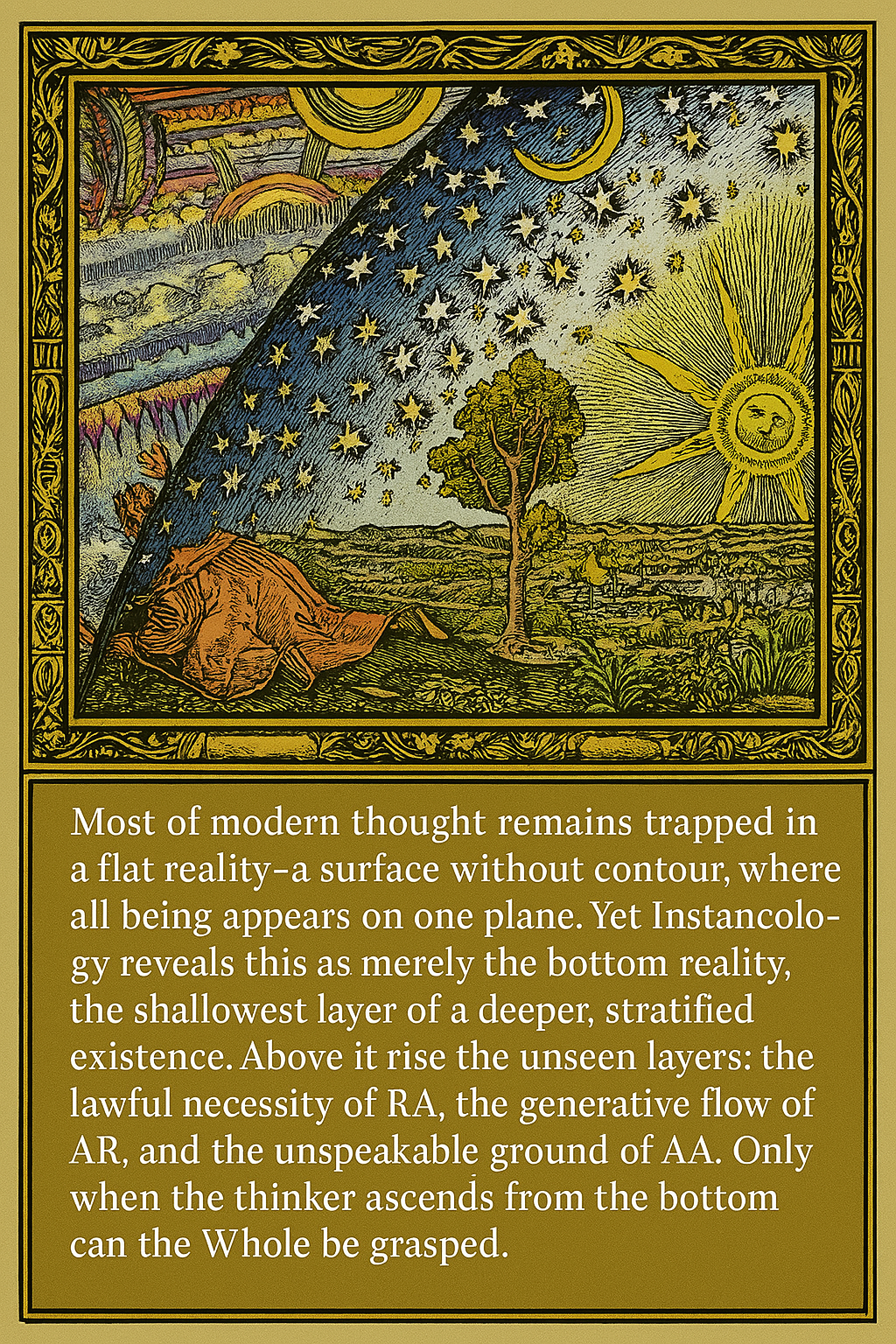
Instancology Structure from 2×2 to 6×6×6×6×6 Instancology, or the Philosophy of Paradigm Instances, is a system that starts with a minimal ontological distinction and unfolds into a vast, layered framework for understanding existence, knowledge, and human cognition. At its base is the 2×2 ontological matrix, which lays the groundwork for all that follows. This foundational insight is not static; it evolves into a 6×6×6×6×6 matrix that encompasses five interrelated domains: ontology, epistemology, cognitive tools, psychology, and knowledge. What begins as a metaphysical seed culminates in a universal model of cognition and being. This essay elaborates on the structural logic and significance of each stage in the progression. I. The 2×2 Ontological Foundation The foundational insight of Instancology is that reality can be structurally understood through a 2×2 matrix of ontological distinctions in Micro-Macro Worlds based on previous analysis of the Relative and the Absolute: - R (Everything in Macro World is Relative) - A (All truth in Micro World is Absolute) - AA (Absolutely Absolute): The issuing source of all that exists, beyond time and space, unchanging and foundational. - RA (Relatively Absolute): Phenomena that retain a trace of the Absolute while being within time; includes logic, laws, mathematics, and life. - AR (Absolutely Relative): The empirical world as it appears to the mind, including perceptions and representations. - RR (Relatively Relative): Artificial constructs, illusions, or false derivations that lack ontological grounding. This 2×2 provides the categorical ground for understanding all instantiation of being. Unlike binary logic systems, it allows for relational identity between the Absolute and the Relative in two axes, providing a richer metaphysical topology. II. The Six Epistemological Angles Building on the 2×2 matrix, Instancology introduces six distinct epistemological angles to classify modes of knowing. These are not isolated perspectives but orientations toward the real: 1. Subjective: Knowledge centered on the self; solipsistic or emotionally colored. 2. Objective: External, impersonal knowledge assumed to be independent of the knower. 3. Objectively Subjective: The individual's inner world examined through structured reflection. 4. Objectively Objective: The ideal of scientific or metaphysical objectivity, often aligned with AA or RA. 5. Subjectively Subjective: Introspective and affective, grounded in immediate personal experience. 6. Subjectively Objective: A synthesis where the subject recognizes the object’s independence while retaining subjective mediation. These six angles provide a multi-perspectival map of epistemic access, enabling the subject to navigate and cross-check multiple knowledge postures. III. The Six Cognitive Tools Each epistemological angle employs a specific cognitive tool that bridges mind and world. These tools are ranked ontologically and reflect increasing sophistication and abstraction: 1. Intuition: Immediate, pre-conceptual awareness; an unmediated grasp. 2. Experience: Empirical input from the senses; the domain of AR. 3. Understanding: Conceptual organization of experience; aligns with logos. 4. Reason: The faculty of abstraction, analysis, and systemic thought. 5. Primitive WuXing: The structuring force of reality in its relational and dynamic form (AR/RA interface). 6. Absolute WuXing: The operation of paradigms at the level of AA; unchanging, universal patterns of instantiation. WuXing here is redefined: no longer ancient cosmology, but structural paradigmatics, governing how instances operate within a reality field. IV. The Six Layers of Psychology Human psychology is not treated in Instancology as a loose empirical science, but as a tiered ontological structure corresponding to tools and knowledge levels: 1. Action: The outermost expression of psyche; observable and kinetic. 2. Ego: The reflexive self; identity and self-interest. 3. Soul: The deeper, often moral or aesthetic self; linked to values. 4. Consciousness: The ability to reflect and direct attention. 5. Thinking: The processing and manipulation of symbolic content. 6. Mind: The ultimate interface with the Absolute; ontologically potent. This model positions the psyche not as a bundle of behaviors but as a conscious bridge from RR to AA. Each level of mind corresponds to a depth of cognitive access and ontological responsibility. V. The Final Matrix: 6×6×6×6×6 These layers form a unified matrix: - Ontology (2×2): R and A, AA, RA, AR, RR - Epistemology (6): Six positions of knowing - Cognitive Tools (6): Instruments for epistemic operation - Psychology (6): Layers of human mental structure - Knowledge (6): Products of the above interaction Together, they form a 6-dimensional matrix (not merely combinatorial but interpenetrating). Each cell represents a unique configuration of reality, cognition, and personality. This matrix becomes a comprehensive map of existence and knowing, from instinct to intuition, from action to AA. Conclusion: From Simplicity to Totality What distinguishes Instancology is its architectural precision: from the 2×2 matrix that defines reality’s fundamental categories, it spirals outward into a fully populated framework that accounts for all legitimate instances of being, knowing, and acting. This is not a mere classification system but a philosophical engine—one that replaces disjointed traditions of metaphysics, epistemology, psychology, and even cosmology. Through the 6×6×6×6×6 matrix, Instancology offers the final map—the logic of the Real, the grammar of truth, and the architecture of consciousness. It is not an interpretation of reality; it is its formal unveiling.
|