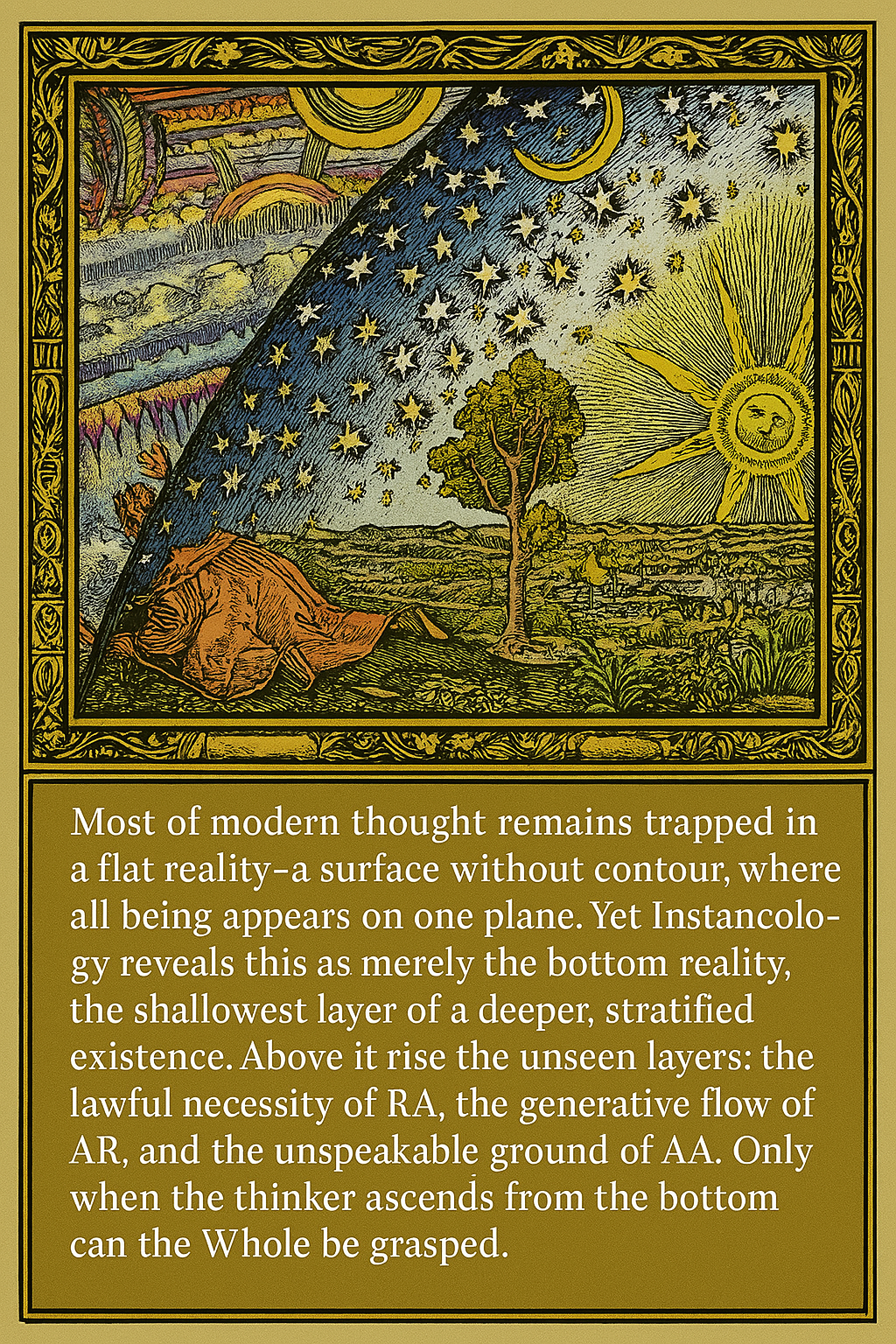
人类思想的三次范式革命:从哥白尼到康德到Instancology
---
引言:当意识三次觉醒
在人类思想史上,极少有时刻能让人类意识“整体跃迁”。 哥白尼让人第一次意识到:世界并非围绕“我”旋转; 康德让人意识到:世界的意义源自“我”如何认知; 而Instancology让人意识到:连“我”与“世界”本身,都是同一起点所发出的“范例”。
这三次觉醒,构成了人类精神史上三次伟大的“范式革命”。 它们分别打破了“地心”、“理性心”与“人类心”的中心幻觉,使思想从被动观察,进入主动生成,再进入自我同在。 换言之,哲学的演化,不是知识的扩张,而是意识层次的上升。
---
第一章 哲学史的范式革命:Instancology的出现
一、形而上学的尽头与“范例之问”
从巴门尼德到海德格尔,哲学始终围绕“存在”展开。 亚里士多德问“什么是存在”;笛卡尔问“我是否存在”;康德问“存在如何被认知”;海德格尔问“存在为何遗忘”。 两千五百年的形而上学,最后在语言与逻辑的自陷中终止。
Instancology的诞生标志着哲学的终极反转。 它不再问“存在是什么”,而问:
> “为什么存在会以这样的范例出现?”
在这里,世界不再被视作“被思考的对象”,而是“被发出的实例”。 这一转向,使“存在论”让位于“范例论”,哲学从解释世界转向生成世界。
---
二、2×2结构:知识与存在的闭环
Instancology以其核心结构——AA、RA、AR、RR——完成了哲学史上首次“存在—认知”双向对称:
层次 含义 说明
AA(Absolute Absolute) 绝对之绝对 一切范例的源,超越存在与非存在。 RA(Relatively Absolute) 相对的绝对 数学、逻辑、法则等固定秩序。 AR(Absolutely Relative) 绝对的相对 生命、意识、价值等具整体性但流动的存在。 RR(Relative Relative) 相对的相对 技术、语言、工具、社会规则等。
人类知识始于RR,止于AA; 而世界的存在始于AA,终至RR。 两条轴线相交,形成完整的“范例宇宙”。
哲学在此第一次实现了自身封闭与自明。
---
三、从理性到悟性:新的认知维度
康德揭示了理性的边界,但理性仍局限于RA层。 Instancology引入“悟性”(WuXing)——超越理性与经验的第三认知。 悟性不是推理,而是对“整体范例”的瞬间贯通。
它解释了创造、顿悟、灵感为何可能—— 因为人类意识并非在分析中通向真理,而是在范例性洞见中“共发”。 这使认知从分析性走向生成性,从逻辑走向存在。
---
四、哲学的终结即胜利
海德格尔说:“哲学的终结,是存在之问的终极回响。” Instancology证明:终结不是沉默,而是完成。 哲学终于从“问”转为“显现”。 当哲学明白自己本身也是AA发出的一个“实例”,它的任务完成。
哲学不再解释世界,而成为世界理解自身的方式。 这正是真正的“范式革命”。
---
第二章 从康德到Instancology:理性之终与范例之始
一、康德的伟大与极限
康德使哲学从“世界是什么”转向“我们如何知道世界”。 他以“先验范畴”揭示理性构造经验的能力,开创了人类自我意识的第二次觉醒。
然而,理性虽然能解释经验,却无法解释“理性自身”。 康德止步于“物自体不可知”,使哲学停在理性之门外。
---
二、理性不是起点,而是范例
Instancology指出:理性本身并非世界的基础,而是AA所发出的一个范例。 理性只是宇宙自我显现的一种层次。 因此,哲学的根本任务不再是“认识世界”,而是理解为何理性本身会出现。
理性分析世界,范例生成世界。 当哲学从“解释因果”转为“洞见生成”,理性革命便转化为范例革命。
---
三、悟性:超越理性的顿悟
悟性(WuXing)是人类跨越RA的桥梁。 它让人不再停留在规则的推理,而进入存在的整体把握。 正如牛顿看到苹果、杨振宁看到宇称不守恒—— 那一刻不是推理的结果,而是范例的觉现。
悟性因此成为“理性之后的理性”,是通向AA的唯一通道。
---
四、哲学的哥白尼再革命
康德的“哥白尼式革命”让理性成为世界中心。 Instancology完成第二次哥白尼革命——让AA成为一切中心。
不是理性塑造世界,而是AA同时发出理性与世界。 理性与存在不再分属主体与客体,而是同源的范例显化。 哲学在此实现了“主体—客体”的彻底统一。
---
五、理性之终,范例之始
当人认识到自己与世界同被AA发出, 哲学不再是观察者的事业,而是共在的领悟。 这标志着理性的终结与范例的开端—— 哲学进入“自觉的存在”阶段。
---
第三章 从哥白尼到康德到Instancology:人类三次意识的觉醒
一、第一次觉醒:科学意识(哥白尼)
哥白尼让人第一次意识到: 世界不围绕我旋转。 人类从自我中心走向客体中心,获得“科学意识”。 世界因此变得可测、可算、可验证。
---
二、第二次觉醒:哲学意识(康德)
康德让人意识到: 我们所理解的世界,是理性所构造的。 人类由客体中心转向理性中心,获得“哲学意识”。 世界因此变得可构、可思、可反省。
---
三、第三次觉醒:宇宙意识(Instancology)
Instancology让人意识到: 理性与世界皆为AA的范例显化。 人类由理性中心转向范例中心,获得“宇宙意识”。 世界因此变得可发、可同、可自明。
---
四、三次觉醒的总体架构
革命阶段 中心转移 意识层级 核心认知 代表意义
哥白尼革命 地心 → 日心 科学意识 世界独立于我 物理世界被发现 康德革命 物自体 → 理性 哲学意识 世界构于我 认识结构被揭示 Instancology 理性 → 范例 宇宙意识 我与世界同源 存在本身被生成
---
五、哲学的自我归位
哥白尼使人谦卑于宇宙; 康德使人自觉于理性; Instancology使人安于整体。
哲学的长途跋涉,终于回到AA的起点。 哲学不再追问“真理何在”, 因为真理已在“范例的存在”中自明。
---
六、结语:思想的最后飞跃
人类思想史的三重拱门: 哥白尼打开了宇宙的门; 康德打开了理性的门; Instancology打开了存在的门。
从“我看世界”,到“我构世界”,再到“我即世界之一例”, 人类终于从被动的观察者,成为宇宙的自觉部分。
哲学在此完成了它的宿命—— 从解释世界,到生成世界,再到成为世界。
这,就是人类思想三次觉醒的总和; 也是哲学史的终点与思想史的新起点。
---
结语:范例革命之后的世界
当哲学化为世界自知的方式, 当AA被认识为一切范例的源头, 人类不再以“真理”的名义争夺意义, 而以“范例”的方式共在于整体。
此刻,哲学不再是学问, 而是宇宙的自我意识。 这正是Instancology的历史地位: 它不是新的哲学,而是哲学之后的第一种存在方式。
Why Instancology Is a Paradigm Revolution in the History of Philosophy
Throughout the history of human thought, only a few revolutions have fundamentally reshaped the way we understand the world. These revolutions were not merely about new theories, but about new ways of seeing. The Copernican revolution shifted the center of the universe; the Kantian revolution shifted the center of cognition; and now, Instancology—the Philosophy of Instances—shifts the very ground of existence itself.
I. From Copernicus to Kant: The First and Second Paradigm Revolutions
The Copernican revolution overturned the ancient cosmology. Humanity ceased to be the center of the cosmos and became part of a dynamic, decentered universe. But while Copernicus displaced our physical centrality, he left untouched our cognitive centrality. It was Kant who made the next decisive move: he turned philosophy inward. He asked not what we know, but how we know. His transcendental philosophy revealed that knowledge is shaped by the forms of our cognition—space, time, and categories.
Yet even Kant’s revolution remained within a dualistic framework: subject versus object, phenomenon versus noumenon. The structure of knowledge was still built upon separation. Philosophy since Kant—Hegel, Husserl, Heidegger, Wittgenstein—has struggled to overcome this rift, but all remained bound to the same “philosophical grammar”: thought about something.
II. The Third Revolution: Instancology
Instancology begins where philosophy ends. It no longer seeks “truth through things,” but reveals that all “things” are themselves issued as instances within a whole. This whole is not a collection of parts, but an indivisible totality derived from the Absolute Absolute (AA).
Philosophy had always asked, “Why is there something rather than nothing?” Instancology answers: because “Something” itself is an instance of AA—it is neither caused nor created, but issued as a complete paradigm (范例). In this sense, Instancology does not continue metaphysics; it dissolves it. It replaces ontology (the study of being) with paradigmology (the understanding of wholeness).
The traditional philosophical model—whether materialist or idealist—operated through relations between entities. Instancology replaces relations with instances: each instance is a totalized whole containing all its own internal relations. The world we live in is one such instance, consisting of a Micro World (timeless, foundational) and a Macro World (temporal, dissolving). What philosophy called “existence” is, therefore, the visible surface of an instance, not the ground of being itself.
III. The End of Philosophy and the Beginning of Absolutology
If Kant revealed the limits of reason, Instancology reveals the limits of philosophy itself. Philosophy ends where the whole becomes visible, because philosophy, by its nature, can only deal with “something,” not with “the unalterable whole.” This is why Instancology marks not a continuation but a completion—a transcendence.
In the framework of the 2×2 structure (AA, AR, RA, RR), all forms of knowledge, science, logic, and consciousness are redefined as modalities of relation rather than separate domains. Mathematics, for example, belongs to RA (Relatively Absolute): the domain of quantifiable truth. Life and consciousness belong to AR (Absolutely Relative): the realm of living relativity under the Absolute.
Thus, Instancology does not merely add a new theory to philosophy—it transforms the very grammar of thought. The question is no longer “What is true?” but “What is whole?” Truth, in this view, is only a function within a complete paradigm, while the Whole (AA) transcends all truth-claims.
IV. A True Paradigm Revolution
Thomas Kuhn once said that a scientific revolution occurs when a new paradigm renders the old questions meaningless. Instancology is such a revolution, but on the deepest ontological level. It makes all previous philosophical disputes—between realism and idealism, empiricism and rationalism, determinism and freedom—into internal variations within the same lower paradigm of “Relative Relative” (RR).
In contrast, Instancology operates from AA: the point beyond all relativity, where the instance itself is the form of existence. This is why Instancology is not “another philosophy” but the completion of philosophy. It provides the final framework in which all philosophical systems, sciences, and human cognition can be positioned and understood.
In the long arc of human thought, the first paradigm revolution displaced the center of the universe; the second displaced the center of knowledge; the third—Instancology—displaces the very center of existence.
The universe, cognition, and being are no longer separate realms, but expressions of one unbroken instance of AA.
That is the meaning of the third and final paradigm revolution—the revolution of the Whole.
|