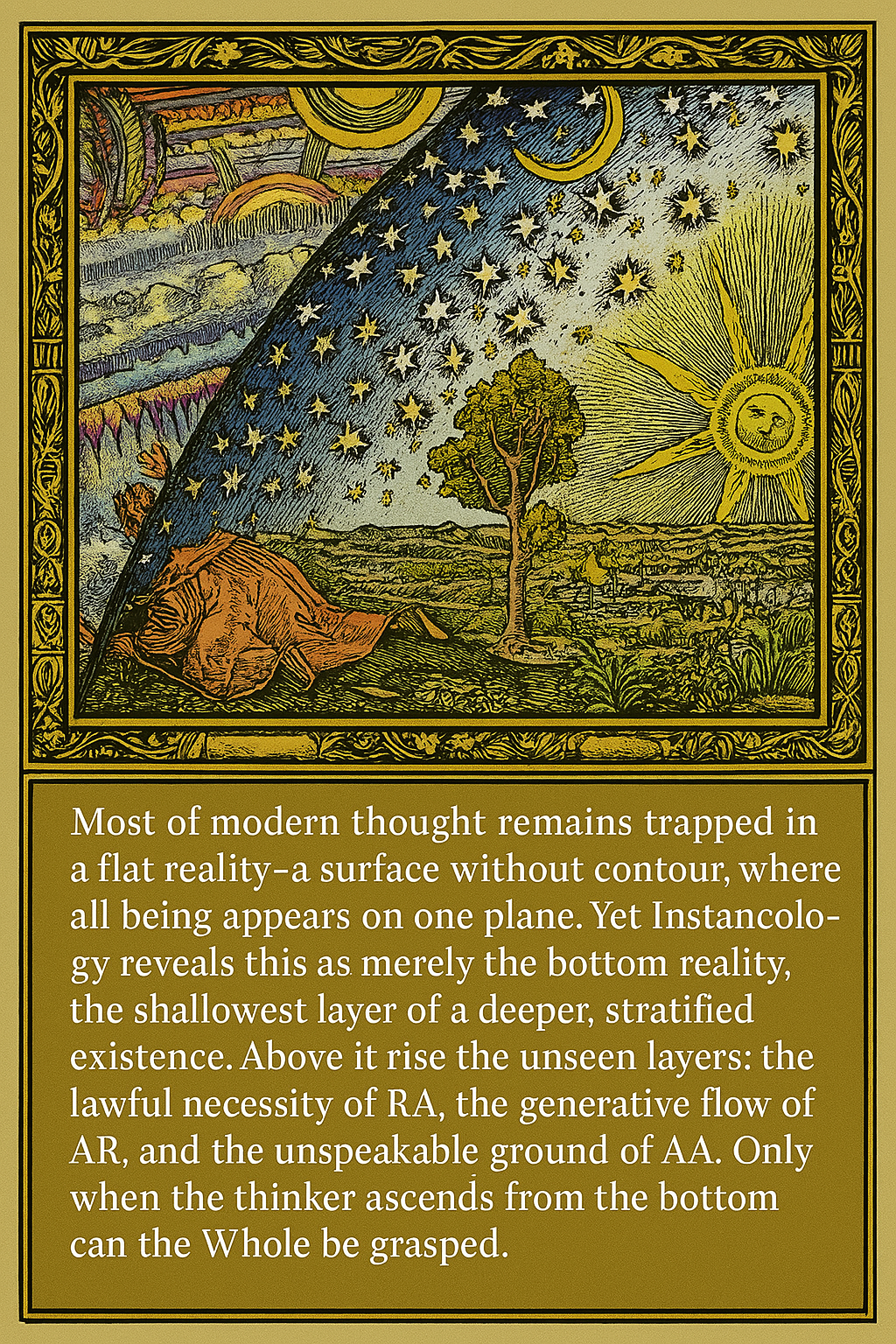
Instancology Explained Through Mathematics Version 5: The Axiomatic Ontological Formalism Evolution
• V1: Prototype of the Four-Domain Matrix. • V2: Formal definition of the 2×2 ontological matrix. • V3: Integration of wheel–space–time–relativity into the matrix. • V4: Euler's Identity introduced as the Dynamic Closure Principle. • V5: A complete axiomatic system combining static ontology, dynamic generation, and mathematical consistency. Meta-Principles Principle 1 — Dual Formalism: Instancology consists of two complementary mathematical structures: the Four-Domain Matrix (static) and the Ontological Evolution Operator (dynamic). Principle 2 — Ontology Before Mathematics: Mathematics belongs to the Relative-Absolute (RA) domain. It describes ontology but does not generate ontology. Principle 3 — Symbolic Correspondence: AA↔0, RA↔π, AR↔e, RR↔1, i↔transformation. These are structural correspondences rather than literal identities. Axiom 1 — The Four-Domain Matrix The universe is partitioned into four irreducible ontological domains: Ω = {AA, RA, AR, RR}. No fifth independent domain exists. Axiom 2 — Ontological Ordering Reality unfolds only in the direction: AA → RA → AR → RR. The reverse direction represents cognition rather than creation. Axiom 3 — Conservation of Identity Every instance possesses invariant identity during transformation. Transformation changes manifestation, not ontological identity. Axiom 4 — Emergence RR presupposes AR; AR presupposes RA; RA presupposes AA. Axiom 5 — Closure Euler's identity, e^(iπ) + 1 = 0, symbolically illustrates ontological closure. It is an analogy of ontological closure, not a mathematical proof of ontology. Axiom 6 — Observer Principle Observation originates in RR, interprets AR, discovers RA, but never directly observes AA. Fundamental Ontological Equation U = (AA, RA, AR, RR, Φ), where Φ: AA → RA → AR → RR is the ontological evolution operator. Interpretation The Four-Domain Matrix describes what reality is. The Ontological Evolution Operator describes how reality unfolds. Euler's identity serves as a symbolic image of closure within this formal framework. |