| | 2022-6-3
英国女王登基七十周年,女王白金汉宫的皇室收藏里,有97把各式各样的的茶壶或酒壶,其中来自中国外销的,大概有十六种或二十六把,而且以酒壶居多。
下面是一把景德镇生产的青花温酒壶,1804年前后的。
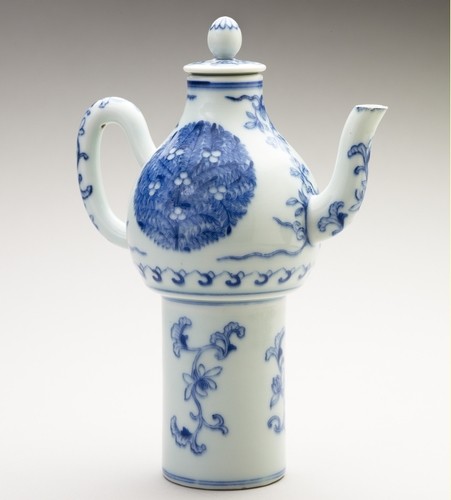
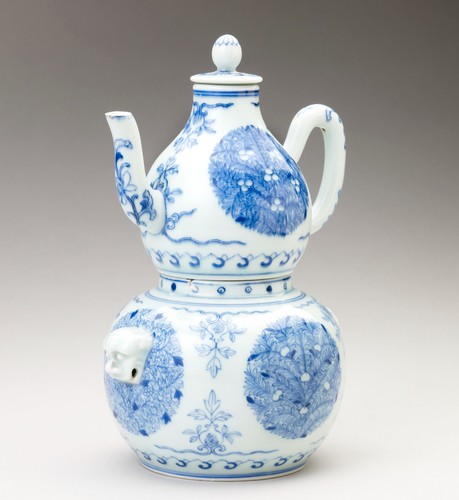
A blue-and-white Chinese porcelain wine pot with a lid and warming bowl. The small, pear-shaped wine pot with a loop handle and rising spout, with attached to the base is a tall hollow cylinder to hold the liquid; the lid is flat with a knob handle. The warming bowl in which it sits is globular with a short neck to hold it in place, a low foot, and on either side, a pair of lion-mask lugs, pierced to take cords for suspension. Painted around the sides of both vessels are medallions of feathery foliage and small fruit with leafy sprays in between, borders of circles around both feet and the mouth of the warming bowl, and leafy sprays on the handle and spout. Probably presented by George IV by Dr J.J. Garrett, surgeon aboard the East Indiaman Warley. In 1804, in company with the decorator John Crace, Garrett conveyed to George, Prince of Wales a miscellaneous collection of curious objects just acquired in China. It is possible that the wine pot was included in the same consignment.
下面这一把,是清中期(1810-1840)釉下青花带盖提梁带篮茶壶:
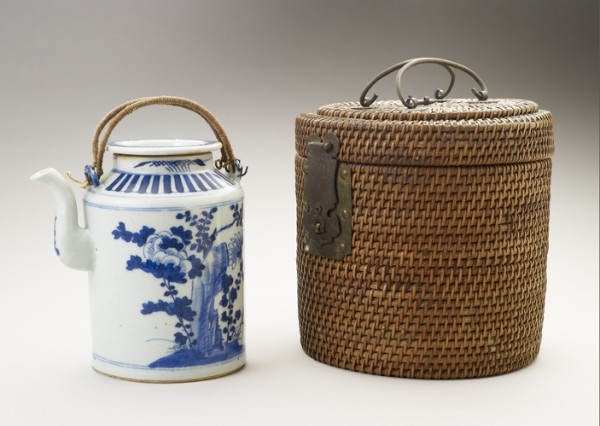
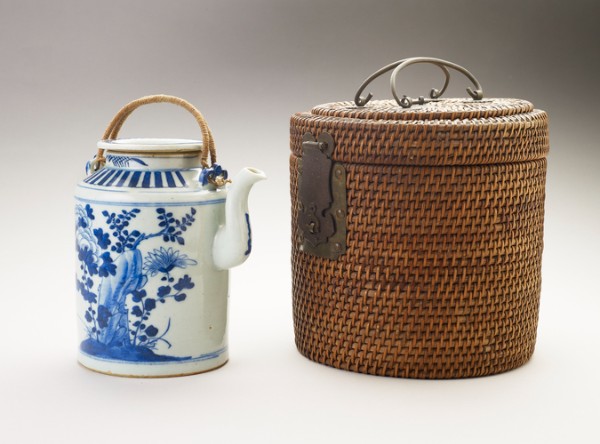
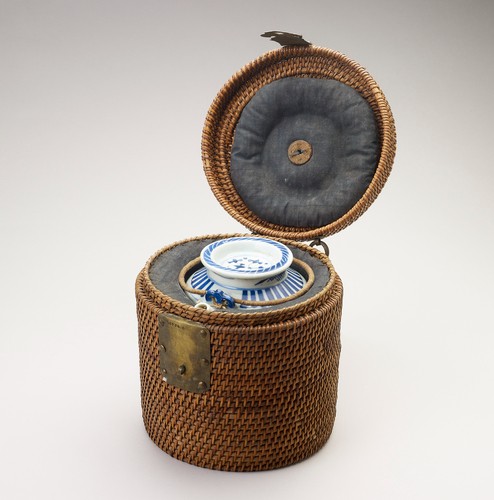
A blue-and-white porcelain teapot, cylindrical, with short curving spout attached to one side, and below the short neck, two pierced lugs on the sloping shoulder, joining which is a double-strand loop handle of metal wrapped in string; the unglazed lip supporting an infitting, dish-shaped lid with flat rim. Painted on either side are a chrysanthemum and peony growing by a rock; on the shoulder, a border of radial strokes; and on the lid, a plant spray within a blue border. The cylindrical lidded basket has a brass lock plate and a ring handle attached to the top.
再下面这两把,是五彩彷生福寿酒壶,为1847年生产的:
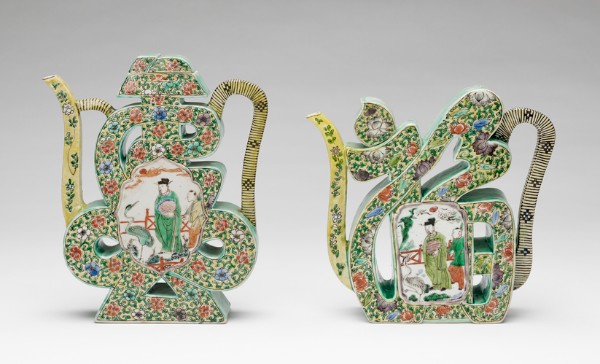
A porcelain wine pot of flattened shape, molded in openwork in the form of the Chinese character shou (long life), with a high, square loop handle painted in yellow and black with bamboo pattern, and a tall, rising spout with a bridge support, painted with flower sprays on a yellow ground. Capped with a small lid with a square hook beneath to hold it in place; the flat base is unglazed. The strokes of the character are painted with a floral scroll on a yellow ground with colored blooms, and in the center are plain panels with ribbed frames painted on either side, with scholars and attendants on a terrace. Almost certainly acquired by George IV. Listed, with RCIN 58953, as ‘A pair of Chinese character tea pots’ sent from the Royal Pavilion, Brighton, to Buckingham Palace in March 1847. The pair were exhibited at the Manchester Art Treasures exhibition in 1857.
第四把为康熙青花钟鼎纹茶壶:
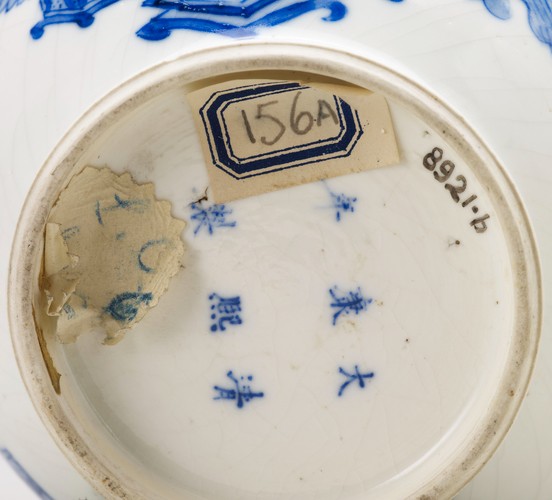
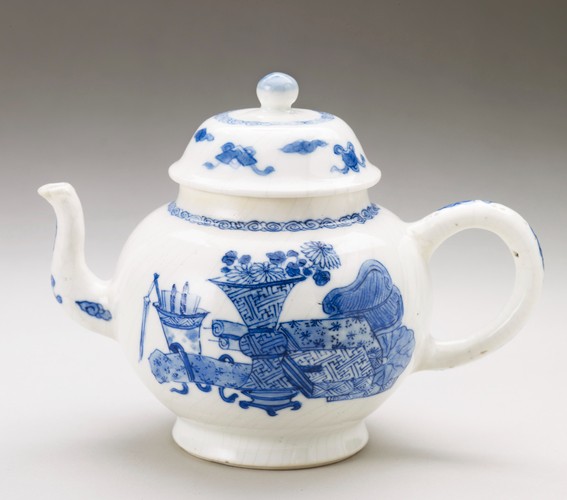
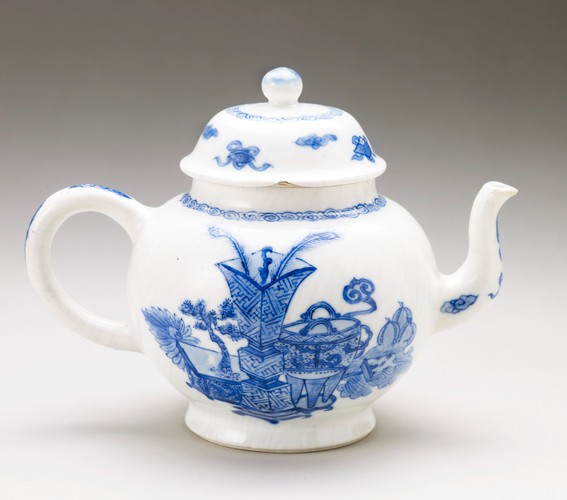
A blue-and-white soft-paste porcelain teapot and lid. Of cream-white material, possibly incorporating pegmatite; globular with short neck and slightly spreading foot, loop handle and upturned spout, the overlapping, low, domed lid with ball knob. Painted on either side is a group of precious antiques, including old bronzes, a ruyi scepter, and writing equipment; and round the neck is a ‘classic scroll’ border, with cloud patterns on the spout and handle, and on the lid a scrolling band and four Precious emblems (flaming pearl, jade stone, mirror and Artemisia leaf). The six-character reign mark is written on the base: Da Qing Kangxi nian zhi (‘Made in the reign of the Kangxi emperor of the Great Qing’).
第五把,是明末崇祯时期生产的青花执壶,最初有一对。后来落单了:
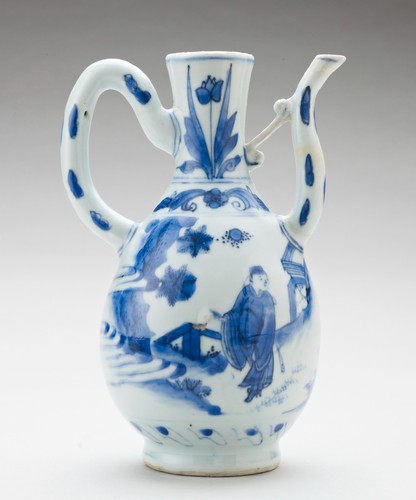
A blue-and-white Ming porcelain ewer. Pear-shaped, with a gently spreading neck and low foot. The high loop handle joins the neck and body opposite a high, curving spout attached to the neck by a bridge with coiled ends (a restoration). Painted in violet-blue in a broad band around the body is a scholar on a terrace with a servant carrying his qin (musical instrument), a willow tree, and a cliff swathed in mist. On the neck are ‘tulip’ sprays above a formal flower-spray border, and round the foot, a border of sloping panels; with cloud motifs on the handle and spout. At one time there was a second ewer, no longer extant.
第六把是明末清初景德镇生产的青花人物提梁六方酒壶,图片是张骞出使西域:
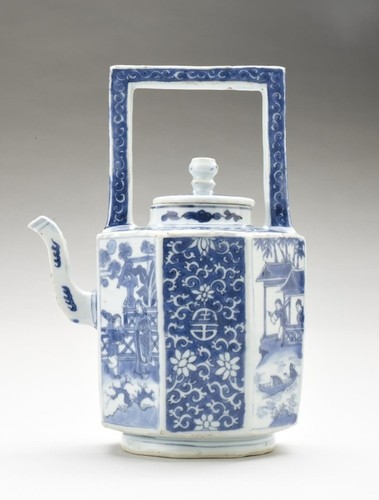
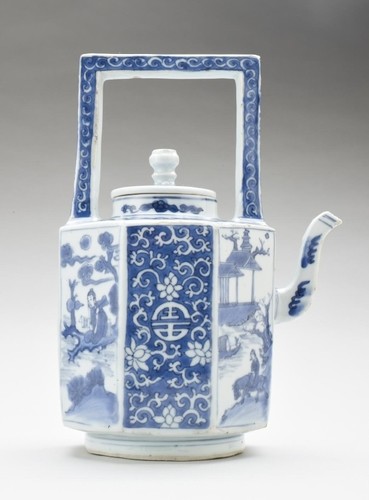
A Chinese porcelain wine vessel and cover painted in underglaze blue. With octagonal body, circular foot, and short, circular neck rising from a flat shoulder, spanned by a high, square, overhead handle; a curving, square spout on the side. The flat lid has an infitting flange and a two-tiered knob. Painted in purplish-blue on alternate faces are a shou (long life) character among lotus scrolls in white reserve and legendary figure scenes. They represent a man and a servant in a pavilion, with another in a boat below; a scholar with a servant carrying his lute; a figure on horseback near a boat and a pavilion; and a scholar seated, reading, while a tree trunk floats by with a gourd hanging from a branch, recalling the legendary voyage of the Han dynasty explorer Zhang Qian. Lotus scrolls in white reserve decorate the shoulder, and further scrolls appear on the handle together with two dragons, with flames on the spout. The two-tiered cover knob is characteristic of teapots and other vessels, including wine pots of this form, recovered from the ‘Hatcher’ wreck of c. 1643 in the South China Sea.
第七是一对康熙五彩提梁酒壶:
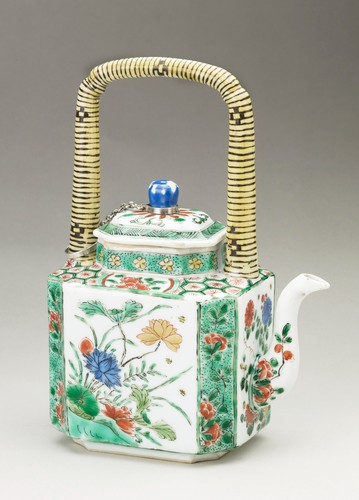
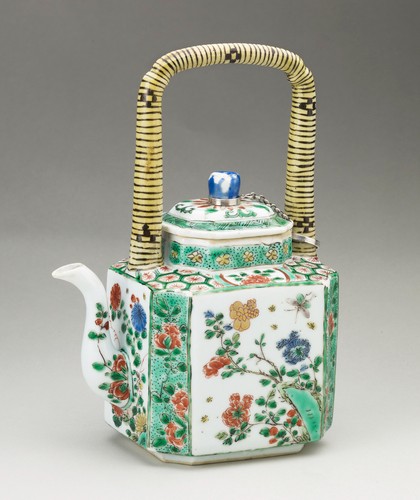
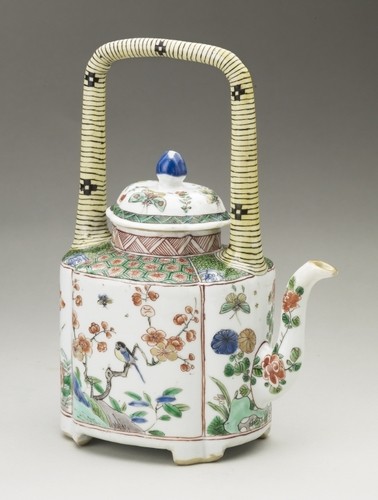
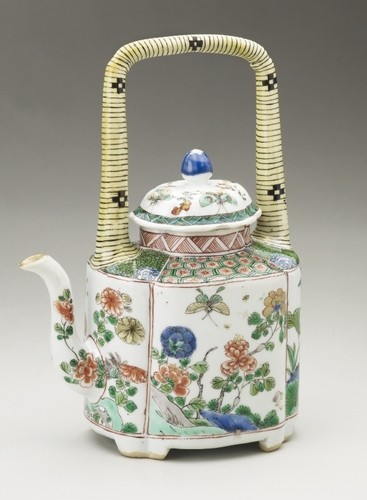
A Chinese porcelain rectangular wine pot, with straight sides indented at the corners, curving spout on one side and an overhead, inverted U-handle spanning the flat shoulder, straight neck and shallow, domed, rectangular lid. Painted on the four sides are growing peonies, chrysanthemums, lotuses and prunus, the corners with flower sprays on a seeded green ground, the shoulder with an octagonal cash-diaper design and floral cartouches in the reserves, the handle striped in black and yellow with bamboo pattern. The lid is painted to match with a blue knob, and was fitted in Europe with a metal ring for attachment to the silver-gilt chain, one end of which is fixed round the handle.
第八是一对叁足青花酒壶,一把是乾隆官窑,一把是道光官窑。是1897年光绪皇帝送给英国维多利亚女王的生日贺礼,算是重宝。当初一起奉献的,还有一个茶壶陈设的支架,被女王随手给扔了。
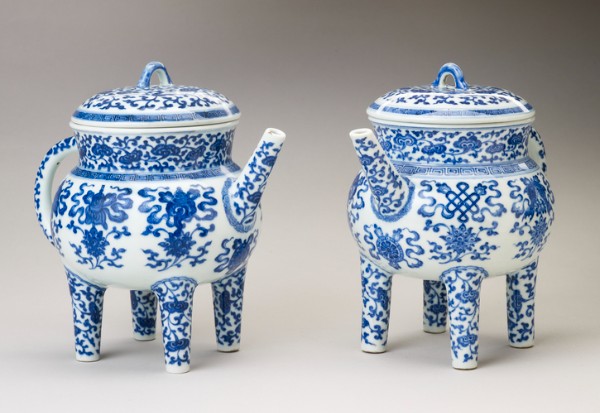
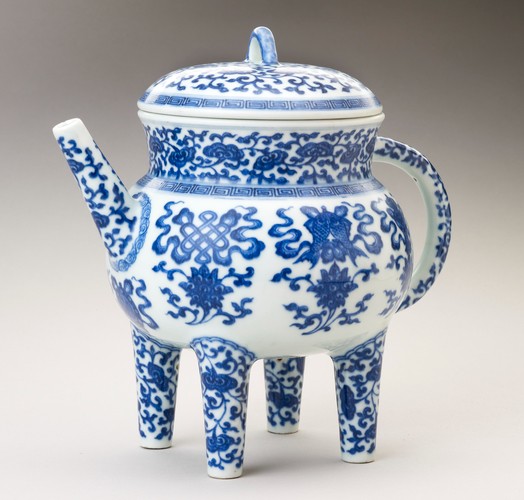
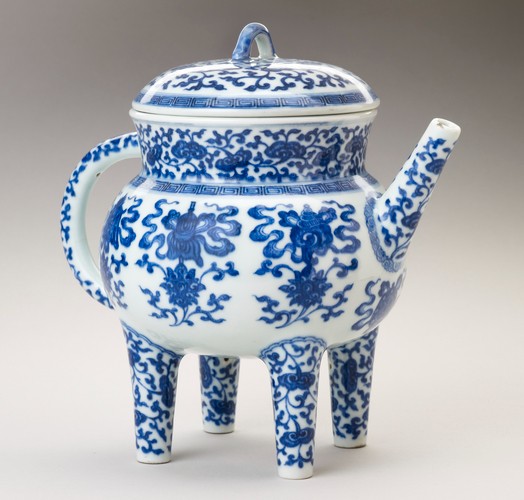
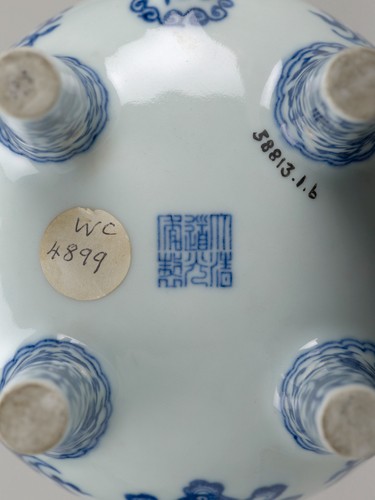
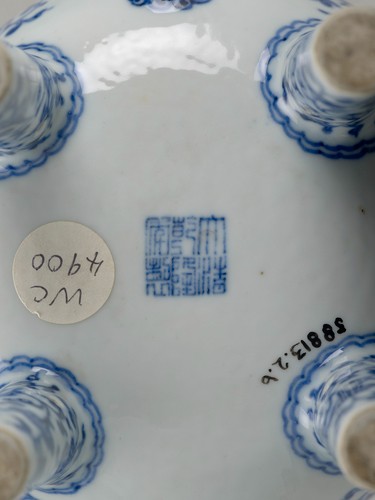
A Chinese porcelain rectangular wine pot, with straight sides indented at the corners, curving spout on one side and an overhead, inverted U-handle spanning the flat shoulder, straight neck and shallow, domed, rectangular lid. Painted on the four sides are growing peonies, chrysanthemums, lotuses and prunus, the corners with flower sprays on a seeded green ground, the shoulder with an octagonal cash-diaper design and floral cartouches in the reserves, the handle striped in black and yellow with bamboo pattern. The lid is painted to match with a blue knob, and was fitted in Europe with a metal ring for attachment to the silver-gilt chain, one end of which is fixed round the handle. Presented to Queen Victoria on the occasion of her Diamond Jubilee in 1897 by Guangxu, Emperor of China (1971-1908). Identifiable as no.12 ;in a list of Diamond Jubilee presents: 'Two Blue and White Porcelain Tea-pots on Stands' (Royal Archives F&V/JUB/1897). Seen in the sketch drawings of the Emperor's Diamond Jubilee presents, as ‘Two Porcelain Vases Blue on White Ground’. The stands, which were square, do not survive.
第九把也是一对五彩姊妹花彷生大吉酒壶:
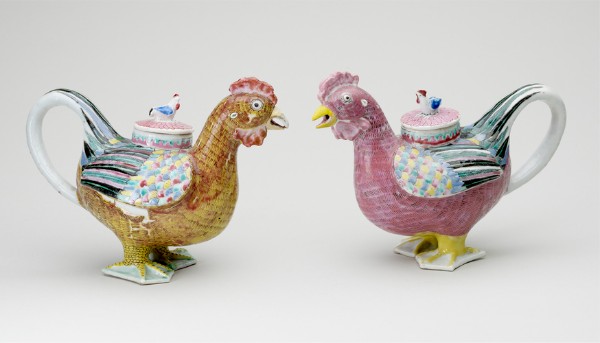
A pair of Chinese porcelain ewers and covers in the shape of small hens standing on flat, webbed feet, the looped tails forming a handle, with an orifice within the beak serving as a spout. On the top, is a large circular orifice for filling, with a flat-topped cover and knob molded in the form of a chick. The two hens have yellow-and-brown (RCIN 3602.1) and rose-pink (RCIN 3602.2) feathers, red (RCIN 3602.1), and pink (RCIN 3602.2) wattles, and a yellow beak; the folded wings with variously colored feathers, and black and green for those extending over the tail. Following the popularity of the blanc de Chine figures imported into Europe by the end of the seventeenth century, a great variety of figures were produced to attract this market, many of them based on Western models.
第十把,算是一个真正的康熙五彩茶壶,可是有修。
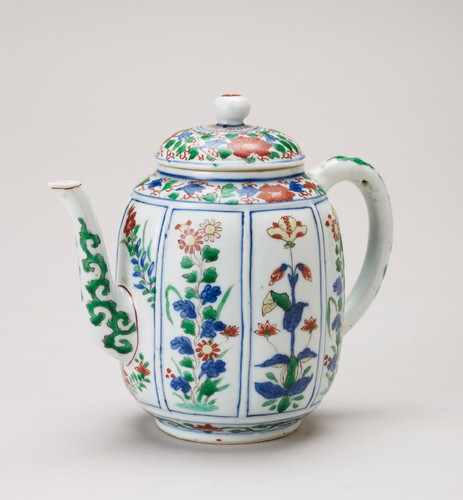
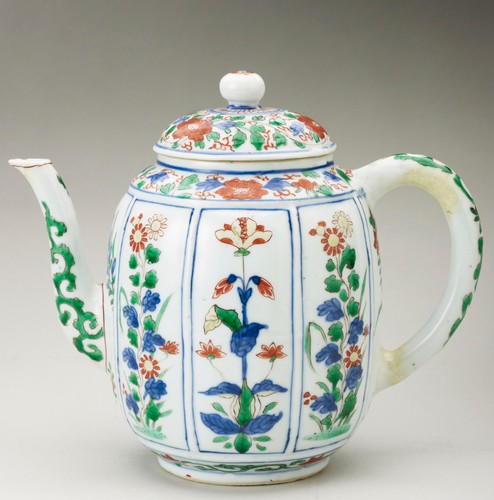
A Chinese porcelain teapot and lid in Japanese style. Melon-shaped in eight lobes, with a loop handle and curving spout; the low, domed lid with a ball knob finial. The decoration, in underglaze blue and famille verte enamels, follows the style of Japanese Arita porcelain ('Kakiemon style'). Painted within the upright lobes, outlined in blue, are panels containing various flower sprays, including chrysanthemum and lotus. Below is a lotus-scroll border and, on the shoulder, one of peony; the handle and spout are decorated with green Karakusa (Japanese term which means ‘Chinese grass’). On the lid is a band of peony scrolls to match the shoulder.
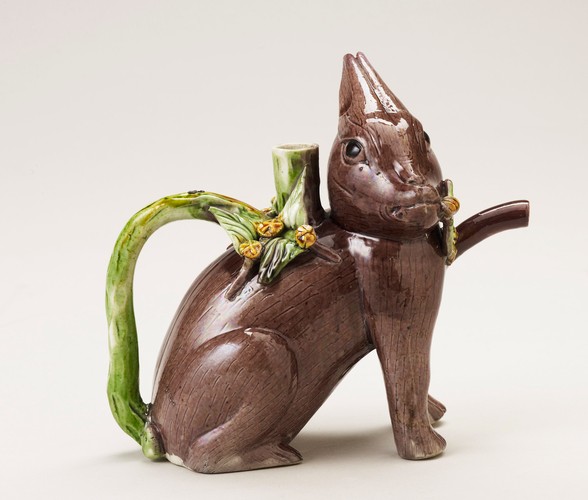
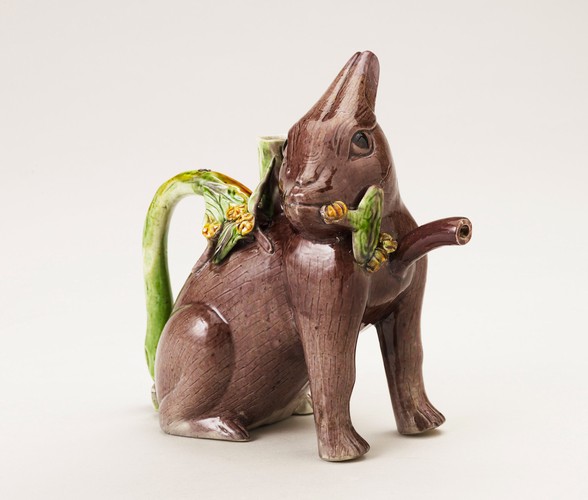
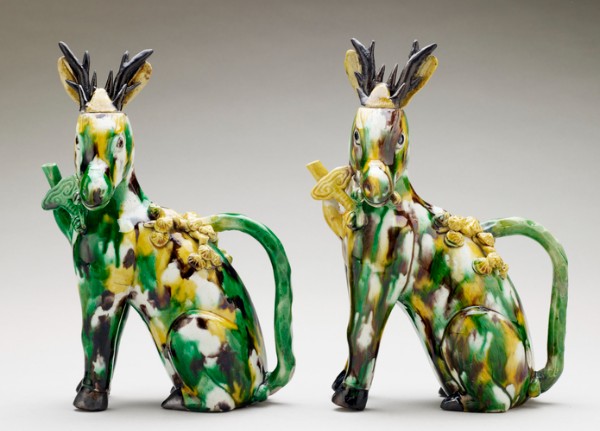
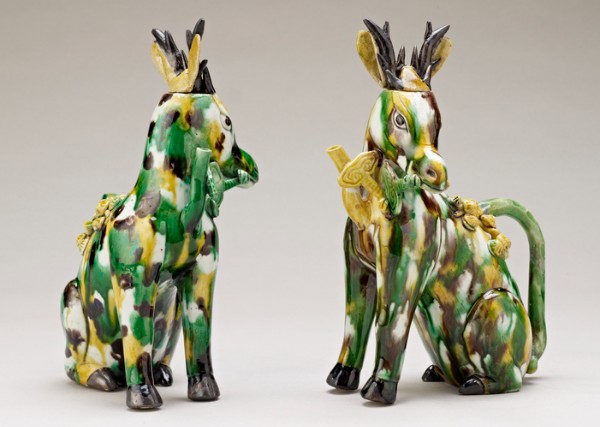
第十一,又是叁把彷生瓷,活泼可爱,精美绝伦:
第十二,是一把金属壶,也是清政府送给英国皇室成员的礼物:
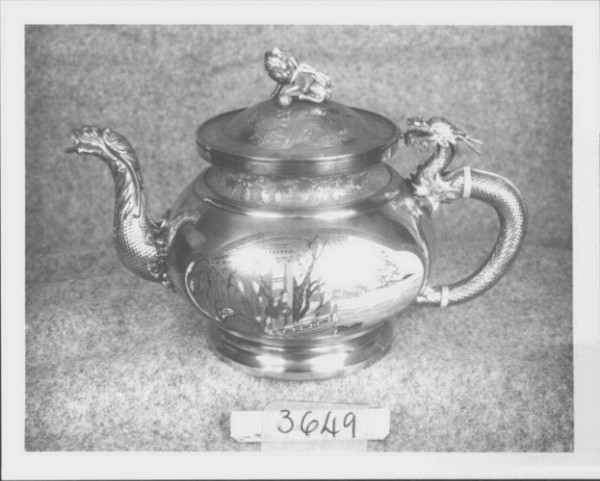
Gilt metal cloisonné teapot with hinged lid, dragon handle, and dolphin spout; the domed lid with Chinese dog finial, incised dragons, and key pattern. The body of the teapot is decorated with two enameled reserves, one dark blue with lotus flowers, the other with a Chinese landscape with figures. Given to King George V and Queen Mary by Prince Tsia Chen, the Chinese representative at their Coronation. Presented to Queen Mary, June 1911.
第十叁十四,是两对明朝青花太平有像纹的军持:
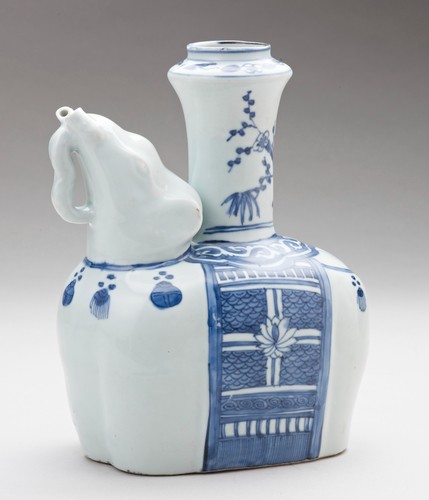
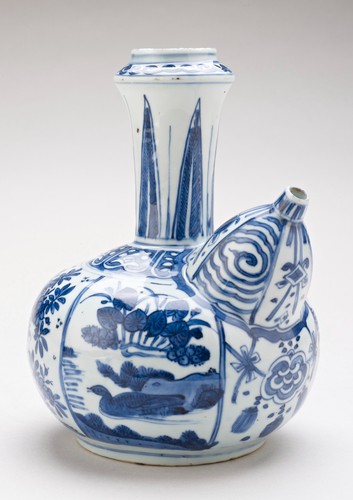
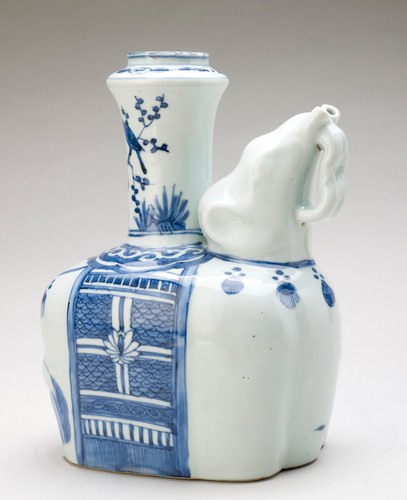
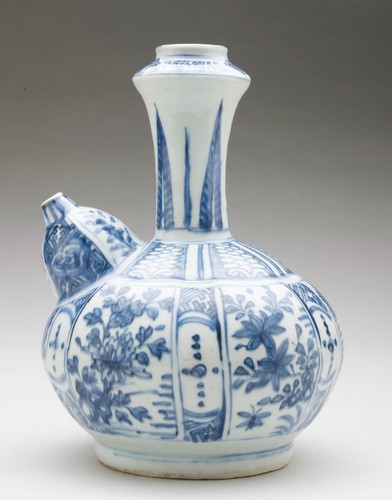
A pair of Ming blue-and-white pouring vessels (kendi). Each loosely modelled on the form of an elephant, the body bowed at the chest and rear, with the tail curling on the right flank, bearing on its back a tubular filler with flanged top and small mouth, the animal with a small head ending in twin shortened, tusk-like spouts with a loop below for suspension; the base flat and unglazed. Painted in a rather purplish blue, with a fringed saddlecloth over the sides, patterned on RCIN 1167.1 with a lotus flower over a white cross reserved on a scale ground, and on RCIN 1167.2 on a ground of key-fret, both having a cord with decorative pendants round the neck, and at the base of the filler on the first, a scroll in white reserve, with a bird on a prunus spray above, and on the second, somewhat taller, a pointed leaf border.
The kendi was popular in south-east Asia as a water vessel used for the ritual pouring of libations (the term is derived from the Sanskrit kundika, a vessel usually having a taller neck), and many examples in plain or animal form were included in exports to Europe. A very similar kendi was recovered from the wreck of the San Diego, which sank in 1600 outside Manila Bay.
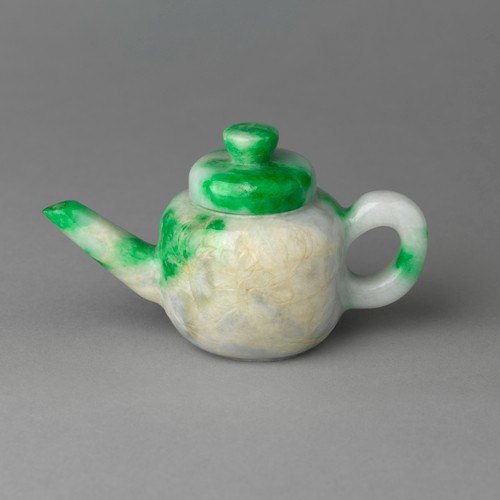
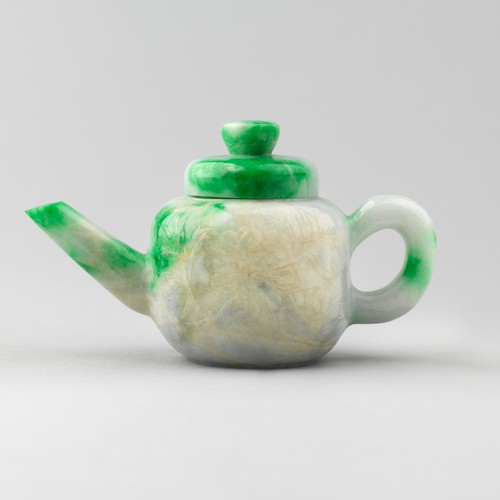
第十五,是一把翡翠酒壶:
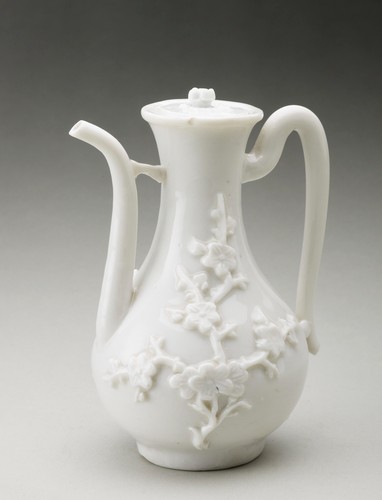
第十六,是六把精美绝伦的德化窑白瓷茶壶:
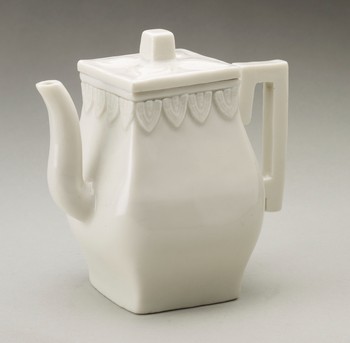
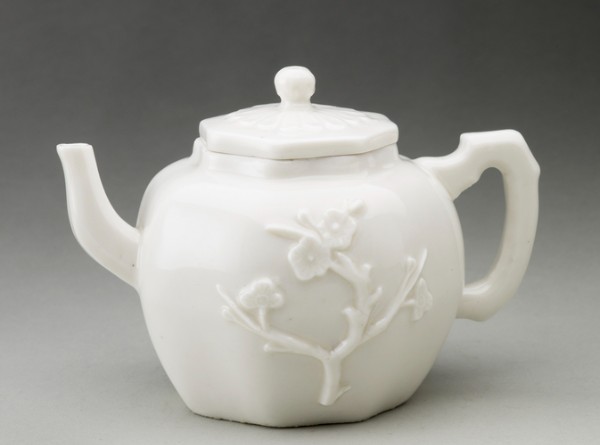
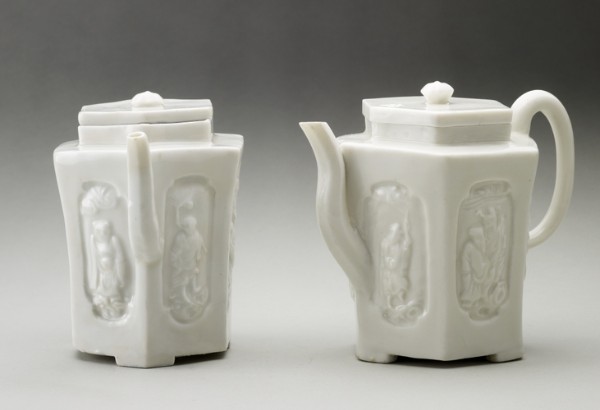
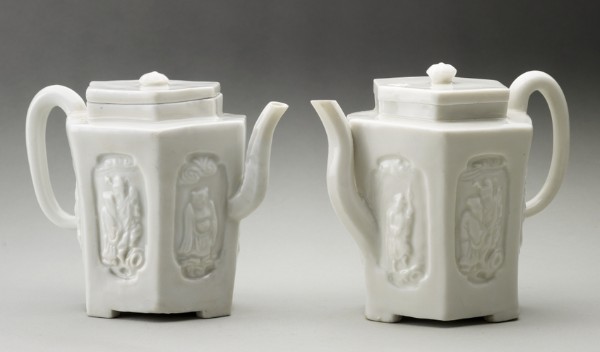
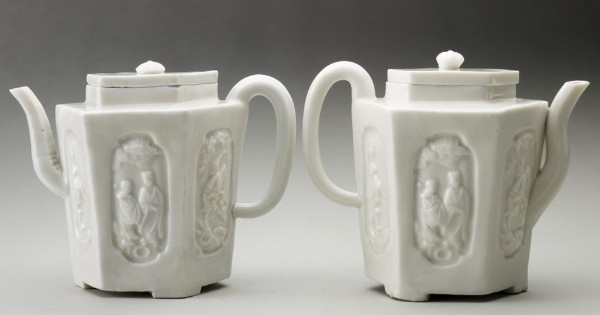
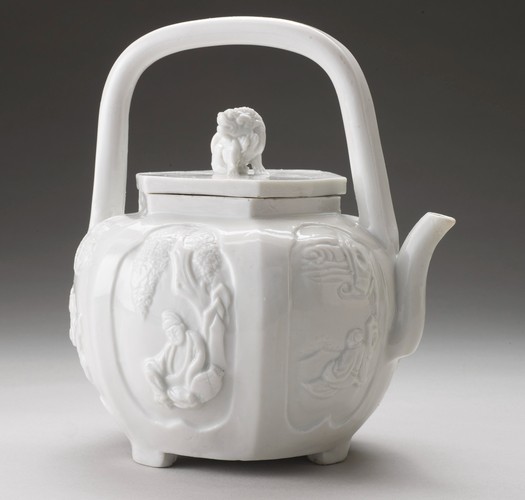
按理说,女王收藏的中国茶壶,应该绝不止于这十六种。假以时日,我们或许,能看到更多。。。。。。例如下面这一把,已不属于传统意义上的景德镇的产品,应该算是废物利用,或者说是中西合璧:
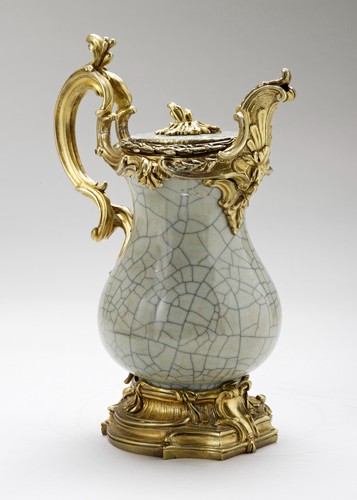
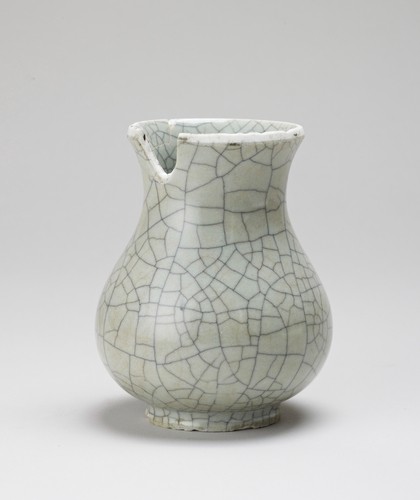
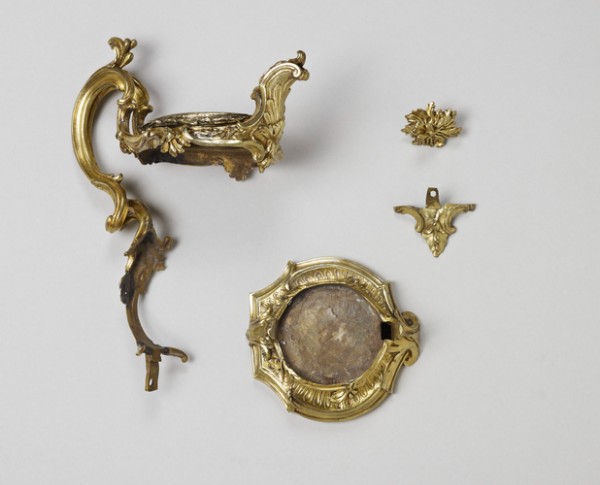
A pear-shaped open-mouthed vase with ring foot and glazed base, with a broad crackle in a pale, near-white glaze. The gilt-bronze mounts which were made in France circa 1750 or perhaps later, turn this vase into an ewer. The base is set in a spreading, gadrooned foot with rococo gilt bronze scrollwork, and the mouth mounted in a band of leafy scrollwork with a scrolled spout attached at one side, opposite an open acanthus scroll loop handle with leaf knop, twisted below with an extension running down the side to join the foot. A section cut from a similar crackle-glazed plate is mounted on top as a hinged lid, also mounted with a gilt-bronze finial. Possibly acquired by George IV, the ewer and its accompanying bowl (RCIN 16) are noted in Jutsham Receipts 'Mr. Colnaghi. A Small Old Fashioned Crackly China Ewer and Cover Mounted in Or Molu 7 1/2 inches high. A-Basin belonging to the Above Mounted in Or Molu 5 inches high & 8 1/2 inches Broad...'. Colnaghi's invoice for these and a further two crackled jars (RCIN 2311.1-2) is dated 5 April 1818, for a total of £52.10.0' (National Archives LC 11 25). It was subsequently inventoried at Brighton as ‘A Bason & Ewer of old Crackle, mounted w. ormolu scroll lips, handles and bases, twelve inches’(1829B ). It was sent to Buckingham Palace in March 1847 (1829A ).
还有这一对,也是中西合璧:
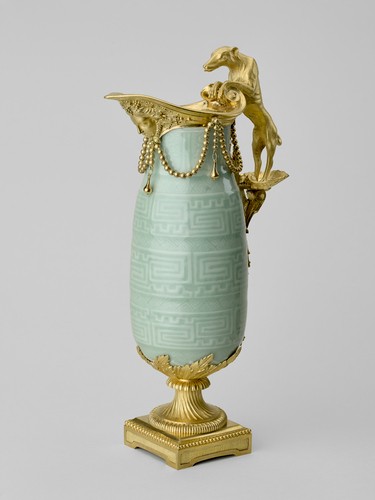
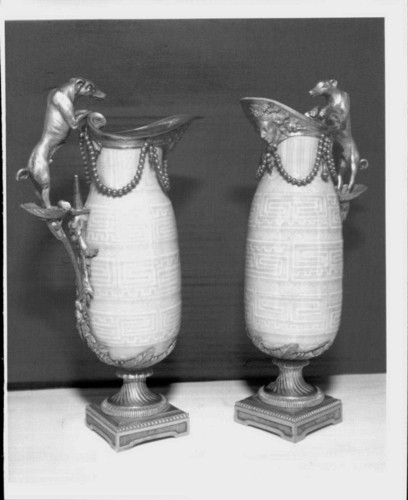
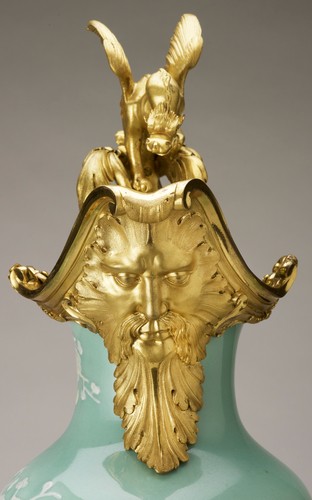
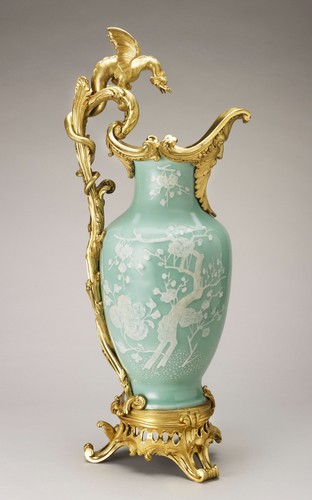
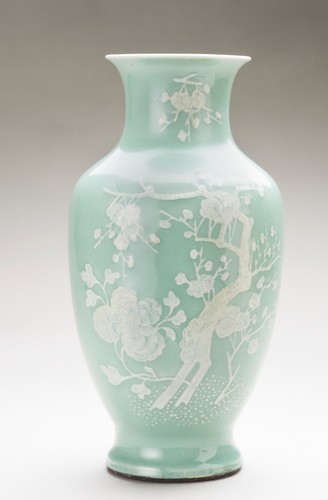
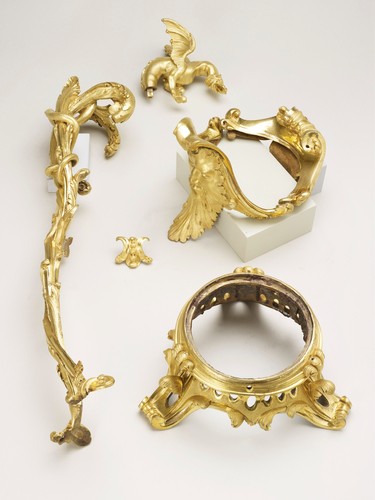
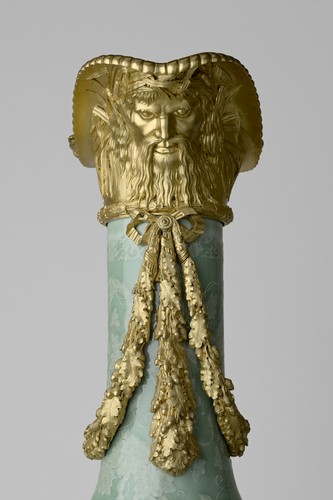
Slender, ovoid vases of Chinese porcelain with rare decoration with French gilt bronze mounts, inverted, with the small neck and mouth, removed, molded-in archaic bronze style, with three bands of bold key-fret on a lozenge-diaper ground, lotus-petal panels on the sides, tapering to the former foot and petal border on the rounded shoulder. The inverted vase with top rim covered with a projecting spout, molded beneath with a Bacchante mask decked with foliage, with beaded swags hanging down the sides. The handle in the form of a standing hound, with snout and paws perched over a boat-shaped cup, the hound standing on a shell supported by a truss; running down the side is a ribbon-tied crossed berried laurel swag, surmounted by a table and a hexagonal obelisk. The vase is held in an acanthus-leaf cup, supported on a spirally fluted stem, with ribbed torus molding on a square plinth with a beaded edge, reeded recessed side panels, and short bracket feet.
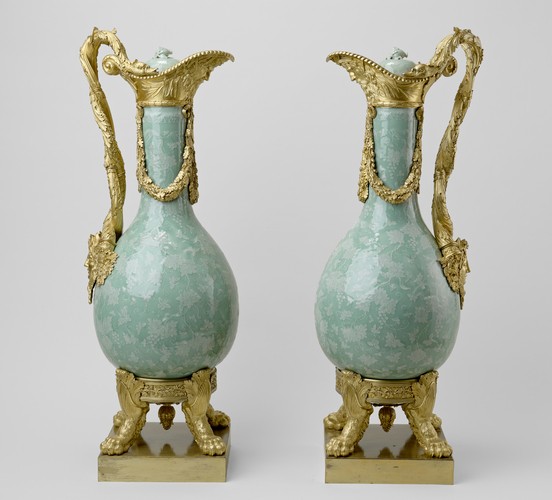
The monochrome grey-green celadon glaze which had been a staple of the Longquan kilns for centuries during the Ming period and earlier was taken up by the porcelain factories of Jingdezhen in the seventeenth century; and from the reign of Kangxi (1662–1722) onwards, wares of distinction were made in this style, frequently with reticent incised decoration. They were among those which the Marchand-mercies of Paris most often sought out for mounting in gilt bronze, and many fine examples of their art, together with that of English bronze makers, displayed to effect at the Royal Pavilion, Brighton, were brought together by George IV.
像此类中西合璧的瓷器,在普普通通的瓶瓶罐罐观赏器中,安个把,装个流,变成金碧辉煌的实用器,在女王的收藏中,不是孤例,俯暇可见。
|