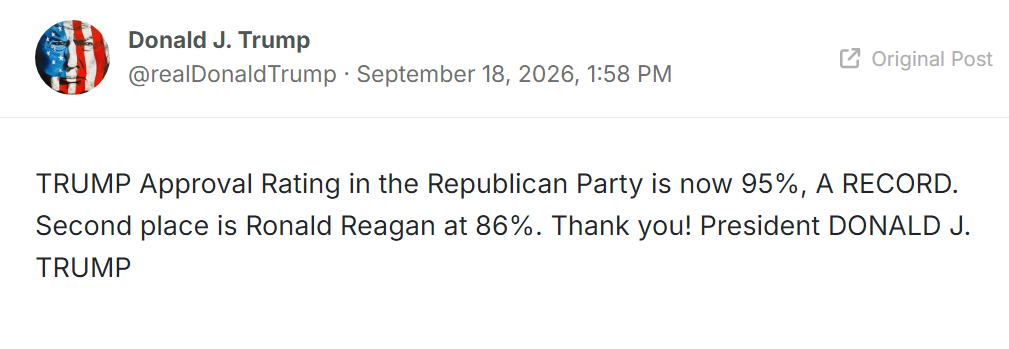
美国右翼媒体 Washington Examiner 惊天爆料, 川普将要与他的亲密好基友习总达成协议: 美国放弃台湾 中国放弃委内瑞拉与古巴 中美共同统治世界 
啥?中国只要放弃古巴与委内瑞拉,就能得到台湾?这交易,感觉习总与中共完胜川普与MAGA。 极端憎恨中共与中共国的毒晕轮,如何看待呢? 尤其是狂热挺川的台毒,会不会哭晕在厕所? 老川老习若真想达成交易,一定会赶在11月份美国中选之前。因为按照目前的选情, 共和党极大可能会全军覆没。一旦民主党掌控参院与众院,川普将会变成瘸脚总统。一事无成。 另外,Washington Examiner 绝不是川普口中的菲克牛死(左媒),是一家严肃的右翼政论媒体。 
ZT:President Xi Jinping’s upcoming meeting with President Donald Trump in Washington, D.C., on Sept. 24 provides a perfect opportunity to kick-start a mutually beneficial strategic reset aimed at forging an enduring modus vivendi between China and the United States. The key would be ensuring that over the next two years, the Chinese footprint within the U.S. and its sphere of influence is di minimis, and likewise the American footprint within China and its sphere of influence is insignificant. If the meeting is to be more than political theatre, there must be a concrete, deliverable bargain that would be consummated over the next two years.
Trump would announce that, effective Dec. 31, 2028, the U.S. would 重点!重点!重点!看川普如何卖台: (1) cease deliveries of military equipment and supplies to Taiwan ; (2) close down the office of the American Institute in Taiwan; (3) no longer consider the Senkaku Islands to be within the scope of the U.S.-Japan mutual defense treaty. Xi would announce that over the next two years ending Dec. 31, 2028: (1) all companies operating in Venezuela that are ultimately owned or controlled by Chinese enterprises will cease operations (or sell their ownership stakes to non-Chinese entities approved by the appropriate Venezuelan authorities); (2) Chinese entities would purchase energy and agricultural products from entities ultimately owned or controlled by U.S. enterprises in an aggregate amount at least equal to $30 billion (to be paid in the form of official Venezuelan debt held by Chinese entities valued at par and the balance in U.S. currency); and (3) all companies operating in Cuba that are ultimately owned or controlled by Chinese enterprises will cease operations (or sell their ownership stakes to non-Chinese entities approved by appropriate Cuban authorities). Both Trump and Xi would be acknowledging difficult geostrategic realities. From the U.S. perspective, Trump would be conceding that Taiwan’s unification with China does not pose a threat to U.S. vital national interests. Sovereignty over the Senkaku Islands (equidistant between Taiwan and Japan), which is under Tokyo’s administrative control, is claimed by Taiwan, China, and Japan. The U.S. has never taken an official position with respect to the sovereignty claims over the Senkaku Islands. Trump would be conceding the obvious: the Senkaku Islands are not a U.S. vital national interest. From China’s perspective, Xi would be conceding that access to Venezuela’s energy resources is not a vital national interest. Cuba, which has no strategically important natural resources, manifestly is not a Chinese vital national interest. Venezuela and Cuba are U.S. vital national interests. Taiwan and the Senkaku are vital to China’s national interests. The suggested bargain would be mutually beneficial and would pave the way to a modus vivendi. The Sept. 24 meeting should also lay out a framework for a modus vivendi: (1) a clear understanding of America’s and China’s view of the geographic scope of the respective spheres of influence; (2) parameters for economic decoupling; and (3) an understanding of the geographic scope of respective strategic partners (and their associated spheres of influence) — for example the EU, Russia, Iran; and (4) a better understanding of the geographic scope of neutral zones where American and Chinese companies are likely to compete — for example, countries in Southeast Asia, South Asia, and Africa. These four topics would be fleshed out over the course of a year and set the agenda for a Trump-Xi summit meeting in September 2027 in Beijing.
|