| | 海斯勒:重返江城
(Return to River Town)
剛收到最近一期(2013年3月)的國家地理雜誌(National Geographic), 上面刊登了彼得海斯勒(Peter Hessler)的文章:“重返江城 (Return to River Town)”。
1996年,一位叫做彼得海斯勒(Peter Hessler)的美國人作為和平隊(Peace Corps)的自願者被派到長江邊上的城市涪陵(四川),教授了兩年英語。回到美國後,他寫出了400頁的《江城》(River Town: Two Years on the Yangtze ),記錄他在涪陵生活的所見所聞。當他最初把《江城》的書稿投送到好幾家出版社時,都被退稿。九十年代的美國,大多數人對中國還不是特別感興趣,一位編輯坦誠地告訴他,“我們不認為有人會讀一本關於中國的書”。彼得最終還是找到了一家出版社出版《江城》,此書出版後成了最暢銷書籍。自《江城》後,彼得海斯勒又寫了兩本以中國為主題的書,不過最有名的還是那本《江城》,曾獲得桐山環太平洋圖書獎 (Kiriyama Pacific Rim Book Prize)。 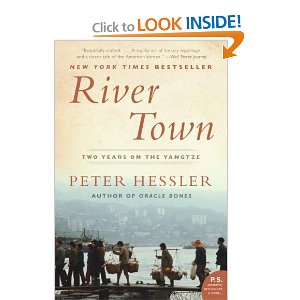
彼得海斯勒的書描寫的都是普通人的生活。他的描寫細緻,真實,文字略帶幽默,視角獨特,很有可讀性。在這期國家地理雜誌上的文章里,彼得講述了《江城》的後續故事:他重返涪陵的見聞。帶着對涪陵的感情,彼得的筆穿梭在九十年代和現在的時空之間,講述了涪陵城市的變化,三峽大壩,以及人的變化。在《江城》一書中彼得曾經詳細地描繪了他的很多學生,這次重返他跟其中的好些人見了面,敘述了他們這些年的生活,從中可以了解中國的改革開放給老百姓的生活帶來的變化。
由於《江城》一書有些關於涪陵的貧窮和城市污染的真實描述,該書出版後彼得以為他自己將不再會受到歡迎,不可能回訪涪陵。沒想到中國的快速變化也轉變了人們的觀念,彼得海斯勒回到涪陵後,當地官員與他會面,感謝他為涪陵作了宣傳。彼得的解讀是涪陵的變化給予了人們自信。 如今,《江城》中九十年代的涪陵景象由於時間的距離,已經定格成了一張黑白照片。如果你曾經讀過《江城》,並且喜愛那本書,你應該會有興趣閱讀彼得海斯勒的這篇文章(原文轉貼如下)。
Return to River Town In 1996 a Peace Corps volunteer arrived in Fuling, a sleepy town on the Yangtze, to teach English. He went back recently to find the landscape—and his former students—transformed. By Peter Hessler Photograph by Anastasia Taylor-Lind There is excellent cell phone coverage at the bottom of the Yangtze River, although Huang Dejian is one of the few people who know this. He’s the director of the new White Crane Ridge Underwater Museum, and today his phone rings constantly at a depth of 130 feet. The museum is the strangest sight in the city of Fuling—visitors enter via a 300-foot-long escalator encased in a steel tube, like a massive straw dipped into the muddy Yangtze. “This is the most expensive museum in the Three Gorges region,” Huang says, answering his phone again. The ringtone is a woman’s voice that urgently repeats the phrase “Jia you—go, go, go, go, go!” The last time I saw Huang, this was all dry land, and the $34 million museum didn’t exist, and the Three Gorges Dam was still under construction 280 miles downstream. I lived in Fuling from 1996 to 1998, when I was a Peace Corps volunteer at the local college. Back then the population was around 200,000, which was small by Chinese standards. Most people strongly supported the dam, although they didn’t talk about it much. It was scheduled for completion in 2009, which seemed an eternity in a place where so much was already happening. In China the reform era had begun in 1978, but it wasn’t until the mid-1990s that free market ideas started to have a major impact on smaller cities like Fuling. Locals coped with overwhelming change: the end of government-assigned jobs, the sudden privatization of housing. In those days the White Crane Ridge gave me a different perspective on time. The strip of sandstone emerged only in winter, when the water level dropped. Low-water season was treacherous for boatmen in ancient times, and somebody carved two fish into the side of the ridge. They served as a gauge, allowing pilots to anticipate the shoals and rapids downstream. Locals associated the stone fish with good fortune, and it became a tradition to mark their annual emergence with a carved message. The earliest dated engraving was from A.D. 763, during the Tang dynasty, and eventually more than 30,000 characters decorated the sandstone. The calligraphy was stunning, and messages had the rhythm of incantations: “The water of the river retreats. The stone fish are seen. Next year there will be a bumper harvest.” In the 1990s admission to the ridge was three yuan, about 35 cents, which included a ride on a rickety sampan manned by an off-season fisherman. Huang Dejian used to sit on the ridge for hours, wrapped in a surplus People’s Liberation Army overcoat. He would note the water level and tell stories about the most famous carvings. During one of my last visits, on January 30, 1998, the Yangtze was exactly two inches higher than it had been at the time of the first inscription in 763. Two inches in 1,235 years—that put the changes of the reform era in a new light. Time moved differently on the river. The Yangtze remained a creature of cycles, even as life along the banks marched to the straight line of history and progress. And both kinds of time, natural and human, intersected at the White Crane Ridge every year. The river retreated; the words emerged; the messages and dates lined up neatly on the rock. And then the spring snowmelt would come, and the water would rise, and all that history would disappear once more beneath the timeless river. Now that the dam is closed, the Yangtze no longer falls anywhere near the old levels. To protect against the high water of the reservoir, Fuling has surrounded itself with a dike that is nearly three miles long and 190 feet tall. The White Crane Ridge Museum is set into the side of this massive concrete wall. Today Huang Dejian takes me to the underwater viewing gallery, where portholes face the submerged ridge. The scene is dreamlike: I recognize places where I once stood and engravings that I touched. But even familiar words seem to have a new meaning: “Pillar Rock in Midstream,” “The River Runs Forever.” What’s the significance of these inscriptions now that they lie 20 fathoms deep? Huang Dejian smiles when I ask if he ever feels a sense of loss. His days of sitting on a cold Yangtze rock are long gone, and so is the People’s Liberation Army overcoat; today he wears a neat gray suit. In addition to handling the constant phone calls, he’s juggling my visit with that of a China Central Television film crew. “They weren’t able to do this at the Aswan Dam in Egypt,” he tells me, noting that Egyptian authorities had to move relics before they were flooded. “It makes me proud. I don’t have any feeling of loss when I come here; I feel like it’s a success. We were able to build the Three Gorges Dam and also successfully protect the White Crane Ridge.” And then Huang heads off to the television crew, and his cell phone rings its modern incantation: “Go, go, go, go, go!” Fuling sits at the junction of the Yangtze and the Wu Rivers, and in the mid-1990s it felt sleepy and isolated. There was no highway or rail line, and the Yangtze ferries took seven hours to reach Chongqing, the nearest large city. Foreigners were unheard of—if I ate lunch downtown, I often drew a crowd of 30 spectators. The city had one escalator, one nightclub, and no traffic lights. I didn’t know anybody with a car. There were two cell phones at the college, and everyone could tell you who owned them: the party secretary, the highest Communist Party official on campus, and an art teacher who had taken a pioneering step into private business. In those days Fuling Teachers College was only a three-year institution, which placed it near the bottom of Chinese higher education. But my students were grateful for the opportunity. Nearly all of them came from rural homes with little tradition of education; many had illiterate parents. And yet they majored in English—a remarkable step in a country that had been closed for much of the 20th century. Their essays spoke of obscurity and poverty, but there was also a great deal of hope: “My hometown is not famous because there aren’t famous things and products and persons, and there aren’t any famous scenes. My hometown is lacking of persons of ability ... I’ll be a teacher, I’ll try my best to train many persons of ability.” “There is an old saying of China: ‘Dog loves house in spite of being poor; son loves mother in spite of being ugly.’ That [is] our feeling. Today we are working hard, and tomorrow we will do what we can for our country.” My students taught me many things, including what it meant to come from the countryside, where the vast majority of Chinese lived at the beginning of the reform era. Since then an estimated 155 million people have migrated to the cities, and my students wrote movingly about relatives who struggled with this transition. They also taught me about the complexities of poverty in China. My students had little money, but they were optimistic, and they had opportunities; it was impossible to think of such people as poor. And Fuling itself was hard to define. The Three Gorges Dam could never have happened in a truly poor country—Beijing reports that the total investment was $33 billion, although some unofficial estimates are significantly higher. But memories of recent poverty helped make the dam acceptable to locals, and I understood why they desired progress at all costs. My apartment was often without electricity for hours, and over-reliance on coal resulted in horrible pollution. After finishing my Peace Corps assignment, I returned to my parents’ home in Missouri and tried to record that moment in Fuling. After completing a 400-page manuscript—I called it River Town—I sent it out to agents and publishers, nearly all of whom rejected it. In the 1990s China hadn’t yet entered the consciousness of most Americans. One editor said frankly, “We don’t think anybody wants to read a book about China.” But I eventually found a publisher, and that was when I began to worry about how locals would respond to the book. The Chinese had always been extremely sensitive about how their country was portrayed by foreigners. Even in remote Fuling, I heard people speak angrily about books and films that they believed had emphasized Chinese poverty. When I began editing my manuscript, I sent a draft to a student named Emily, and most of her responses were positive. But sometimes she sounded a note of disappointment: “I think no one would like Fuling city after reading your story. But I can’t complain, as everything you write about is the fact. I wish the city would be more attractive with time.” The balancing act seemed impossible. I wanted to show my affection for Fuling, but I also needed to be honest about the pollution, the dam, and the problems I sometimes had as a foreigner. In the end I accepted the possibility that I wouldn’t be welcomed there again. But I hadn’t imagined how fast the place would change. By the time River Town was published in early 2001, the city’s first highway had been completed, rendering the Yangtze ferries obsolete. Two more new highways would follow, along with three train lines. Because of the Three Gorges project, large amounts of central government money flowed into Fuling, along with migrants from low-lying river towns that were being demolished. (All told, more than 1.4 million people were resettled.) In the span of a decade Fuling’s urban population nearly doubled, and the college was transformed into a four-year institution with a new campus and a new name, Yangtze Normal University. The student body grew from 2,000 to more than 17,000, part of the nation’s massive expansion in higher education. Meanwhile, Americans began to take new interest in China, and River Town became a surprise best seller. I heard that an unofficial translation was commissioned in Fuling, with access limited to Communist Party cadres. But I never learned how the government reacted to the book. This is my first visit back in more than five years, and it’s the first time I’ve been invited to meet with a high-level official. At the Fuling District Government office, I wait for Vice-Director Liu Kangzhong, who has been preceded by an entourage of eight officials. The men sit in a line along one side of a conference table; I am alone on the other side. My attempts at small talk are unsuccessful. The room falls silent, and I realize that even in a Chinese boomtown there are moments when time moves very slowly. Finally one of the cadres clears his throat. He says, “Have you sold a million copies of your book yet?” This wasn’t the question I expected, but it’s easy to answer: No. “Are they making a movie about it?” I say that there has been some talk but nothing more. “It would be hard to make a movie of that book,” he says. “Fuling looks completely different from when you lived here. They wouldn’t be able to find places to film that looked like it did in those days.” Everybody stands up when Vice-Director Liu arrives. He’s in his early 50s but looks younger, a fine-featured man with gelled black hair. He distributes a round of Emperor cigarettes to his entourage, and then he recites the kind of statistics that you hear only in China. For the past five years Fuling’s GDP has grown at an annual rate of 20 percent, and the city plans to add another 300,000 residents by 2015. A new factory district has attracted more than three dozen foreign-invested firms, including several that produce battery cells for cars and computers. All local cabs and buses now run on natural gas, in order to reduce pollution. To the west, the government is building a new satellite city, which will be three times as large as the Fuling I remember. “We’ve opened our eyes,” Liu says. “When I was in school in the 1970s, we couldn’t communicate with outsiders. China has been an open country for a while now, and we have a sense of what foreigners think. I’ve read some of your book.” He continues: “Thank you for giving us xuanchuan.” The word can be translated in different ways; sometimes it means “publicity,” and sometimes it means “propaganda.” Vice-Director Liu smiles and says, “Fuling is a good example of a Chinese city for Americans to know about.” The writer’s vanity likes to imagine permanence, but Fuling reminds me that words are quicksilver. Their meaning changes with every age, every perspective—it’s like the White Crane Ridge, whose inscriptions have a different significance now that they appear in an underwater museum. Today anybody who reads River Town knows that China has become economically powerful and that the Three Gorges Dam is completed, and this changes the story. And I’ll never know what the Fuling residents of 1998 would have thought of the book, because those people have also been transformed. There’s a new confidence to urban Chinese; the outside world seems much less remote and threatening. And life has moved so fast that even the 1990s feels as nostalgic as a black-and-white photo. Recently Emily sent me an email: “With a distance of time, everything in the book turns out to be charming, even the dirty, tired flowers.” One evening I have dinner with Huang Xiaoqiang, his wife, Feng Xiaoqin, and their family, who used to own my favorite noodle restaurant. In 1998 Huang acquired his driver’s license and told me he hoped to buy a car someday, which seemed impossible with his limited family income. But tonight he picks me up at my hotel in a new black Chinese BYD sedan. Huang drives exactly two blocks to a restaurant, and then we drive exactly two more blocks to his family home. These journeys may be short, but they provide ample time for Huang to make full use of his dashboard DVD player. After dinner he insists on chauffeuring me back to my hotel. He tells me that his brother-in-law, who doesn’t speak English, used a dictionary to read River Town. He went word by word; it took two years. “In your book you wrote that my biggest dream was to have a car,” Huang says. “And this is the third one I’ve owned!” I ask him what his biggest dream is now. On the dashboard screen, girls in miniskirts bounce to a song called “The Smiling Eyes of Love.” “There’s nothing else I really need,” he says at last. “Having a car was my big dream. We already have the important things now.” When you live in the Chinese interior, you realize how Beijing and Shanghai create an overly optimistic view of the country. But this is the first time I’ve wondered if Fuling might inspire a similar reaction. The city is under the jurisdiction of Chongqing Municipality, which receives more funding than other regions because of the dam. At the time of my visit, the top Chongqing official is Bo Xilai, who is known for having national ambitions. Along with his police chief, Wang Lijun, Bo has orchestrated a well-publicized attempt to crack down on crime and reform a corrupt police force. As part of this project, cities like Fuling have erected open-air police stations where officers must be available to the public at all times. This is hardly a new idea, but in China it feels revolutionary. I visit a few stations, which are busy handling the kind of problems that in the past often flared up as street fights. Everywhere I go, people tell me about Bo’s reforms, and I realize that I’ve never been anywhere in China where people speak so positively about their government. But you don’t have to travel very far to hear a different story. Poverty and isolation no longer characterize Fuling, but smaller cities and villages still face these challenges. Most of my former students live in such places, where they teach English in middle schools and high schools. Their letters remind me how far China still has to go: “Dear Mr. Hessler: I am sorry to tell a bad news. My town is called Yihe in Kaixian County in Chongqing. Two days ago, a big thunder hit my wife’s village school. It killed 7 students and wounded 44 students ... There used to be lightning rod ... but the school can not afford it.” “One of my students’ mothers worked [in a factory] in Guangdong for 10 years, she came [back] to Luzhou last month. She was cheated out of her bank card and code … She lost 45,000 yuan [more than $7,200]. This was the money she saved in the past ten years. She wanted to use the money to build a new house and get prepared for her kids to go to college ... She went back home and cried for many days, and two days later, she ate mouse poison and died in bed. What a bad things. It is hard to imagine what 45,000 means for a country woman.” During my visit, about 15 students return to Fuling for an impromptu reunion. They give updates on the classmates who, like so many Chinese of their generation, have migrated far from home. Several live in coastal boomtowns, and one does trade in India. Another is a Communist Party official in a Tibetan city, where he’s in charge of xuanchuan. (“Publicity” to some, “propaganda” to others.) One woman hosted a popular radio show for years. Another man got fired from his teaching job, drifted out to the Tibetan Plateau, started a cab company, and became a millionaire. One student is in prison for corruption. William Jefferson Foster, a kid from a poor village who gave himself an impressive English name, has earned an excellent living by teaching English to the children of wealthy factory owners in the east. Emily now works in a Fuling elementary school, and she tells me about her cousin, a high school dropout who used to live in my building on campus. In those days he worked as a gardener. He subsequently went into construction, then contracting, then real estate; and now he has assets worth more than $16 million. The new mind-sets impress me even more than the material changes. At the college, teachers tell me that today’s students, most of whom come from the new middle class, are more sophisticated. One evening I give a lecture, and during the question-and-answer session a freshman stands up and asks, “Do you think that China will ever be able to surpass the United States in democracy and freedom?” When I was a teacher, no student would have dared to ask such a thing in public. My answer is diplomatic but honest: “That depends on you and your generation.” I also find that educated Chinese seem much more interested in analyzing their own society. Emily tells me that her cousin may be rich, but she’s noticed that money hasn’t made him happier. William observes that his younger relatives now migrate to destinations close to home rather than the coast, a sign that China’s boom is moving inland. William and his wife recently decided to violate the “planned birth” policy by having a second child. He made this decision after attending a funeral of a man with only one child. “I had to help his son lift the casket,” William says. “It made me think about what happens when we’re gone and my daughter is alone in the world. It’s better to have a sibling.” His classmate Mo Money—another poor kid who gave himself a bold English name—has succeeded as a teacher at an elite school in Chongqing. But he’s ambivalent about the relentless pressure of urban China. “Life is so competitive,” he says. “I think this is a special stage for China. The Chinese may have criticized other countries when they went through this—there was so much criticism of capitalist America in the old days. But now we are going through the same thing.” From Fuling I hitch a ride down the Yangtze with a student named Jimmy, who has a new SUV. I remember when this journey took two days by riverboat; now it’s a three-hour drive on a beautiful new highway. We pass the resettled cities of Yunyang and Fengjie, and then we arrive in new Wushan. The old town sites lie far beneath the Yangtze, and these fresh-built places appear prosperous. But in the past few years the region has suffered from landslides, and some believe that the constantly evaporating reservoir water has changed weather patterns. Students periodically send jarring updates: “Flood has come into our school, and it also came to the second floor of our teaching building. There were two big floods before this one. Now more and more people are doubting the Three Gorges project. Since it established, Chongqing and Sichuan have been natural disaster area.” “I want to tell you that my old family will be moved to somewhere because of the Three Gorges project. But I don’t know where our villagers’ homes will be ... people here know it is because of landslide, but the government says it is for our good future.” Soon after my journey, China’s State Council issues a surprisingly blunt statement admitting that the dam has “caused some urgent problems in terms of environmental protection, the prevention of geological hazards, and the welfare of the relocated communities.” The council says that new safety measures are being taken, but it’s a reminder that the Three Gorges Dam isn’t truly finished and never will be, and that the cycles of the old Yangtze are still alive somewhere beneath the surface of the reservoir. In March 2012 China’s biggest scandal in decades erupts in Chongqing. Bo Xilai and Wang Lijun, once so widely praised, are suddenly purged from the Communist Party and accused of a spectacular series of crimes. Wang is found guilty of four offenses, including abuse of power and taking bribes. Bo is charged with a long list of offenses, ranging from “taking massive bribes” to “inappropriate sexual relationships,” according to the official government news source. His wife, Gu Kailai, is convicted of the most shocking crime of all: the murder of a British businessman. Across China, Bo and Wang are portrayed as the nation’s worst villains. But many people in the Chongqing region are sorry to see the officials go. One student told me that in the early stages of the scandal, when preliminary reports said that Wang would be demoted to handling municipal education, teachers in her Chongqing school became worried. For years they had embezzled money from the students’ lunch fees, and now they feared that Wang would clean up the schools. As far as my student was concerned, corruption was endemic at all levels, but at least Bo and Wang had made some changes. “Wang gave people a sense of safety and Bo gave us hope,” she wrote. “They were not perfect, but they really did something.” In the end Wang did not receive the demotion; instead he was sentenced to 15 years in prison. My student updated me on the dirty lunch fees: “We got the extra money when it was confirmed that Wang wouldn’t come back.” My last stop is Wushan, where I call a number for the first time in eight years. I don’t expect success: In fast-changing places no one keeps a phone number for long. But Huang Zongming answers, and soon I’m sitting on his boat. Zongming and his brother Zongguo are fishermen; I watched them move out of their homes in June 2003, when the first stage of the dam was completed. During that week the Yangtze flooded the entire district, and I felt certain that the brothers’ lives were being irrevocably changed. But now I discover that they are the only people I know who remain virtually the same. The government paid for a new house on the banks of the Daning River, a Yangtze tributary, but the brothers prefer to sleep on their boats, as they have done all their lives. They still make their own sampans, and their clothes are just as dirty as ever. They have not been anywhere interesting. Zongming, who dislikes all land transport, has still never ridden a train. Today their boat cruises up the Daning, famous for its Little Three Gorges. The rapids were shallow at the time of my last visit; now the placid water is more than 300 feet deep, with new bays and inlets that cover former farmland. I ask Zongming what he thinks of the dam. He says, “The river looked better in the old days.” And that’s all he has to say—the simplest analysis I’ve heard. The brothers tell me there’s still good fishing upstream, where the rapids are low and fast. We head in that direction, and I imagine one final incantation: The weather will be perfect, the fish abundant. The river runs forever. ~~~~~~~~~~~~~ 新近博文: 夜行 茶--故鄉--我--父親
|