2018-07-18
【The Flower from the Edge of the Crevasse】 Eugenio Montale (1896—1981) 〖Nobel Prize in Literature in 1975〗 The flower which keeps repeating from the edge of the crevasse never forgets me has tints no lighter nor more clear than the space flung out between you and me.
The clank of metal gears and we're apart, the stubborn azure doesn't reappear. In the almost visible heat-daze I'm carried to the other landing, already dark, of the funicular. —— • —— • —— • —— • —— • —— • —— • —— 【《花朵在山谷的边缘》】 欧亨尼奥·蒙塔莱“贵族·丘陵”(1896生—1981卒) 〖1975年诺贝尔文学奖〗 花朵在山谷的边缘 重复着自身, 别忘记我, 没有任何色彩比你我之间 绑定的空间更加愉悦、纯粹。
一个吱嘎声释放出来,将我们分离, 过度疲惫的蓝色不再出现。 在薄雾中,你几乎看见,那里 已经变黑,缆车带着我穿过。
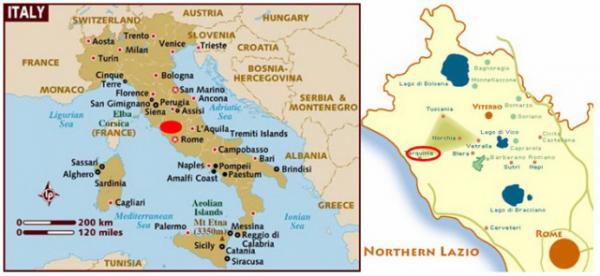
【注】塔奎尼亚的蒙特罗齐“崎岖丘陵”墓地,是伊特鲁里亚“土著人”文明留给世界最珍贵的遗产——超过6,000座墓葬、约200座装饰着精美壁画,构成前罗马时代古典绘画最集中的宝库。这些“视死如生”的壁画上,狩猎、宴饮、舞蹈、亲昵的夫妻生活依然鲜活,仿佛2,000多年前的伊特鲁里亚人从未离开。通过壁画,后人得以窥见伊特鲁里亚人的生活细节——他们的服饰、发型、乐器、舞蹈姿势,甚至宴会上的食物和器具。更重要的是,壁画揭示了他们的宗教信仰和丧葬习俗,那些神话传说中的场景,那些关于死亡与重生的想象,都成了解读这个消失文明的重要密码。 同一时代的东方,正值春秋后期(前770—前476年)。周室衰微、诸侯争霸的动荡中,却催生了中国思想史上最璀璨的篇章:老子写《道德经》,孔子创儒家,孙武著《孙子兵法》——百家争鸣的开端,中国文化基因的奠基。两地文明几乎同时繁荣,最终又各自融入更大的体系:伊特鲁里亚被罗马“力量”吸收,春秋战国孕育了秦汉大一统。 站在这些色彩依然鲜艳的壁画前,我忽然有一种奇妙的错位感:这边是地中海边的宴饮与海豚,那边是中原的礼乐与兵书;它们相隔万里,从未相遇,却在同一个千年里,各自用死亡表达着对生活最深的眷恋。海浪与黄土,都不曾遗忘。 2004年,塔奎尼亚的伊特鲁里亚墓地被联合国教科文组织纳入《世界遗产名录》。 Today in History(历史上的今天):
2018: Tarquinia & Tuscania, Italy(意大利塔尔奎尼亚墓葬群与图斯卡尼亚古城)
2016: Capital Paris, France(法国首都巴黎)
2014: GHCS Camp—Chinese Chess(光华营中国像棋) 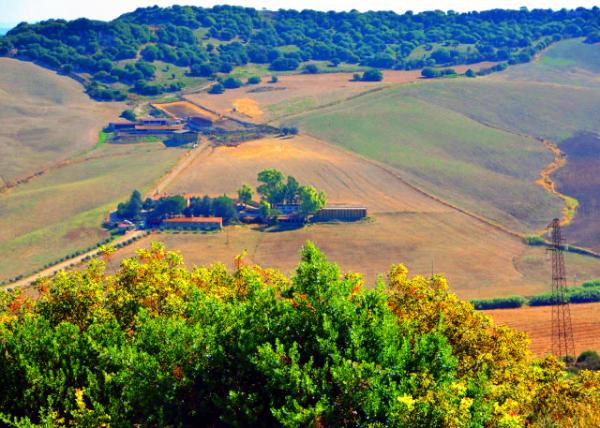 Monterozzi Necropolis Located in Marta River Valley Monterozzi Necropolis Located in Marta River Valley
(蒙特洛奇陵墓位于玛尔塔“女士”河谷)  Marta River Valley w/ a Charming, Idyllic, & Rural Lifestyle Marta River Valley w/ a Charming, Idyllic, & Rural Lifestyle
(玛尔塔河谷·拥有迷人、田园诗般的乡村生活方式 07-18-2018) 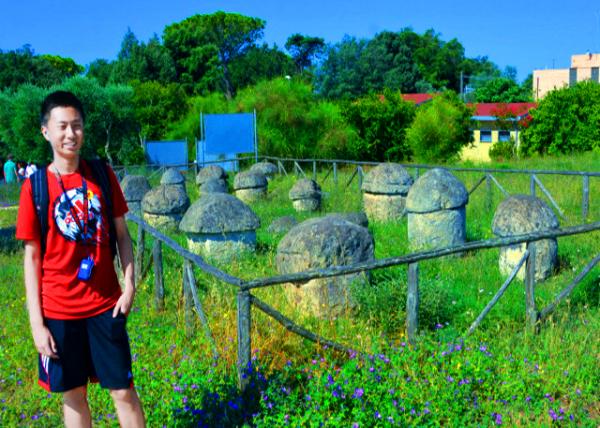 Early Villanovan Tombs w/ Tumuli or Surface Mound Early Villanovan Tombs w/ Tumuli or Surface Mound
(早期带有坟头或土堆的维拉诺瓦“新城”陵墓 07-18-2018)
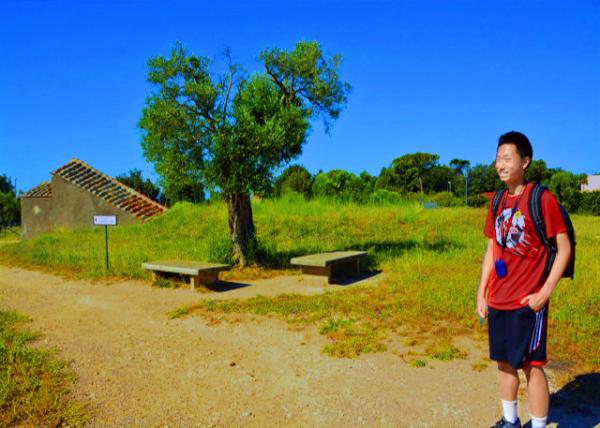 Trenches Cut in Rock, Tumuli, or Carved in Rock, in the Shape of Huts or Houses w a Wealth of Structural Details @ Necropolis of Monterozzi Trenches Cut in Rock, Tumuli, or Carved in Rock, in the Shape of Huts or Houses w a Wealth of Structural Details @ Necropolis of Monterozzi
(蒙特罗齐陵墓·岩石中开凿的沟渠、古墓或岩石雕刻,形状像小屋或房屋,结构细节丰富 07-18-2018)
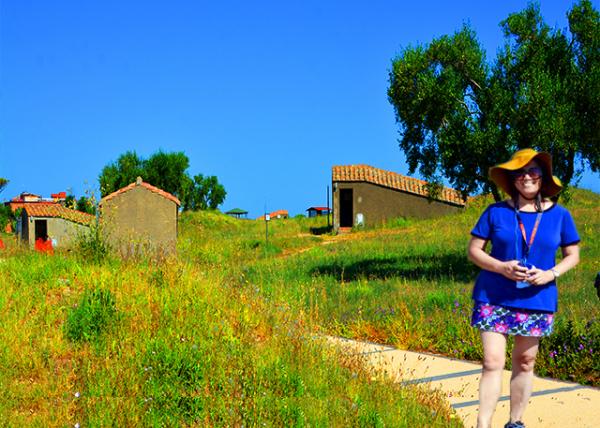 Entrance to Necropolis of Monterozzi Entrance to Necropolis of Monterozzi
(蒙特洛奇陵墓·入口) 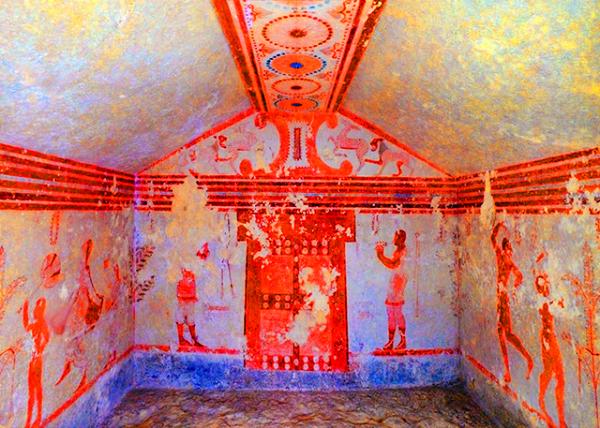 Cardarelli Tomb in 510-500 BC, Dedicated to the Poet as a Portal into the Artistic & Cultural Intricacies of Etruscan Life Cardarelli Tomb in 510-500 BC, Dedicated to the Poet as a Portal into the Artistic & Cultural Intricacies of Etruscan Life
(公元前510-500年的卡达雷利“温暖”墓·献给诗人,作为了解伊特鲁里亚生活艺术和文化复杂性的门户) 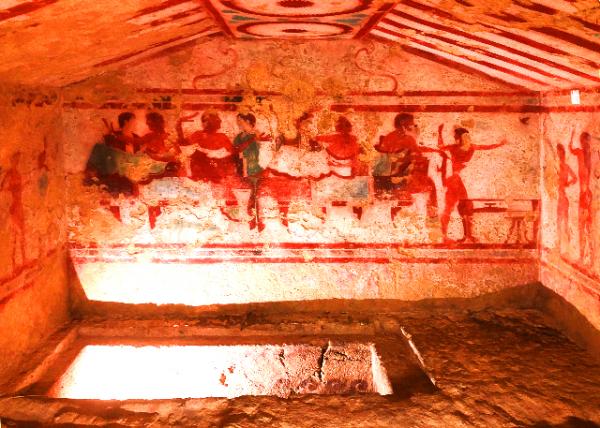 Living & Dead or Cities Meridiane Living & Dead or Cities Meridiane
(生与死 | 子午线) 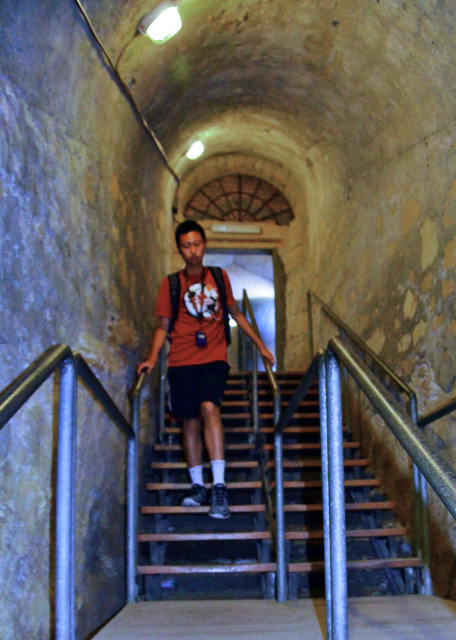
Tomb of Hunting & Fishing in 520-510 BC, an Access Dromos w/ Steps (渔猎墓·公元前520-510年间入口建有楼梯墓道 07-18-2018) 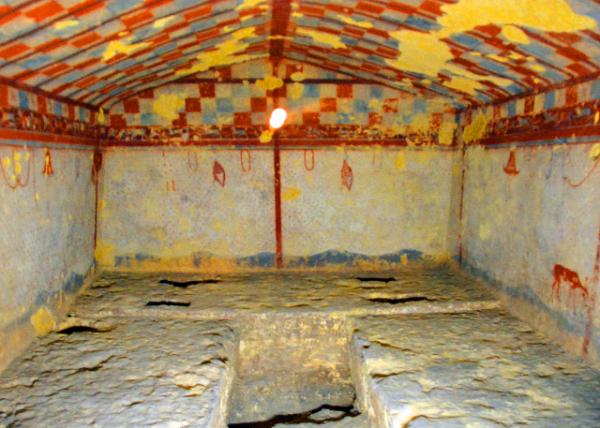 Tomb of the Hunter in 510-500 BC, Featuring a Distinctive Gabled Ceiling Designed to Resemble a Tent Tomb of the Hunter in 510-500 BC, Featuring a Distinctive Gabled Ceiling Designed to Resemble a Tent
(公元前510-500年的猎人之墓·独特的坡屋顶设计类似于帐篷) 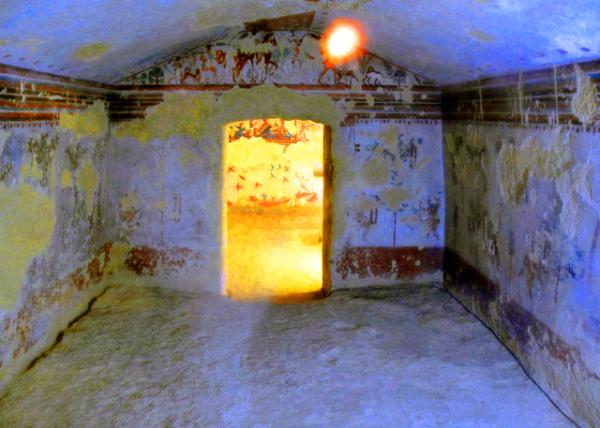 Tomb of Hunting & Fishing in 520-510 BC w/ 2 Axial Chambers Tomb of Hunting & Fishing in 520-510 BC w/ 2 Axial Chambers
(公元前520-510年的渔猎之墓·两间轴向墓室) 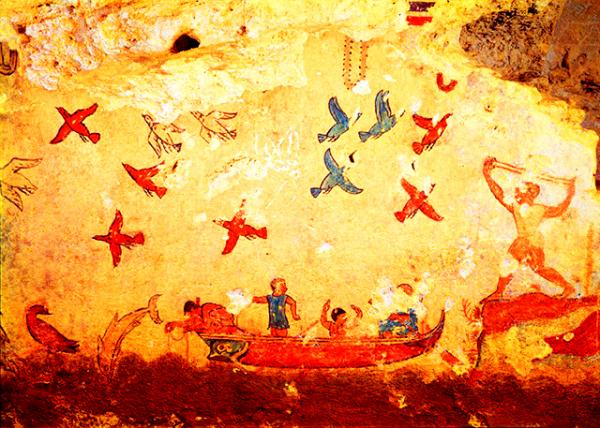 Tomb of Hunting & Fishing, Depicting Lively Scenes of Nature—diving Youths, Fishing Boats, & Bird Hunters - Symbolizing the "Leap" from the World of the Living to the Underworld Tomb of Hunting & Fishing, Depicting Lively Scenes of Nature—diving Youths, Fishing Boats, & Bird Hunters - Symbolizing the "Leap" from the World of the Living to the Underworld
(渔猎之墓·描绘了生动的自然场景——潜水的年轻人、渔船和猎鸟人——象征着从生者的世界“跃入”冥界) 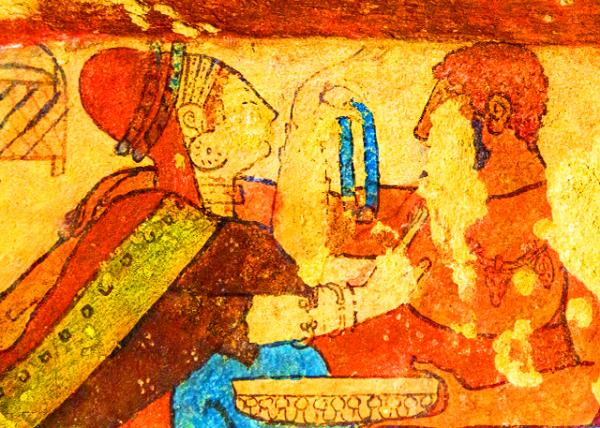 Tomb of Hunting & Fishing, Depicting a Well-dressed Husband & Wife Reclining together @ a Banquet & Likely Representing Their High Social Status or an Idealized Afterlife Tomb of Hunting & Fishing, Depicting a Well-dressed Husband & Wife Reclining together @ a Banquet & Likely Representing Their High Social Status or an Idealized Afterlife
(渔猎之墓·描绘了一对衣着考究的夫妇在宴会上并肩而坐,可能象征着他们崇高的社会地位或理想化的来世) 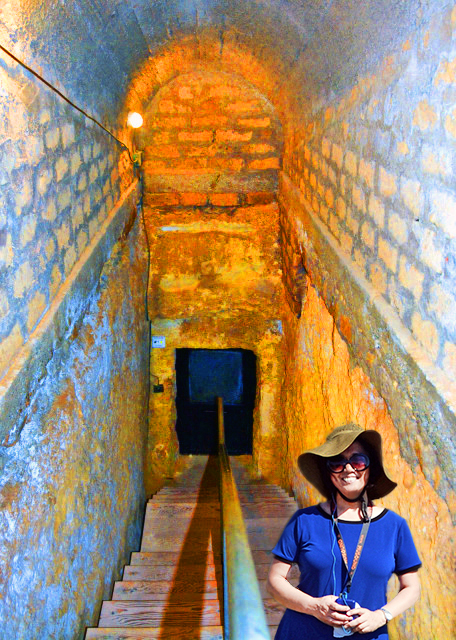
Tomb of the Pulcinella w/ an Extremely Long Access Dromos in the Late 5th BC (公元前5世纪后期的普尔切拉“小鸡”墓·带有超长墓道 07-18-2018) 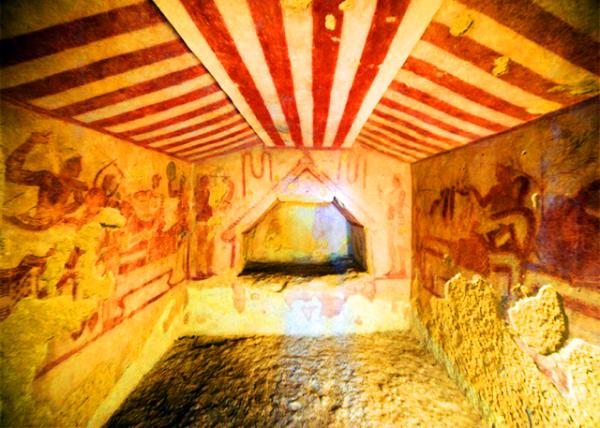 Panoramic Tomb of the Pulcinella, Dating to the 2nd Half of the 5th Century BC Panoramic Tomb of the Pulcinella, Dating to the 2nd Half of the 5th Century BC
(普尔切拉墓全景·可追溯至公元前5世纪下半叶)
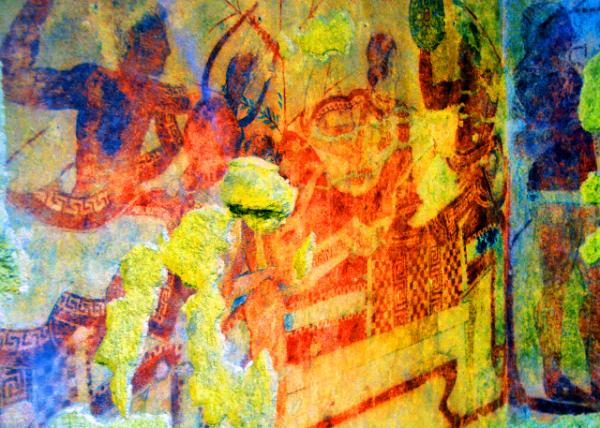 Tomb of the Pulcinella, Depicting a Young Maid, the "Pulcella", on the Left Wall & Its Back-wall Niche Decorated like an Etruscan Temple Tomb of the Pulcinella, Depicting a Young Maid, the "Pulcella", on the Left Wall & Its Back-wall Niche Decorated like an Etruscan Temple
(普尔切拉“小鸡”墓·左侧墙壁上罕见的年轻少女“普尔切拉”画像,以及装饰成伊特鲁里亚神庙模样的后墙壁龛) 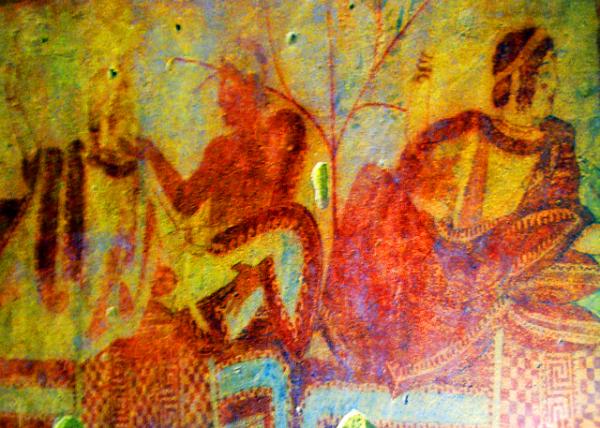 Tomb of the Pulcinella w/ 2 Couples Reclining on Convivial Beds Tomb of the Pulcinella w/ 2 Couples Reclining on Convivial Beds
(普尔切拉墓·两对夫妇夫妇斜躺在舒适的床上大吃大喝) 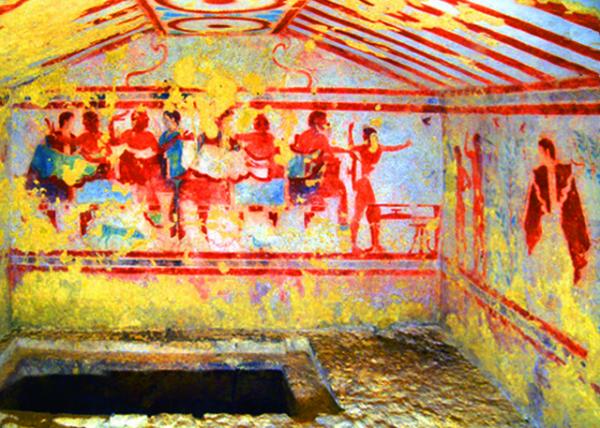 Claudio Bettini Tomb in the Middle of the 5th Century BC, Featuring a Distinctive Double-sloping Ceiling & Vibrant Paintings of Ancient Etruscan Daily Life Claudio Bettini Tomb in the Middle of the 5th Century BC, Featuring a Distinctive Double-sloping Ceiling & Vibrant Paintings of Ancient Etruscan Daily Life
(克劳迪奥·贝蒂尼“跛子·受祝福”墓——公元前5世纪中叶的彩色宴会,生动描绘古代伊特鲁里亚人日常生活的壁画)
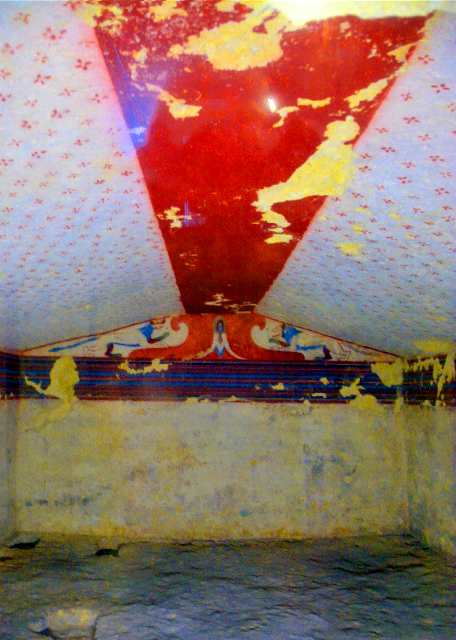
Tomb of the Lotus Flower around 520 BC, Featuring Frescoes Attributed to an Ionian Workshop (莲花墓·大约公元前520年,爱奥尼亚“女神领地”工坊的作品)
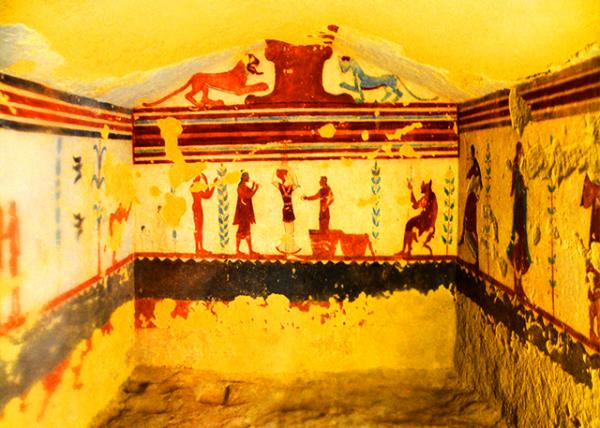 Tomb of Jugglers around 510 BC, Decorated w/ Vibrant Scenes Celebrating Games, Dances, & Athletic Activities Designed to Honor the Departed Tomb of Jugglers around 510 BC, Decorated w/ Vibrant Scenes Celebrating Games, Dances, & Athletic Activities Designed to Honor the Departed
(大约公元前510年的杂耍者之墓·描绘了游戏、舞蹈和体育活动,旨在纪念逝者) 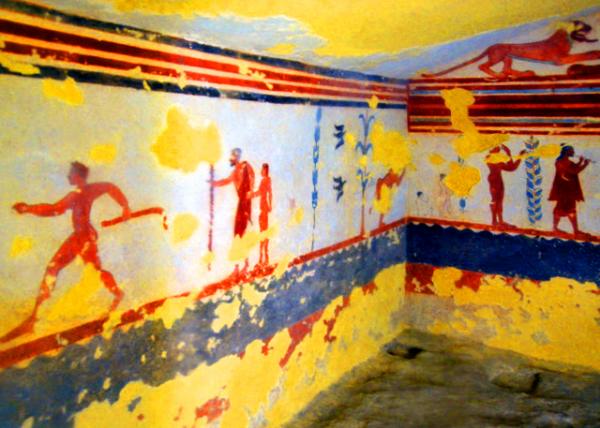 Tomb of Jugglers around 510 BC, Depicting a Male Juggler Balancing 2 Discs & a Female Acrobat Balancing a Weighty Candelabrum on Her Head, Perfectly Capturing the Lively, Celebratory Spirit of Etruscan Funerary Customs Tomb of Jugglers around 510 BC, Depicting a Male Juggler Balancing 2 Discs & a Female Acrobat Balancing a Weighty Candelabrum on Her Head, Perfectly Capturing the Lively, Celebratory Spirit of Etruscan Funerary Customs
(大约公元前510年的杂耍者之墓·描绘了男性杂耍演员平衡两个圆盘和女性杂技演员头顶着一个沉重的烛台,完美地捕捉到了伊特鲁里亚葬礼习俗中活泼欢快的精神) 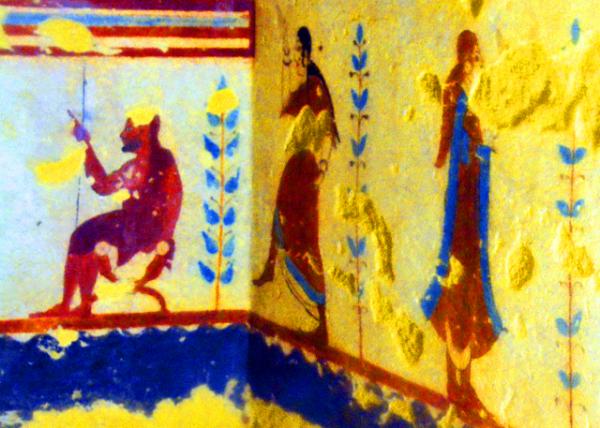 Tomb of Jugglers around 510 BC w/ Celebrating Games & Dances Tomb of Jugglers around 510 BC w/ Celebrating Games & Dances
(大约公元前510年的杂耍者之墓·描绘庆祝游戏和舞蹈) 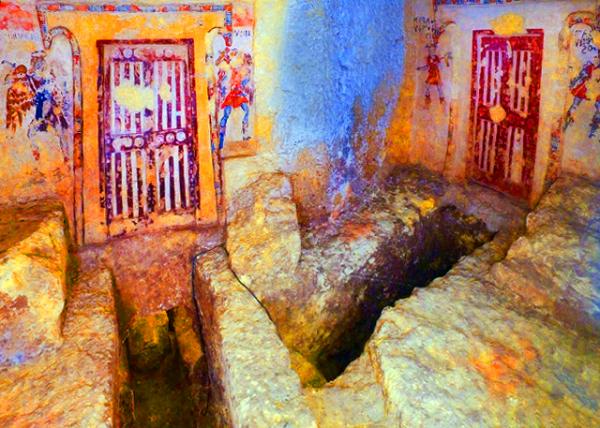 Tomb of the Charuns in 150-125 BC, the Hellenistic Period w/ 2 Levels & a Vestibule Tomb of the Charuns in 150-125 BC, the Hellenistic Period w/ 2 Levels & a Vestibule
(公元前150-125年的卡戎“炽烈光芒”家族墓室·希腊化时期典型的两层带门厅之墓)
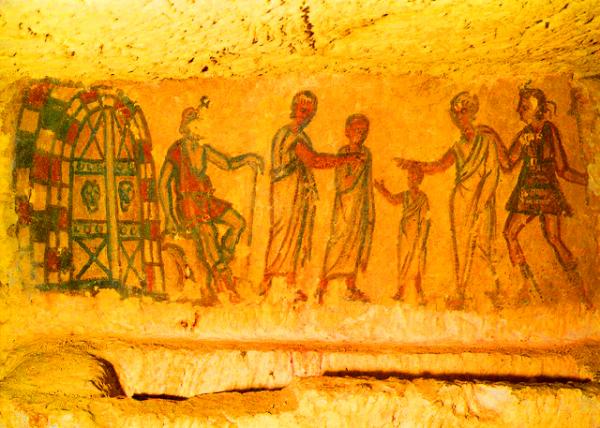 Tomb of the Two Roofs, Featuring the Underworld Gate Guardian Charun Seated on the Left, Dating to Approximately the 3rd Century BC Tomb of the Two Roofs, Featuring the Underworld Gate Guardian Charun Seated on the Left, Dating to Approximately the 3rd Century BC
(双屋顶之墓·可追溯到公元前3世纪左右,描绘了伊特鲁里亚人来世的场景,画面左侧是冥界之门守护神卡戎) 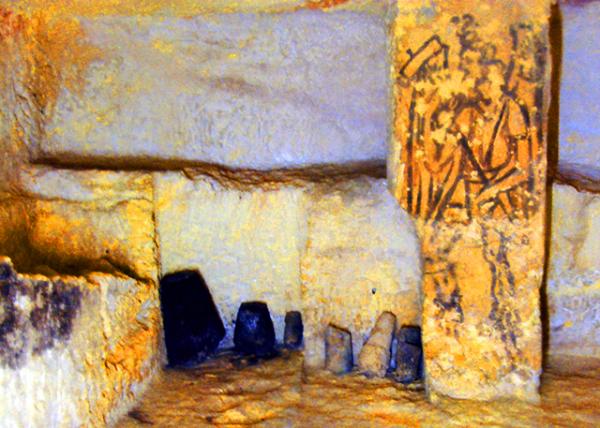 Tomb of the Two Roofs, Featuring Graves Carved Directly into Stone Benches, Dating back to the 2nd-century BC Tomb of the Two Roofs, Featuring Graves Carved Directly into Stone Benches, Dating back to the 2nd-century BC
(双屋顶之墓·公元前2世纪直接在石凳上雕刻的墓穴) 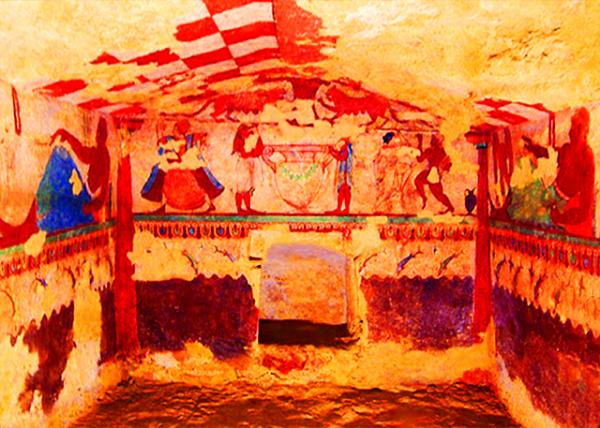 Tomb of the Lionesses, around 520 BC, Depicting Flying Birds & Leaping Dolphins & the Life of the Etruscan Aristocracy Tomb of the Lionesses, around 520 BC, Depicting Flying Birds & Leaping Dolphins & the Life of the Etruscan Aristocracy
(公元前520年左右的母狮之墓·描绘飞鸟与跳跃海豚的场景和伊特鲁里亚贵族的生活)
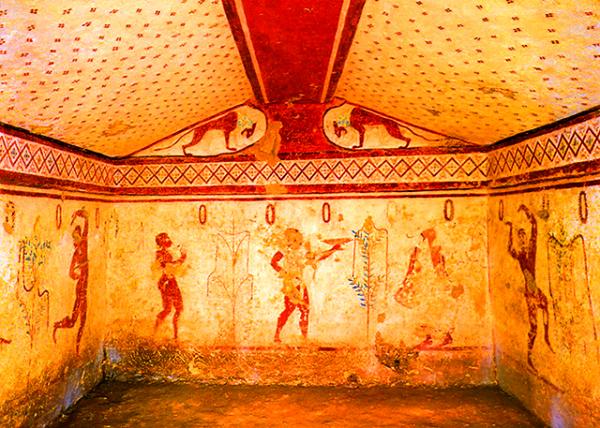 Moretti Tomb w/ Its Vibrant, Well-preserved Interior Frescoes Dating back to the Late 6th Century BC Moretti Tomb w/ Its Vibrant, Well-preserved Interior Frescoes Dating back to the Late 6th Century BC
(莫雷蒂“黝黑”墓·色彩鲜艳、保存完好的室内壁画,可追溯至公元前6世纪末) 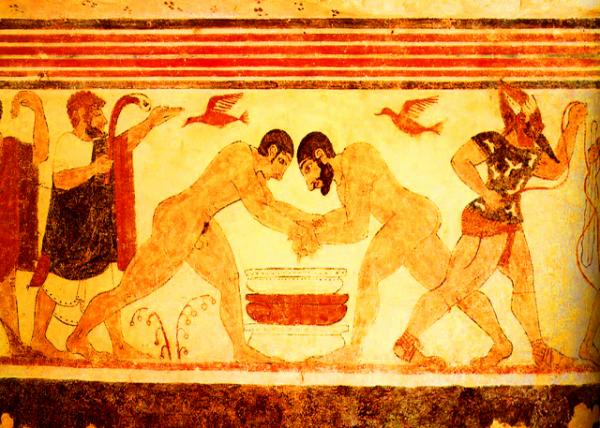 Tomb of the Augurs, Frescoed Between 530-520 BC, a Burial Monument to Help an Individual Pass into the Afterlife Tomb of the Augurs, Frescoed Between 530-520 BC, a Burial Monument to Help an Individual Pass into the Afterlife
(占卜者之墓·壁画创作于公元前530—520年间,用以助人进入来世的墓碑) 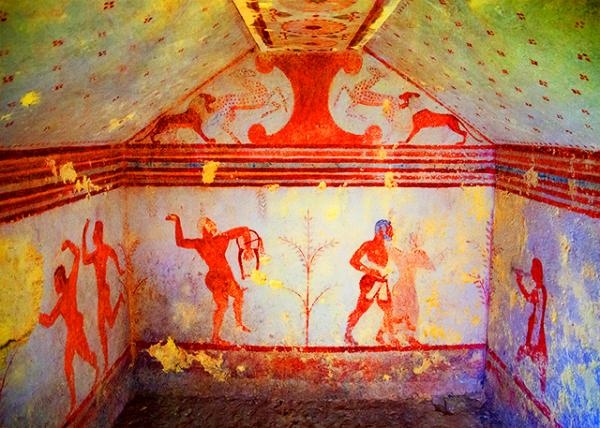 Tomb of the Bacchants, a Testament to the Vibrancy & Artistic Expression of the Late 6th Century BC Etruscan Culture Tomb of the Bacchants, a Testament to the Vibrancy & Artistic Expression of the Late 6th Century BC Etruscan Culture
(酒神女祭司之墓·公元前6世纪晚期伊特鲁里亚文化活力与艺术表现力的证明) 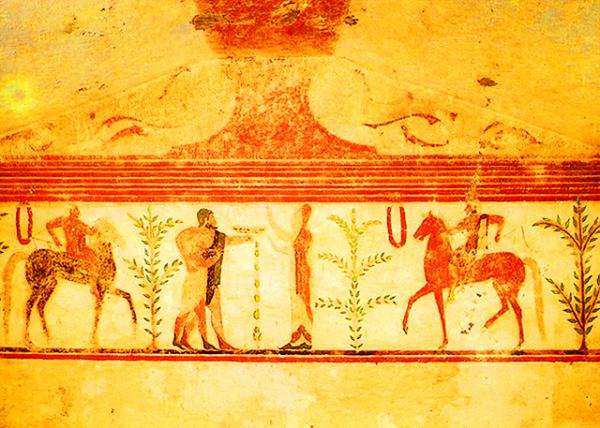 Tomb of the Baron, Dating to around 510 BCE Tomb of the Baron, Dating to around 510 BCE
(男爵墓·可追溯至公元前510年左右)
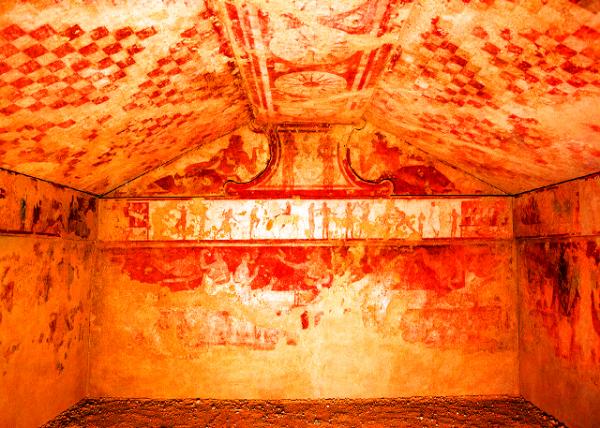 Tomb of the Bigas or Two-Horse Chariot, the Sumptuous Frescoes & the Only Ancient Tomb Depicting All the Chariot Races & Sports Practiced in Both Greece & Etruria during the Late 6th Century BC Tomb of the Bigas or Two-Horse Chariot, the Sumptuous Frescoes & the Only Ancient Tomb Depicting All the Chariot Races & Sports Practiced in Both Greece & Etruria during the Late 6th Century BC
(比加斯“双马战车”之墓·公元前6世纪末华丽的壁画,号称唯一一座描绘希腊和伊特鲁里亚所有战车比赛和体育运动的古代墓葬)
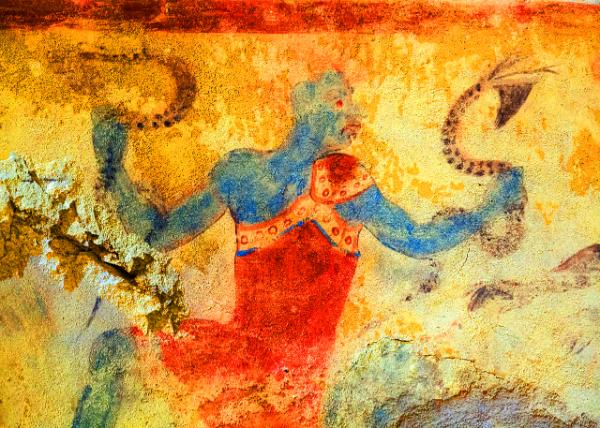 Tomb of the Blue Demons w/ Its Vivid, Groundbreaking 5th-century BC Frescoes Depicting the Etruscan Underworld Tomb of the Blue Demons w/ Its Vivid, Groundbreaking 5th-century BC Frescoes Depicting the Etruscan Underworld
(蓝魔之墓·生动逼真、开创性的公元前5世纪壁画描绘了伊特鲁里亚冥界) 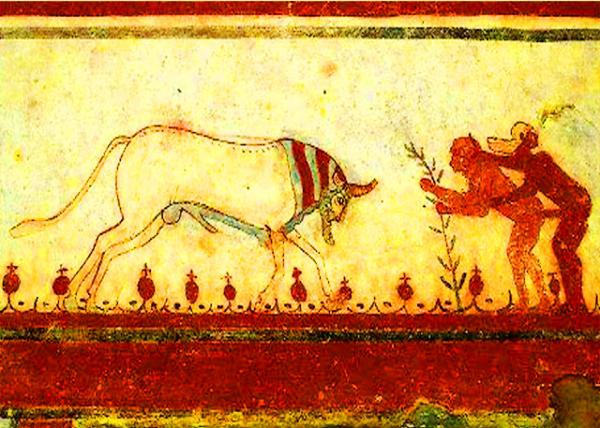 Tomb of the Bulls, the Earliest Tomb in the Necropolis to Feature Complex, Narrative Frescoes, Dating back to 530 BC Tomb of the Bulls, the Earliest Tomb in the Necropolis to Feature Complex, Narrative Frescoes, Dating back to 530 BC
(公牛之墓·墓地中最早拥有复杂叙事性壁画的墓葬,其历史可追溯至公元前530年) 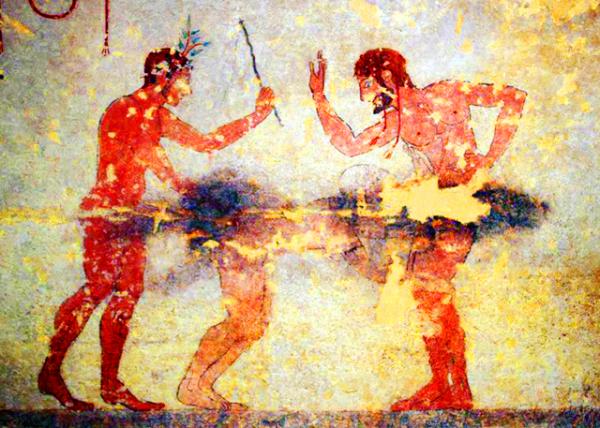 Tomb of the Flogging, Dating to the Late 6th Century BC, w/ Its Rare, Explicit Frescoes Featuring Ritualistic Erotic Scenes, Including a Woman Being Flogged by a Male Figure, Surrounded by Musicians & Dancers Tomb of the Flogging, Dating to the Late 6th Century BC, w/ Its Rare, Explicit Frescoes Featuring Ritualistic Erotic Scenes, Including a Woman Being Flogged by a Male Figure, Surrounded by Musicians & Dancers
(鞭笞墓·可追溯至公元前6世纪晚期,罕见露骨的壁画描绘了仪式性的情色场景,包括一名女子被一名男子鞭打,周围环绕着乐师和舞) 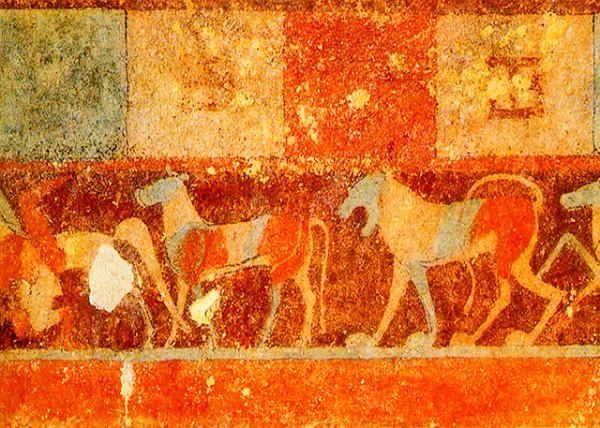 Tomb of the Hunting Lodge, Dating back to the Late 6th Century BC, Simulating an Ancient Etruscan Fabric Tent & Featuring Vibrant Wall Paintings Tomb of the Hunting Lodge, Dating back to the Late 6th Century BC, Simulating an Ancient Etruscan Fabric Tent & Featuring Vibrant Wall Paintings
(狩猎小屋墓·可追溯至公元前6世纪晚期,模拟了古代伊特鲁里亚人的布帐篷,并饰有色彩鲜艳的壁画)
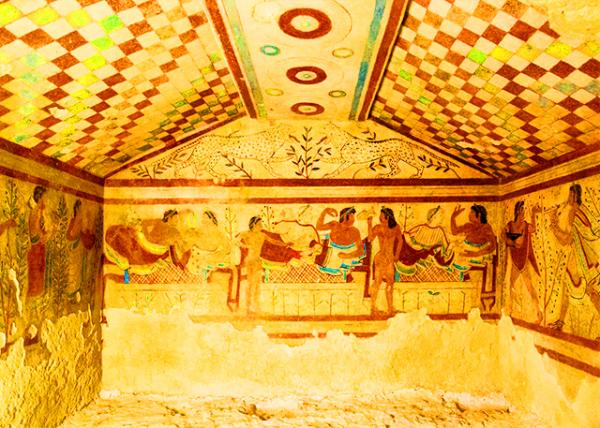 Tomb of the Leopards Influenced by the Greek-Attic Art of the 1st Quarter of the 5th Century BC Tomb of the Leopards Influenced by the Greek-Attic Art of the 1st Quarter of the 5th Century BC
(豹之墓·受到公元前5世纪前25年希腊艺术的影响) 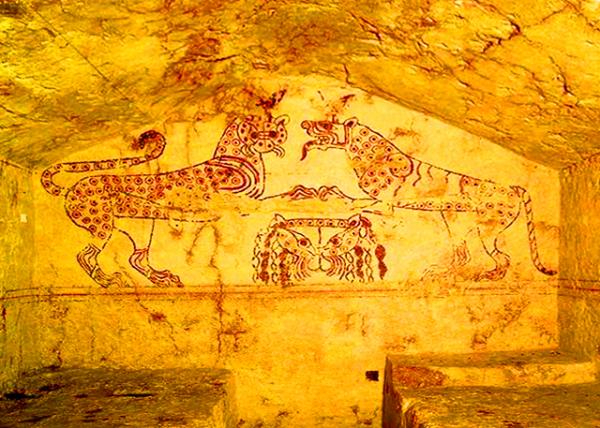 Tomb of the Panthers, the Oldest Example of Figurative Painting in Tarquinia, Dating back to the Late 7th Century BC Tomb of the Panthers, the Oldest Example of Figurative Painting in Tarquinia, Dating back to the Late 7th Century BC
(豹墓·保存着塔尔奎尼亚最古老的具象绘画作品,其历史可以追溯到公元前7世纪末) 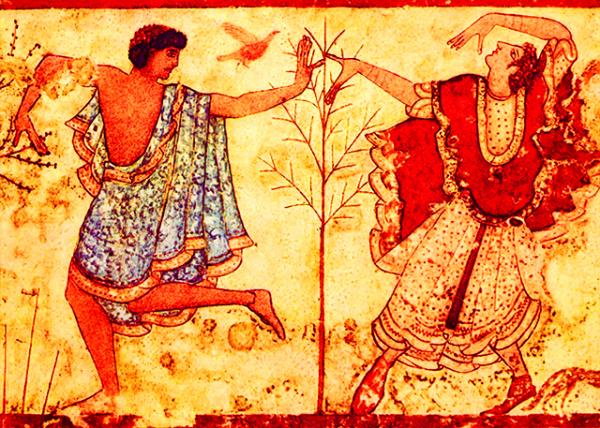 Tomb of the Triclinium or Joy & Celebrations Tomb of the Triclinium or Joy & Celebrations
(三联厅之墓·欢乐与庆典之墓)
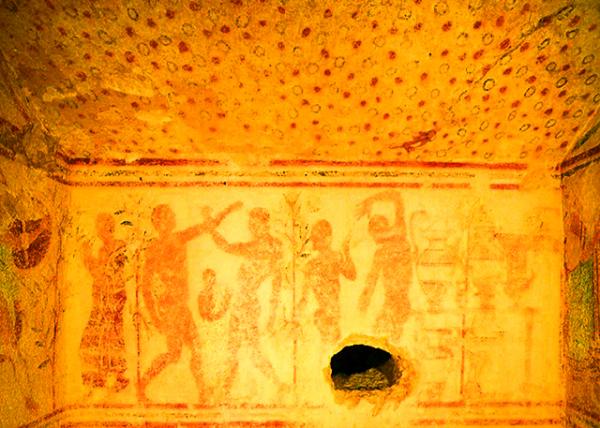 Tomb of the Warrior, Detailed 5th-century BC Frescoes about Elaborate Funeral Games & a Dancing Warrior Tomb of the Warrior, Detailed 5th-century BC Frescoes about Elaborate Funeral Games & a Dancing Warrior
(武士墓·公元前5世纪的壁画细节精美,描绘了盛大的葬礼游戏和一位跳舞的武士) Crosslinks(相关博文): Italy(出游意大利)
Europe(欧洲掠影) 9th Grade(高中一年级) |