2013-03-29 Good Friday 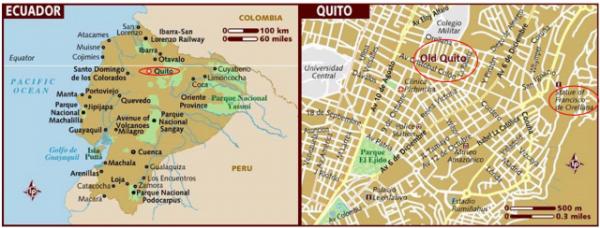
【Aiden in English】
Today was Holy Friday, and we stayed in Quito, Ecuador's capital city. At 9,350 feet/2,800 meters above sea level with a latitude of 0 ° 15 'S, Quito was the highest and only capital on the Equator in the world. After I put on a new set of clothes, Mom and I went down for breakfast. Our hotel was Patio Andaluz, and I wasn't surprised we couldn't pronounce it in Spanish. The breakfast mostly consisted of toast with ham, aged cheddar, French-Swiss, creamy Havarti, Dutch Gouda, American cereals, plantain chips, local fruits, fresh soursop (guanabana) juice/little orange (naranjilla) juice/banana passion fruit (taxo) juice, and authentic coffee. It was quite a simple meal for me. Later, our room's phone rang, signaling that our private tour guide had arrived. He looked very friendly and introduced himself as Juan Carlos Guerra. Juan Carlos sounded extremely popular, from the president to the ordinary people in Ecuador. Before I knew it, we were bumping on the streets up and down hills in the historical center of Quito. We drove up a small hill to El Panecillo, where an enormous statue of the Virgin of Quito, an angel, stood on a snake she had killed. In Quito, the snake was believed to symbolize evil and was said to encourage people to do bad things. Mom and I could see the whole city, from the historic old town to the modern districts, with just a turn of our heads. The proliferation of churches, convents, and monasteries earned Quito the nickname "The Cloister of America," which led to its declaration as a UNESCO World Heritage Site in 1978. Even more impressive was that we could observe 16 active stratovolcanoes from the summit if the sky was clear enough. Only two showed up today, i.e., Pichincha and Cotopaxi, in the Andes mountains. After we took all the panoramic pictures Mom needed, we headed straight for the fascinating Calle La Ronda. During the late 16th and early 20th centuries, La Ronda was home to several notable musicians, poets, historians, and other prominent figures in Quito's history. This neighborhood inspired poetry and some of the most romantic traditional music. It was a unique street for us to get a feeling of conventional life in colonial Quito. Within just two blocks of cobblestone streets, numerous small stores, bakeries, antique shops, and authentic Ecuadorian restaurants were located. Once in a while, we would come across various cultural activities and play universal games on the street, such as hopscotch, hula hoops, or aiming sticks. Mom looked desperate for some reason. When I asked, she said she wanted to see the Catholic Procession that happened only on Good Friday every year. Thousands of Catholics participated in the traditional Easter ceremony commemorating Jesus' resurrection. As we arrived at the Carondelet Palace in Independence Square, a large crowd of residents gathered around the streets. After we met, we were joined by Juan Carlos's wife, their 8-year-old daughter, a 10-year-old nephew, and a 6-year-old niece. It seemed as if we had caught up with the vast religious parade. Trumpets were blaring, and drums were being hit. Most people dressed in purple or blue with long sleeves covered their faces with high hoods. Some carried crosses, while others chanted as they marched from the Church and Convent of San Francisco. The hooded penitents were seeking purification. The procession ran through the main streets of Quito for 3-4 hours and ended with reading the liturgy in the convent. The Church and Convent of San Francisco were the oldest in Quito (1536-1580) and one of America's most prominent religious architecture complexes. The façade was said to have a style similar to that of El Escorial in Spain. Quito's ice cream, Ecuadorian water ice made in a copper paila, and plantain chips looked so tempting in the street. We proceeded along Garcia Moreno Street and passed through the Cathedral of Quito, characterized by its late Gothic arches, Moorish ceilings, and Baroque main altar. Soon, we found ourselves at the doorway of our hotel, facing the Basilica of the National Vow (1892-1988), which symbolized the most enormous neo-Gothic Basilica in the Americas. Mom paid cash and thanked Juan Carlos for being a good tour guide. When I was ready for lunch, my stomach rumbled like distant thunder, which I didn't realize it could do. I had a local appetizer of Mini Corn Tamalitos stuffed with chicken and vegetables, served on a bed of leaves with special Ecuadorian hot sauce, "Aji," and an entree of Fritada Quintana, made with pork sirloin, a potato patty, avocado, toasted kernel corn, and fried sweet banana. Pork sirloin was cooked as hard as the toasted kernel corn. Mom ordered the Easter special Ecuadorian Lenten chowder, Fanesca, a stew made of 12 different kinds of tender grains, beans, and dry codfish. The number of grains and beans symbolized the 12 apostles and the 12 tribes of Israel. Codfish represented Christ and the way his message nourished the Christian community. The soup tasted delicious; it was no wonder Ecuador was known for its soups! People put all sorts of soups on their tables every single day. As Mom decided to explore the local Mass late afternoon, we set off to see the most beautiful church in Latin America - the Church of the Society of Jesus on our own. Besides the seats, everything was decorated with gold, reflecting light every few seconds inside. It exhibited magnificent foliage, vines, fruits, birds, and caryatids. We were entranced by the splendor that met our eyes as we entered the church. Since we did not understand anything in Spanish or Latin, we left the church in a French style when the archbishop prayed in the middle of his Mass. In the US, we have never experienced the religious spirit with such faithful natives on Good Friday as Ecuadorians. Now, we are blessed to do it once in our lives. 【红霞译】
今天星期五是耶稣受难日,我们来到厄瓜多尔“赤道”首都基多“第五”,碰巧与当地民众一起欢度佳节。
基多海拔9,350英尺/2,800米,南纬0度15秒,在世界上不仅算作地势最高的首都,而且还是独居赤道的国府。
早起我穿好衣装,立即和妈妈一起到楼下吃早饭,我们酒店叫安达卢西亚“安步”天井,因为不会西班牙语,所以总也叫不地道它的发音。这里早餐主要供应烤面包、火腿、黄油干酪、蜂窝奶酪、丹麦半软乳酪、荷兰干酪、美式麦片、芭蕉干、应时水果、新鲜刺果荔枝/小柑柚/香蕉西番莲汁以及正宗咖啡,我简单吃些东西应付了事。
不一会儿屋内电话铃声响起,事先预约的私人导游胡安·卡洛斯·格拉“神慈·自由人·士兵”正在酒店大厅等候我们,他看上去非常和善,其名字风靡厄瓜多尔全国,上至总统、下至百姓,“胡安·卡洛斯”多如牛毛。书归正传,转眼间我们便出征在上坡下坡高低起伏的古城街道上。
我们登上帕内西约“小块面包”山,眼前出现巨幅“基多圣母”塑像,她面容慈祥脚踩莽蛇,勇于为民除害,在基多人眼中蛇代表邪恶专做坏事。站在山顶放眼远眺,整个首都尽收眼底,厄瓜多尔印第安民族历史悠久,直至16世纪西班牙依靠宗教思想统治当地民众300年,基多经历了若干社会变革,再加上火山爆发、地震灾害等自然磨难,土著部落在彻底摈弃印加帝国影响的基础上不断吸收兼容西方意识,结果教堂林立,歌特式、摩尔式、巴洛克式等建筑风起云涌,全方位矗立在古城各个角落。时至今日,本土传统与殖民文化交织并重,教堂、修道院、修女观几乎完好无恙,最大程度保持了历史原貌,古城遗风仍然不减当年,基多赢得了“美洲寺院”之盛誉,正因如此早在1978年间,世界科教文组织将基多历史名城纳入《世界遗产名录》。更令人激动的是倘若天气晴朗,基多周围安第斯山脉中16座层状活火山定将历历在目,只是我们来的时候仅看到两座著名火山——皮钦查“两座火山”峰和科托帕希“颈月”峰。
等妈妈拍完所需全景相片之后,我们下山直取古城最浪漫的“圆街”,自16世纪晚期至20世纪初期,基多地区不少志趣相投的音乐家、诗人、史学家以及其他重要人物喜欢聚集于该地抒发情怀激扬文字,因此成就了许多厄瓜多尔诗歌创作和民族音乐,尽管这条鹅卵石铺就的弄堂总长不过两段街口,但却以邻家客居特有的方式向游客展示不同风格的本土文化,杂货铺、糕点房、古董店和小吃餐馆紧锣密鼓,我们走东家串西家,逛得不亦乐乎,每隔几步路远我们都会停下脚步玩一玩全球流行的跳房子、呼拉圈、套圈等街头游艺项目。 没过多久妈妈看上去有点焦虑,我问她缘由,得知她想去看一年一度的天主教信徒为纪念耶稣受难而举行的盛大传统游行,于是我们抓紧时间赶往地处独立广场上的总统府,在那里我们不但正好与游行队伍会合,而且还巧遇导游的太太、八岁女儿、十岁外甥和六岁外甥女。喇叭吹鼓声起,有的身着紫色或蓝色长袍,头戴圆筒高帽,脸面遮挡得严严实实,还有的肩扛“耶稣神力无限”十字架,深表虔诚信主之心,尽展悔改罪过之意,他们从方济各教堂出发,围绕古城一周,历时3~4个钟头,最后再回到方济各修道院念经唱诗。方济各教堂及修道院建于1536─1580年,既是基多最古老,同时又是美洲最大的宗教建筑群,据说其正门效仿西班牙马德里郊外的埃斯科里亚尔“炉渣”修道院设计而成。
我们与路边贩卖基多冰激凌、厄瓜多尔刨冰、南美芭蕉片的小摊小吃擦肩而过,沿加西亚·莫雷诺“年轻·黝黑”(厄瓜多尔政治家)街紧随人流进入基多大教堂参观,晚期歌特式拱门、摩尔式房顶、巴洛克式主祭坛横贯建筑主体,由此出门朝全美洲最大的全国誓言大教堂方向走去,不知不觉回到酒店下榻,妈妈付完现金并衷心感谢这位导游热情周到的服务。
午餐时分,我肚子叫得咕咕惨烈,犹如雷声轰鸣,自己从未意识到肠胃内脏竟会鬼哭狼嚎!我头台点的“玉米粽子”,鸡肉蔬菜馅通常蘸土著辣酱,主餐上了“油炸猪腩”配土豆饼、鳄梨片、烤老玉米粒和油炸芭蕉块,猪腩硬得实在嚼不烂,可以对决拼盘上的老玉米豆;妈妈则根据厄瓜多尔复活节正宗食谱要来“斋汁”圣周春汤,它由12种不同谷物和鳕鱼干煮成的杂烩,而12种谷物代表耶稣12门徒和以色列12支派,鳕鱼则代表圣主耶稣以及由他栽培的基督信徒。圣周春汤喝起来味道不错,难怪厄瓜多尔是一个翡声国际誉满全球的泱泱“汤”国,本土居民每天都要喝汤。
傍晚临近妈妈决定参加节日弥撒,我们立刻动身前往拉丁美洲最为富丽堂皇的教堂──耶稣会教堂,除了长凳座位之外教堂内到处镶金镀金,打造得金碧辉煌;灯光下,金树叶、金藤枝、金鸟禽和金女像柱光芒四射,耀眼夺目。我们一进入主殿大堂,立刻被它的神彩圣明所迷住,可惜因为完全听不懂西班牙语甚至拉丁文,我们只好中途退堂。 在美国我们从来没有亲眼目睹像南美天主信徒如此虔诚庆祝耶稣新生,因此格外庆幸今生通过朝拜盛况了解基多文化背景,真正认识厄瓜多尔人。  Quito, the Middle of the World (基多·世界中心) Quito, the Middle of the World (基多·世界中心)
 Breakfast @ Hotel Patio Andaluz Breakfast @ Hotel Patio Andaluz
(安达卢斯“流浪者”天井酒店·早餐 03-29-2013) 
Courtyard @ Hotel Patio Andaluz (安达卢斯天井酒店·厅堂 03-29-2013)

Mini Tamales, Fanesca, & Fritada Quitena @ Hotel Patio Andaluz (安达卢斯天井酒店·迷你玉米粉蒸肉、圣周春汤与油炸猪腩 03-29-2013)  Bar @ Hotel Patio Andaluz Bar @ Hotel Patio Andaluz
(安达卢斯天井酒店·酒吧 03-29-2013)  Restaurant @ Hotel Patio Andaluz Restaurant @ Hotel Patio Andaluz
(安达卢斯天井酒店·餐厅 03-29-2013)  Lounge @ Hotel Patio Andaluz Lounge @ Hotel Patio Andaluz
(安达卢斯天井酒店·休息室 03-29-2013)  Nintendo 3DS XL @ Hotel Patio Andaluz Nintendo 3DS XL @ Hotel Patio Andaluz
(安达卢斯天井酒店·任天堂3DS XL游戏 03-29-2013) 
Virgin of Quito, Inspired by the Biblical Book of Revelation (基多圣母雕像·灵感来自圣经《启示录》 03-29-2013)
 El Panecillo w/ Virgin of Quito Sitting atop the Hill El Panecillo w/ Virgin of Quito Sitting atop the Hill
(帕内西约“小面包”山·山顶上坐落着基多圣母)  Historic Center of Quito, Inscribed as a UNESCO World Heritage Site in 1978 Historic Center of Quito, Inscribed as a UNESCO World Heritage Site in 1978
(基多历史中心·1978年被联合国教科文组织纳入《世界遗产名录》)  Old Town, Founded in the 16th Century on the Ruins of an Inca City, Standing @ an Altitude of 2,850 Meters/9,350 Ft Old Town, Founded in the 16th Century on the Ruins of an Inca City, Standing @ an Altitude of 2,850 Meters/9,350 Ft
(老城·建于16世纪的印加古城遗址之上,海拔2,850米/9,350英尺)  Aerial View of Independence Plaza, the Heart of Quito's Historic Center Aerial View of Independence Plaza, the Heart of Quito's Historic Center
(鸟瞰独立广场·基多历史中心的核心地带) 
Independence Plaza w/ a Statue of Lady Liberty, Symbolizing the Ideals of Freedom & Independence (独立广场·矗立着自由女神像,象征自由和独立的理想 03-29-2013)
 Aerial View of Basilica of the National Vow, the Largest Neo-Gothic Basilica in the Americas Aerial View of Basilica of the National Vow, the Largest Neo-Gothic Basilica in the Americas
(鸟瞰国家誓言大教堂·美洲最大的新哥特式圣殿)  Basilica of the National Vow, Featuring Sculpted Representations of Ecuadorian Animals Like Armadillos & Llamas, Adding a Unique Local Touch Instead of Traditional Gargoyles Basilica of the National Vow, Featuring Sculpted Representations of Ecuadorian Animals Like Armadillos & Llamas, Adding a Unique Local Touch Instead of Traditional Gargoyles
(国家誓言大教堂·刻有犰狳和骆驼等厄瓜多尔动物的形象以增添独特的当地风情,而非沿用传统的石像鬼)  Basilica of the National Vow Viewed from Hotel Balcony Basilica of the National Vow Viewed from Hotel Balcony
(从酒店凉台观望国家誓言大教堂 03-29-2013) 
Venezuela Street (委内瑞拉“小威尼斯”街 03-29-2013)  Plaza San Francisco, Arguably the Largest in the Old City Plaza San Francisco, Arguably the Largest in the Old City
(圣弗朗西斯广场·老城最大的广场)  Plaza de San Francisco, a Major Public Square in the Historic Center Plaza de San Francisco, a Major Public Square in the Historic Center
(圣弗朗西斯科广场·基多历史中心的主要公共广场 03-29-2013)
 Domes of the Church of the Society of Jesus Viewed from Plaza de San Francisco Domes of the Church of the Society of Jesus Viewed from Plaza de San Francisco
(从圣弗朗西斯科广场近观耶稣会教堂穹顶 03-29-2013)  Church of La Compañía or Church of the Society of Jesus, the Temple of Solomon of South America Church of La Compañía or Church of the Society of Jesus, the Temple of Solomon of South America
(耶稣会教堂·南美洲的所罗门“和平”圣殿) 
Nave @ Church of the Society of Jesus as Golden Ember (耶稣会教堂中殿·金色余烬)
 Church and Convent of St. Francis, the Oldest & Most Significant Religious Site in Ecuador Church and Convent of St. Francis, the Oldest & Most Significant Religious Site in Ecuador
(圣弗朗西斯“自由”教堂和修道院·厄瓜多尔最古老、最重要的宗教圣地)  Church & Convent of San Agustín, w/ the 1st Cry of Freedom Church & Convent of San Agustín, w/ the 1st Cry of Freedom
(圣奥古斯丁“高贵”教堂和修道院·由此响起民族自由的呼声) 
Bell Tower @ Church & Convent of San Agustín, Reaching a High of 22 Meters/70 Ft & Housing 2 Bronze Bells (圣奥古斯丁教堂和修道院·钟楼高达22米/70英尺,内有两口铜钟) 
Santa Clara Monastery, the Most Significant Female Abbey in the Town (圣克拉拉“明亮”修道院·该市最重要的女修道院 03-29-2013)
 Metropolitan Cathedral of Quito, Consecrated in 1545, the Senior-most Catholic Church in the Country Metropolitan Cathedral of Quito, Consecrated in 1545, the Senior-most Catholic Church in the Country
(基多都市大教堂·祝圣于1545年,全国最古老的天主教堂)  Altar @ Metropolitan Cathedral of Quito Altar @ Metropolitan Cathedral of Quito
(基多都市大教堂·祭坛) 
Metropolitan Cathedral of Quito w/ Its Mudéjar-Style Coffered Ceiling Featuring Intricate Geometric Patterns & a Significant Example of Spanish-Moorish Architectural Influence in the Americas (基多都市大教堂·拥有穆德哈尔“获准留下”风格复杂几何图案的格子天花板,成为西班牙—摩尔式建筑在美洲影响的典范) 
Roof, Domes, & Lantern Roofs @ @ Metropolitan Cathedral of Quito (基多都市大教堂·屋顶、圆顶和灯笼屋顶 03-29-2013)  Numismatic Museum of the Central Bank of Ecuador, Former Central Bank of Ecuador, Built in 1927 Numismatic Museum of the Central Bank of Ecuador, Former Central Bank of Ecuador, Built in 1927
(厄瓜多尔中央银行钱币博物馆·建于1927年的前厄瓜多尔中央银行)  Jesus in the Great Power (万能的耶稣) Jesus in the Great Power (万能的耶稣)
 Jesus in the Great Power Procession on Good Friday Jesus in the Great Power Procession on Good Friday
(耶稣受难日·万能的耶稣游行 03-29-2013)
 Cucuruchos, Men in Purple Tunics to Represent Penitence Cucuruchos, Men in Purple Tunics to Represent Penitence
(库库鲁乔斯“身穿紫色长袍的男子”·象征着忏悔)  Women in Verónicas, Representing the Woman to Wipe Jesus' Face w/ a Cloth as He Carried His Cross, Accompanied the Image of Jesus the Almighty Women in Verónicas, Representing the Woman to Wipe Jesus' Face w/ a Cloth as He Carried His Cross, Accompanied the Image of Jesus the Almighty
(身穿维罗尼卡“真实形象”的女子·象征着在耶稣背负十字架时用布擦拭他脸庞的女子陪伴着全能耶稣的圣像)  “O Lord, you are so good and kind, so ready to forgive; so full of mercy for all who ask your aid.”–Psalm 86:5“ “O Lord, you are so good and kind, so ready to forgive; so full of mercy for all who ask your aid.”–Psalm 86:5“
(主啊,你如此善良,如此乐于宽恕;对所有向你求助的人,你都充满怜悯。”——诗篇 86:5)
 Carondelet Palace & Hotel Plaza Grande Carondelet Palace & Hotel Plaza Grande
(卡隆德莱特“小铃铛”宫与大广场酒店 03-29-2013) 
Carondelet Palace Serves as the Seat of Government & Official Residence of the President of Ecuador (卡隆德莱特宫·厄瓜多尔共和国政府所在地和总统官邸 03-29-2013)  Meet Tour Guide Family @ Carondelet Palace Meet Tour Guide Family @ Carondelet Palace
(卡隆德莱特宫·与导游一家 03-29-2013)  Carondelet Palace_Guard Dressed in Traditional Ceremonial Costume During a Presidential Parade in Plaza de la Independencia Carondelet Palace_Guard Dressed in Traditional Ceremonial Costume During a Presidential Parade in Plaza de la Independencia
(卡隆德莱特宫·卫兵身着传统礼服参加独立广场的总统游行 03-29-2013)  Courtyard of Carondelet Palace Courtyard of Carondelet Palace
(卡隆德莱特宫·庭院 03-29-2013) 
Historic Old City Viewed from Carondelet Palace (从卡隆德莱特宫观看历史古城 03-29-2013)  Archbishop's Palace, Exemplifing the Unique "Art School of Quito" w/ a Blend of Spanish, Italian, Moorish, Flemish, & Indigenous Artistic Influences Archbishop's Palace, Exemplifing the Unique "Art School of Quito" w/ a Blend of Spanish, Italian, Moorish, Flemish, & Indigenous Artistic Influences
(大主教宫·体现独特的“基多艺术学校”风格,融合西班牙、意大利、摩尔、佛兰芒和土著艺术的影响)  Archway of Calle La Ronda Archway of Calle La Ronda
(隆达“圆”街·拱道 03-29-2013) 
Calle La Ronda, the Most Famous Street in the Colonial Center of Quito (圆街·基多殖民中心最著名的街道 03-29-2013)

Calle La Ronda, Bohemian Barrio (圆街·波西米亚“放荡不羁的艺术家“社区 03-29-2013) 
Calle La Ronda, the Crown Jewels of Quiteño Culture (圆街·基多本土文化的珍宝 03-29-2013) 
Hula Hoop on Calle La Ronda (圆街·呼啦圈 03-29-2013)  Harpsichord w/ Double Keyboard, Symbolizing Resurrection Harpsichord w/ Double Keyboard, Symbolizing Resurrection
(双键盘大键琴·象征重生 03-29-2013)

Street Vendor of Plantain Chips (街头摊贩·兜售芭蕉片)

Street Vendor of Ecuadorian Ice (街头摊贩·兜售厄瓜多尔刨冰) 
Street Vendor of Ecuadorian Icecream (街头摊贩·推销厄瓜多尔冰激凌)
 Patisserie (糕点) Patisserie (糕点)
 Cemetery of San Diego, the Final Resting Place for Many Famous Figures from Ecuador's Past, Including Presidents, Poets, & Military Leaders Cemetery of San Diego, the Final Resting Place for Many Famous Figures from Ecuador's Past, Including Presidents, Poets, & Military Leaders
(圣地亚哥“后继者”公墓·厄瓜多尔许多著名人物的安息之地,其中包括总统、诗人和军事领导人)  Modern Quito (基多新城) Modern Quito (基多新城)
 Pichincha, a Stratovolcano in Ecuador Pichincha, a Stratovolcano in Ecuador
(皮钦查山·厄瓜多尔的层状火山)  19,347-ft/5,897-m Stratovolcano Cotopaxi 19,347-ft/5,897-m Stratovolcano Cotopaxi
(19,347英尺/5,897米科托帕希火山) Crosslinks(相关博文): Ecuador(出游厄瓜多尔)
South America(漂流南美洲) 小学四年级(4th Grade) |