2019-06-28
【Aiden in English】
"How does one think of something to write about?" I often hear that from my students. Usually, a prompt is slapped in their face, a pencil is stabbed into their hand, their arms are taped to the table, and a clock is glued to their eyes, telling them, "Hey, this is exactly what you should do to get a good grade." Oddly, I respect the school system for this matter. They understand that not all kids are creative, and it's a tough pill I've come to swallow. In elementary school, ideas burst out of my head faster and more frequently than words can describe. I held so many ideas; many times, instead of struggling to think of ideas, I had too many choices. In school, the teacher passed down a prompt. The prompts would command, no other word for it, students down a road with an imperative sentence and strict descriptions, eliminating any creative thought. Again, some students are less open to new ideas, but this process is just the absolute worst. Outside the devil's child known as essay prompts, the writing process is… far less strict. Having young students brainstorm and then proceed with an outline is not an evil plan. Unlike myself, reckless, it appeared to work well, in addition to preparing students for future assignments in higher education. Here's a personal anecdote that I would like to share. In the fourth grade—no… fifth grade, no… It's all the same to me now. Regardless, I recall attempting a new skill I saw in a book: the hyphen. A simple dash connects two words that link together to form something more descriptive or meaningful. I saw it once in a book and wanted to integrate the skill into my arsenal. I ended up receiving a "Proficient" in conventions. In other words, it is sub-optimal to my usual performance (Advanced is the highest tier, and elementary schools were always hesitant to hand out letter grades). The hyphen was misused, which was unsurprising even at the time. But the reaction from the teacher, as I recall, was a red circle drawn around the hyphen and a question mark scribbled below. Of course, the first thing any student needs to do is appeal to the teacher. I asked if I could receive less punishment because of an error in the trial. After all, I was learning. However, stuck within the confines of rigorous teaching, nothing changed. As a result, I became scared of innovating. Many more examples of trial and error in my writing would appear later, yet I blamed myself for putting something new into my writing with every mistake. I never stood up to the system and shouted, "You're wrong," because I knew the system would spit right back deep down. Is this wrong? Is it wrong to hiss at embarrassing errors made in the name of learning? As children, we are taught to understand mistakes as a natural part of the learning process. That entirely contrasts with my school experience. Another result of that young incident is a new inability to use hyphens. I understand they are powerful grammatical tools, but I have developed some mental gag reflexes from a sour past. 【红霞译】
“人怎样把想的东西写出来?”
我从所教的学生那里体会颇多。通常情况下,作文提示语啪唧甩到跟前,大家只得攥紧铅笔头,胳膊趴在桌子上,两眼盯住时钟,告诫自己“嘿,这跟得分有关”。出乎意料地,我同意学校这种做法,毕竟老师们清楚并非每个孩子都别具想象力,这让我情何以堪。
我记得上小学的时候,脑袋瓜里奇思异想总是层出不穷,简直无法用语言来描述,况且很多念头用不着使劲去想,要什么有什么。
在学校,老师给出提示语。提示语如同圣旨,没有其它代名词,学生必须服从权威性指令,严禁自由发挥。总有个别学生我行我素,但结果肯定……没有好果子吃。
且不谈魔鬼再生侠即作文提示语,写作过程……远非那么严格,让满头雾水的年轻人按照条条杠杠写作未尝不可。别像我漫无边际,没有规矩不成方圆,这样可以帮助学生为将来深造做准备。
在此我想分享一下个人趣闻。四年级,不对……五年级,不对……现在对我来说完全一码事,总而言之,我记得当时曾想尝试刚从书本上学来的新招:连字符。小破折号将两个单词连接在一起,形成更具表现力的词汇,我是从书上看来的,并想活学活用。
我在考试中因此得了“良好”,换句话说,仅次于本人正常分数线(优秀是评分系统中最高档,小学对该用什么字母表示考试结果总是迟疑不决),连字符用得不当。即便在那个年头,我一点也不感觉奇怪,但我认为老师却反应强烈,围着连字符画了一个红圈,并在下面打了个问号。当然,任何学生的当务之急就是要向老师申诉缘由,我问是否可以因为初试失误而少扣点分,毕竟自己正在学习新理念。然而,在一个非常严格的教学体制下,分数是不能改的。
结果,我变得害怕创新,之后的写作还有很多张冠李戴的例子,乃至各个错误,我自责把新东西引入写作之中,从不敢站出来大声疾呼“你错了”,因为我深知教育体制肯定会反戈一击。错了吗?对学习过程中所犯的尴尬错误发出嘘声错了吗?作为孩子,我们所接受的教育是,每个人都从错误中学习,从失败中成长,这与我在学校的经历真是大相径庭。 年幼时亲身经历的另一后果便是不再使用连字符,我知道连字符是一种行之有效的语法工具,但心酸的往事好像已在我心理上引起某种条件反射。 Today in History(历史上的今天):
2016: Warnemünde—Mouth of Warrnow, DEU(德国瓦尔内明德—瓦尔诺河口) 2016: Berlin the Capital of Prussia, Germany(德国柏林—普鲁士首府) 2016: Berlin Wall, Germany(德国柏林墙) 2015: Dardanelles Strait, Turkey(土耳其欧亚分界线达达尼尔海峡) 2012: Third Grade Drama Camp(三年级戏剧夏令营) 
Peace Valley Park (和平谷公园 06-16-2019) 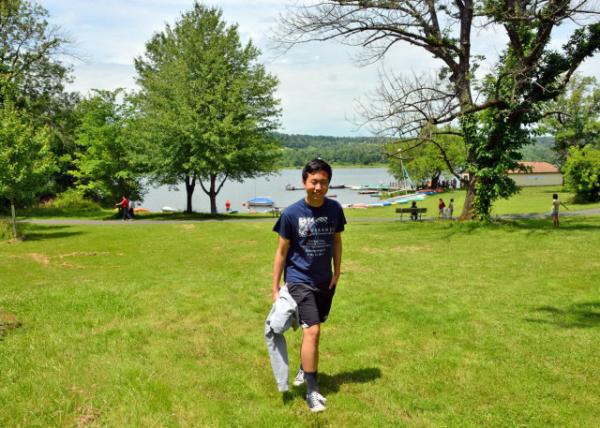
Lake Galena of Peace Valley Park (和平谷公园·方铅矿湖 06-16-2019) Crosslink(相关博文): 10th Grade(高中二年级) |