| | 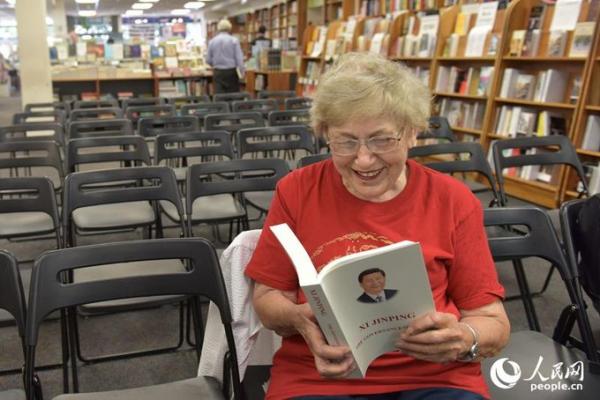
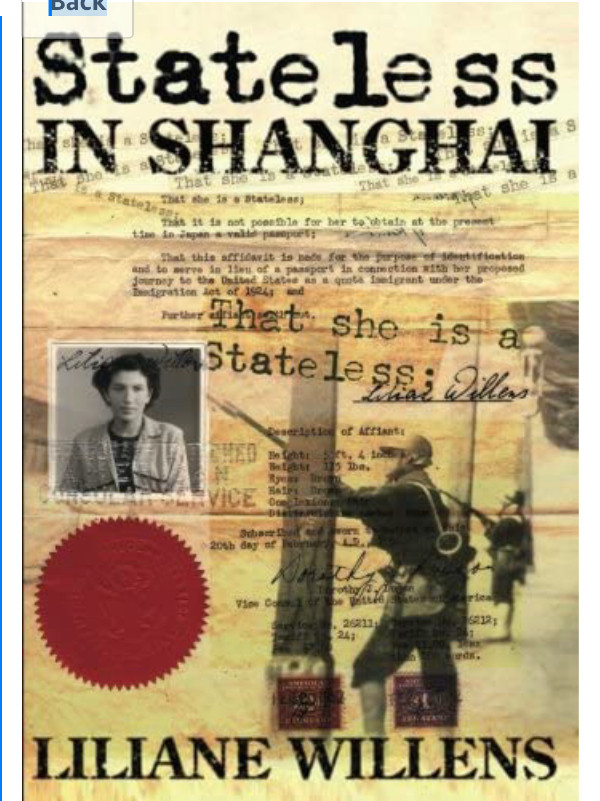
网友:翟東升演講中提到的搞定紐約書店的老太太被中國網友挖出,她就是Liliane Willens。Liliane Willens出生於俄羅斯的猶太人,後來全家在二戰中逃到上海。中共建政後她被中共允許移民到美國,隨後幾十年活躍中美兩國。她的代表作《無國籍者在上海》(下图)。
继续深挖的结果,我发现了更多的关于她的资料。 下图是她网站上的简历: 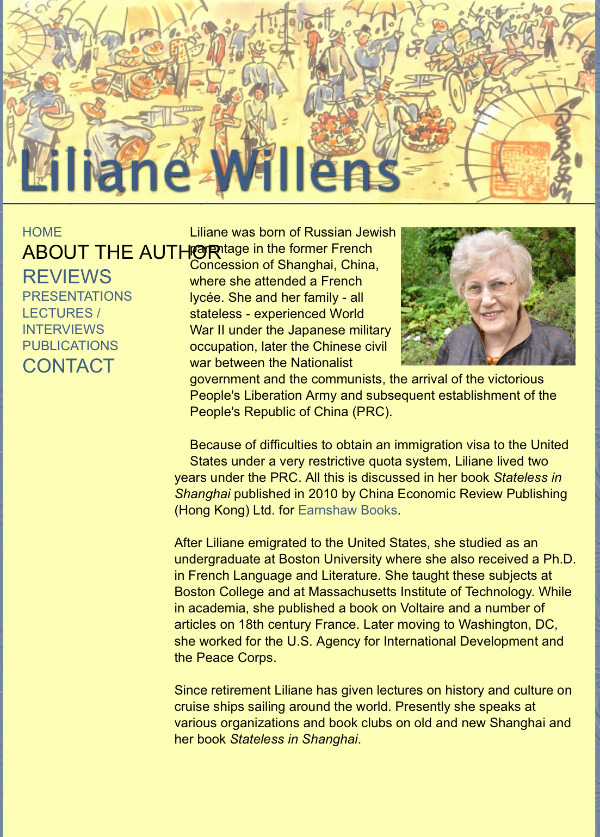
Liliane Willens 出生于上海的法租界。难怪她的中文讲得这样好。其父母是俄罗斯犹太人,她在那儿读的是一所法国学校。 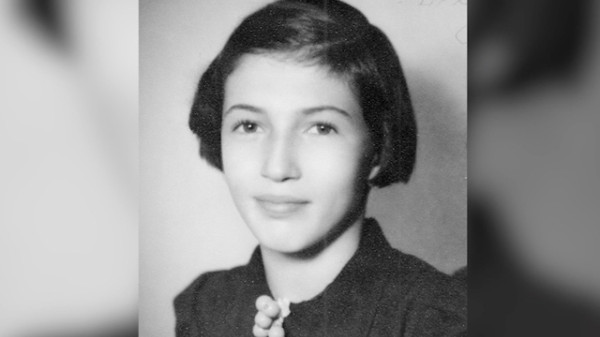
她和她的家人-全都是无国籍人士-在日本军事占领下经历了第二次世界大战,和后来的国共内战。随后PRC成立。
由于严格的配额制度,Liliane难以获得前往美国的移民签证,她在中国居住了两年。 所有这些都在中国经济评论出版(香港)有限公司于2010年为Earnshaw Books出版的《无国籍者在上海》一书中有讲述。
莉莉安娜(Liliane)移居美国后,在波士顿大学攻读本科,并获得了法国语言文学专业博士学位。 后来她在波士顿学院和麻省理工学院教授这些课程。 在学术界,她出版过一本有关伏尔泰的书以及一些关于法国18世纪的文章。 后来搬到华盛顿特区,她曾在美国国际和平开发署工作。 退休后,Liliane就在世界各地航行的游轮上举办有关历史和文化的讲座。 目前,她在各个机构和读书俱乐部做关于新旧上海以及她的《无国籍者在上海》的演讲。
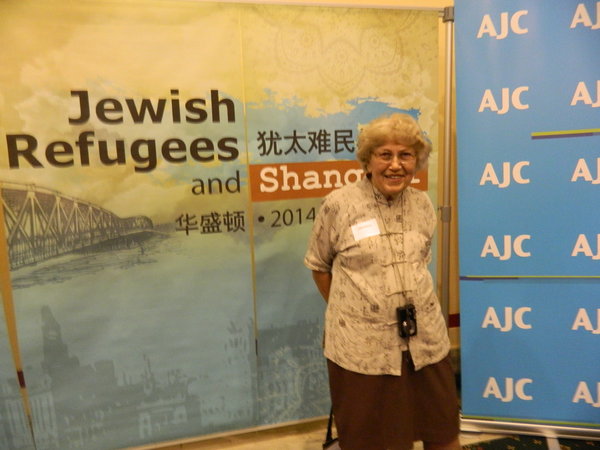

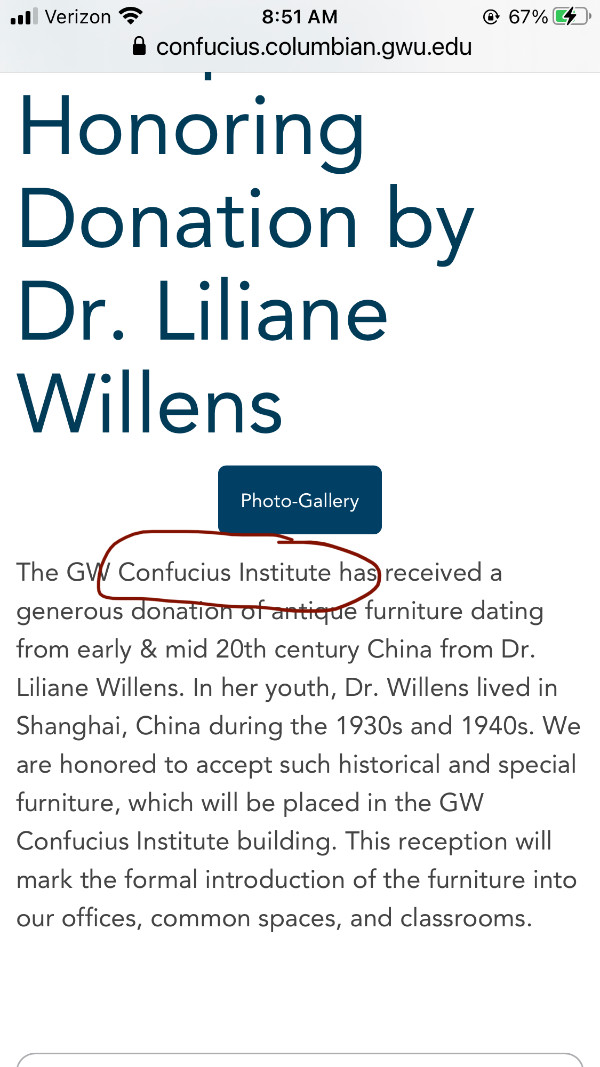
(上图)乔治·华盛顿大学孔子学院举行Liliane的二十世纪早中期的上海古董家具捐赠仪式。
从介绍和以及照片上看她的穿戴,她的确对中国是有着浓厚的情感的。
看来,这位犹太裔的红色老太太不是具有华尔街背景啥的,也许她的家人是, 也许是翟东升在吹牛?
下面是她的《无国籍者在上海》那本书的摘录: Stateless in Shanghai extractby Liliane Willens Old Amah and I became inseparable as I was growing up. She took full
charge of me (“Leelee”) and of my sister Riva whom she called “Leeva”.
She fed, bathed and dressed us in clothes which my mother no longer
sewed but now purchased. My father’s income increased substantially at
the end of 1927 when he was hired as a sales representative for Sun Life
Assurance Company of Canada, a firm headquartered in Montreal. Soon
after, we moved to a larger apartment in a small complex of rental
buildings on Route Ratard (Julu Lu), where my parents got a private room
for Old Amah in the servants’ quarters annex. Socially, our family was
moving up — Old Amah, too, in the eyes of her friends.
Old Amah insisted on getting us soft canvas shoes, explaining to my
mother that leather shoes were “vely no good” for our feet since the
shoelaces would untie quickly and we could fall and hurt ourselves.
Thanks to these soft shoes, I easily could outrun Old Amah, who walked
with a spring in her gait because her feet were very narrow for her tall
build.
My sister Riva hardly ever caused any problems but by the time I was
five years old I was terrorizing the little girls with whom I played in
the garden, fighting with the little boys living in our complex and
sticking out my tongue at the Chinese children in the streets. Old Amah
often saved me from yelling and spanking, calming my mother down by
saying: “When Missee Leelee big, she good like Leeva.” Although I had
already picked up some of the Shanghainese dialect, Old Amah always
spoke to me in Pidgin English, for she understood intuitively that my
parents and other European parents did not want their children to learn
Chinese. There was no need for the foreigners to use it since Chinese
servants were obliged to speak a smattering of their masters’ languages,
whether it was Pidgin English, French, Russian or German.
When I was about six years old, my mother let me accompany Old Amah on
her shopping trips in the streets of “Chinese” Shanghai, a world that I
discovered was very different from my own. I was glad to be away from my
noisy baby sister Jacqueline, a crying “nuisance” who had come into my
life a year earlier. This child, whom all called Jackie, was getting too
much attention from my parents and their friends. They could not decide
whether she resembled her mother or her father but they agreed that she
did not resemble her two older sisters. Riva had my father’s looks and
calm disposition, while I resembled my mother in looks and temperament,
which meant I was a very active child.
On the way to the market, Old Amah and I walked through several very
poor neighborhoods where we would inevitably pass a man slowly pushing a
wide wooden cart. He went in and out of the alleys and lanes, where the
Chinese lived in tenements and hovels without flush toilets, collecting
the buckets of human waste that had accumulated overnight. When this moo dong man
announced his arrival women rushed out with wooden buckets, which he
emptied with a deft arm movement into large wooden containers securely
tied to his cart. When they were filled to the brim he covered them with
wooden lids and then slowly pushed his overloaded cart in the direction
of the nearby countryside where he sold his morning collection to
farmers as fertilizer. During the very humid summer months of July and
August, when the thermometer sometimes hovered near 100 degrees
Fahrenheit, the putrid smell from these carts hung in the air for the
entire morning.
On those trips with Old Amah I watched her bargain endlessly with the
food vendors over the price of rice, noodles, vegetables and fruit. She
became quite theatrical when a price was quoted — she walked away
complaining loudly that the street vendor was trying to rob her. She
soon returned, however, and bargained again; then after much sighing she
agreed grudgingly to buy the items she had earlier examined. She
watched very carefully as the seller weighed her purchases on a scale
consisting of a metal tray attached a stick with a movable weight piece.
On one of our excursions to the market Old Amah became very angry with
me. I did not have time to tell her that I needed to “makee doodoo”, so
while she was talking to a friend at the marketplace I squatted on the
street and defecated in my pants. I was simply doing what small Chinese
children always did when they wanted to “makee doodoo”, except that my
pants were not split on the backside. Old Amah began lamenting that
“Big Missee get vely, vely angly”, and that Leelee “give me walla, walla (trouble, trouble), ah ya, ah ya”.
My proper and demure Old Amah always yanked me away whenever she
noticed a man using a wall as an open-air toilet, while I wondered why
he did not go home and use his bathroom as we did in our house. In my
mind, only small children had the right to relieve themselves in public!
I looked forward to these outings with Old Amah because I knew that
whenever she bought cooked meat, fish or baked dough she would bite off a
small piece and share it with me. While flies were swarming and buzzing
around the open food stalls, I admired the vendors who tried to hit
them with the straw fans they used to fan their charcoal stoves.
Sometimes, when Old Amah had a few extra copper coins to spare, she
bought a piece of tofu fried in sizzling oil which she blew upon before
handing it to me. She would also share with me her breakfast food, the
small da bing pancake and the you tiao, strings of dough
fried in boiling oil and then twirled by the vendor into an elongated
shape. These two oily and very hot food items were wrapped in a piece of
soiled paper torn from a newspaper. When Old Amah was feeling extra
generous she bought and shared with me the pyramid-shaped zongzi filled
with glutinous rice and wrapped in palm leaves, which I munched with
delight. For dessert, which she bought for me when I nagged her
sufficiently, there were the sticky yuan xiao, balls of rice
covered with sesame seeds. I especially enjoyed the Chinese Mid-Autumn
Festival since Old Amah would always buy me a dousha bao, a cake filled with mashed sweet red beans that she knew I preferred to the cakes and sweets we ate at tea time in our home.
Old Amah could never ask to be refunded for the copper coins she spent
on me because my parents would not have allowed her to buy me food made
in such unsanitary conditions. Of course I did not tell my mother about
eating these forbidden delicacies because my trips with Old Amah would
have ended. The food I ate in the marketplace was much tastier than the
meat, chicken, potatoes, vegetables and soup we ate at home, where I was
always told to eat slowly and wipe my mouth with a napkin. My taste for
Chinese food may have been enhanced by the fact that Old Amah and I had
a secret which we hid from my parents.
Whenever I ate food in the street Old Amah had to shoo away beggar
children who had gathered around me watching me intently. I yelled “sheela, sheela”
(“go away”) at them, not realizing they were hungry. I thought it was
silly of them to stare at me while I was eating and wondered why their
mothers did not buy them food. I was annoyed when they surrounded me and
I yelled at them in the Shanghai dialect, borrowing the words they used
to insult me. The fact that Chinese children swore at me — the yang guizi(foreign devil) with her da bizi (big
nose) — did not bother me, for I had already surmised that as a white
person I was superior to them. From a very early age my friends and I
looked down on the Chinese, whose main function we had observed was to
serve us and all other foreigners. Little did I know then we were
behaving as colonial racists did in other parts of the world.Stateless in Shanghai is
the story of Dr. Liliane Willens' experiences growing up as a
"stateless person" in cosmopolitan Shanghai from the late 1920s to the
early 1950s. Willens was born to Russian Jewish parents, both
denationalized by the Soviet Union after fleeing the Bolshevik
revolution, hence her "stateless" status refers to her family's
inability to flee elsewhere. Willens not only lived through the rise of
Japanese power in, and eventual occupation of, Shanghai, but more
unique, her nationality status left her stranded in the city through the
early years of the People's Republic of China.
我发完这篇博文,就去画画, 画完画, 正剥个橘子吃的时候忽然觉得不对。等等,首先这个老太太不像翟东升所说那样一口京片子。她从小生长在上海,不太可能说的是一口京片子,上海话是可能的。即使在北京生活过的外地人怕也难以说出一口京片子。而且在她的回忆中,家人是不允许她学说中国话的,因为没有这种必要,家里雇的中国佣人在当时必须跟主人说一样的语言, 哪怕说的磕磕巴巴的。她的书是用英文写的。我只是看了上面摘录的段落得出这个印象,她也只会几句上海话。 不知网友们有何其他想法?是不是另有其人?
|